
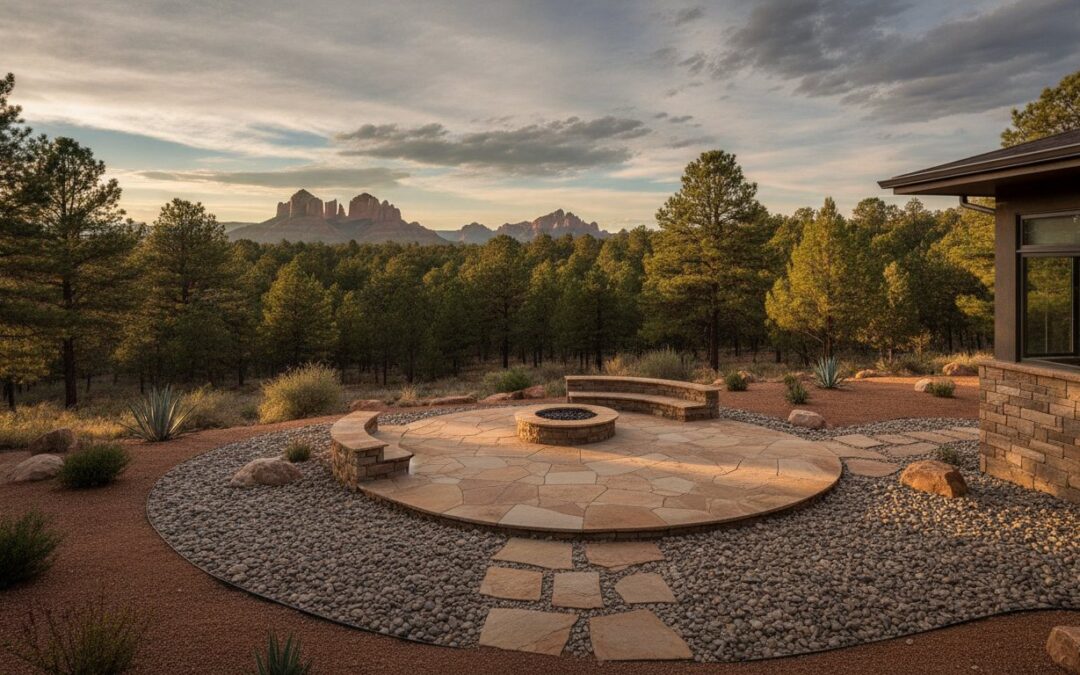
What if the most powerful tool for defending your home against a wildfire wasn’t a sprinkler system, but a beautifully crafted stone patio? Living in the high country means appreciating the beauty of the forest while respecting its inherent risks. It’s natural to feel a sense of anxiety when fire season approaches, or to worry that following Firewise regulations will leave your property looking barren and unattractive. You shouldn’t have to choose between a safe home and a beautiful yard.
The truth is that fire resistant hardscaping Northern Arizona properties require can be both a life-saving barrier and a stunning architectural feature. By choosing the right non-combustible materials, you can protect your investment without sacrificing the aesthetic charm of your outdoor living space. You’ll learn how to use strategic design to create a structural defense that actually increases your property value and reduces weekly chores. This guide explores how to implement a resilient three-zone defense, navigate the latest 2024 Coconino County building code updates, and select premium materials like flagstone and river rock to create a low-maintenance sanctuary that stands strong against the elements.
Key Takeaways
- Understand how fire resistant hardscaping Northern Arizona residents utilize creates essential fuel breaks that stop fire in its tracks using non-combustible materials.
- Learn the specific design requirements for the three-zone defensible space strategy, starting with the critical ember-resistant zone nearest your home’s foundation.
- Discover why masonry features like stone retaining walls and pathways are superior, long-lasting alternatives to traditional wood structures for wildfire protection.
- Identify how professional grading and drainage techniques prevent the accumulation of flammable organic debris near your home.
- Explore how to combine structural safety with high-end aesthetics to increase your property value while meeting the latest regional building codes and Firewise standards.
The Essentials of Fire-Resistant Hardscaping in Northern Arizona
Fire resistant hardscaping Northern Arizona residents implement is far more than a luxury upgrade; it’s a calculated structural defense. In our region, hardscaping refers to the permanent, non-living features of a landscape, such as natural stone, pavers, and retaining walls. By utilizing these non-combustible materials, homeowners can create effective fuel breaks that disrupt the path of a wildfire. This isn’t just about removing plants; it’s about replacing flammable surfaces with beautiful, resilient masonry that protects your home’s perimeter. It’s a strategic way to manage land that balances aesthetics with the harsh realities of our high-altitude climate.
Our local environment presents a unique spectrum of risks. Sedona’s high-desert terrain is prone to fast-moving brush fires fueled by manzanita and scrub oak, while Flagstaff’s ponderosa pines present the threat of high-intensity crown fires. A professional, environmentalist approach to design means understanding these local nuances. We focus on sustainable solutions that respect the natural landscape while providing a robust shield against heat and embers. Elements like river rock and concrete pavers do more than look professional; they actively reduce the chance of ember ignition, which is responsible for the majority of home losses during wildfires. By choosing materials that don’t burn, you’re acting as a responsible guardian of your property and the surrounding forest.
Why Hardscape is Your First Line of Defense
Stone and concrete serve as a physical firewall. Ground-level fires often travel through dry grass or wood mulch, but they stop when they hit a wide paver patio or a gravel path. Masonry also protects your home’s foundation from direct flame contact. While wooden decks can act as a fuse that leads fire directly to your siding, stone features remain stable and non-reactive even in high-heat scenarios; this durability makes masonry the most reliable choice for long-term property protection in Arizona. This structural integrity ensures that even if a fire passes through the area, the core footprint of your living space remains intact and protected from ground-level creep.
Understanding Regional Firewise Standards
Effective protection begins with Defensible space principles tailored for the Verde Valley and the Mogollon Rim. A critical standard is the “Zone 0” or ember-resistant zone, which covers the first five feet around any structure. In this area, all flammable materials should be replaced with non-combustible alternatives like decomposed granite, river stone, or flagstone. Many HOAs in Sedona and Prescott now mandate these fire-safe materials to ensure community-wide resilience. Following these standards doesn’t just provide peace of mind; it’s a disciplined way to enhance your property’s value and safety simultaneously. It shows a commitment to high standards of craftsmanship and long-term community safety. Sedona property owners navigating HOA requirements and local ordinances can benefit from exploring expert fire mitigation landscaping Sedona AZ solutions that balance rigorous safety standards with the iconic Red Rock aesthetic.
Designing Your Defensible Space: The 3-Zone Hardscape Strategy
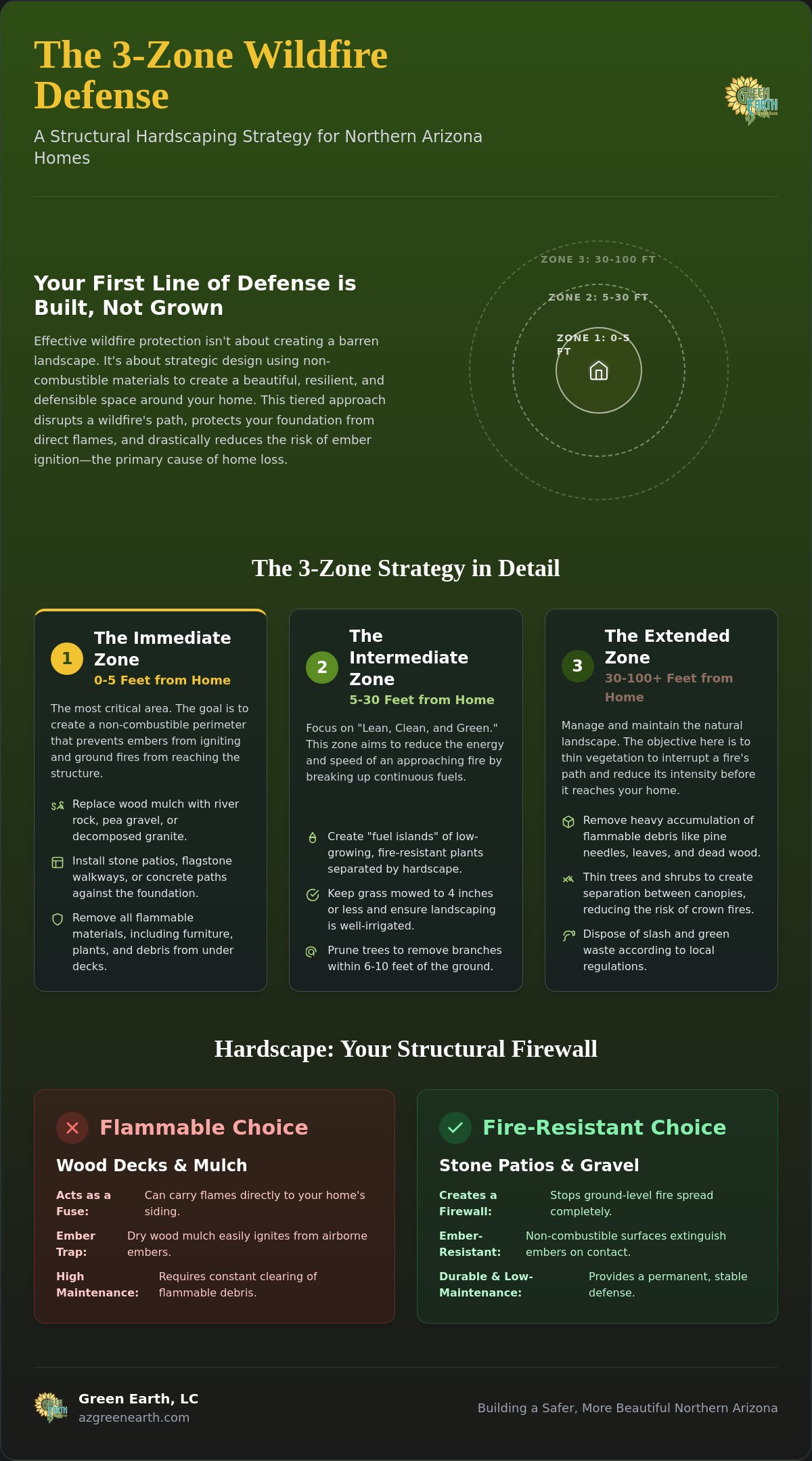
Designing a landscape that survives a wildfire requires a methodical, zone-based approach. While many property owners focus solely on vegetation, the most effective strategy centers on the structural elements. This is where fire resistant hardscaping Northern Arizona homeowners rely on becomes the backbone of property protection. By transitioning from high-density masonry near the structure to a more natural desertscape at the property line, you create a tiered defense that is both functional and aesthetically pleasing. This disciplined framework ensures that your home isn’t just an island in the forest, but a fortified sanctuary designed with professional precision.
Zone 1: The Non-Combustible Perimeter
The first five feet from your home’s foundation, known as the “Immediate Zone,” is the most critical area for fire defense. In this space, the goal is to eliminate all sources of fuel. Replacing traditional wood mulch with river cobble, pea stone, or decorative gravel is a vital first step. These materials don’t ignite when embers land on them; instead, they provide a clean, non-reactive surface. This design aligns with the 2024 International Building Code standards adopted by Coconino County in June 2026, which emphasize structural wildfire resistance. Utilizing wide paver walkways or stone patios against the siding creates a robust buffer that prevents ground fires from climbing the walls. It’s essential to ensure no flammable debris, such as pine needles or dried leaves, accumulates in these stone-lined areas. For homeowners who want to take this concept further, exploring firewise landscaping ideas with no plants Arizona residents can implement offers a comprehensive look at building a sophisticated, zero-vegetation sanctuary using premium stone and professional hardscape design.
Zone 2: Breaking the Fuel Chain
In the “Intermediate Zone,” which extends from 5 to 30 feet, the focus shifts to segmenting the landscape to prevent fire from spreading. You can achieve this by using stone pathways to create “islands” of vegetation, effectively breaking the fuel chain. Incorporating masonry retaining walls serves a dual purpose; they act as vertical fire barriers that can slow the progress of a flame front and help manage the slope of your land. For ground coverage, decomposed granite is an excellent fire-resistant choice that maintains a natural look while providing a clear path for firefighters. If you’re unsure where to begin, a professional assessment of your Firewise defensible space can help identify high-risk areas on your property.
The “Extended Zone” (30 to 100+ feet) focuses on the outer reaches of your property. Here, strategic drainage and grading are paramount. Proper grading ensures that organic debris doesn’t wash down and pile up against your hardscape features or home foundation. By maintaining a steady transition from dense stone features near the house to thinned, managed natural areas further out, you create a balanced ecosystem. This approach respects the local environment while ensuring your property meets the rigorous safety standards required for high-country living. Through these deliberate design choices, you transform your land into a resilient barrier that protects your family and the surrounding community.
Comparing Fire-Resistant Materials for Arizona Landscapes
While many property owners focus on the plants they should remove, the true strength of fire resistant hardscaping Northern Arizona homes require lies in the materials you choose to add. Structural elements like stone and masonry are essentially inert, meaning they won’t ignite even when exposed to direct flame or intense radiant heat. This is a stark contrast to traditional landscaping approaches that rely on organic mulches and timber structures. By selecting high-quality, non-combustible materials, you’re not just designing a patio; you’re building a permanent defense system that respects the local ecology and stands up to the unique environmental pressures of the high country.
Pavers and Natural Stone vs. Wood Decks
Timber decks are a significant liability in fire-prone regions. Wood has a relatively low ignition point and often requires flammable stains or sealants to survive the Arizona sun. In contrast, concrete pavers and natural stone features offer a virtually limitless lifespan with zero risk of combustion. Pavers provide an interlocking, non-combustible foundation that stabilizes shifting soil on fire-prone slopes while creating a permanent fuel break that timber simply cannot match. Beyond safety, the return on investment for masonry is substantially higher; stone doesn’t rot, warp, or require the expensive annual maintenance that wood demands. For homeowners in Sedona and Flagstaff, switching to masonry is a disciplined choice that balances long-term value with essential property protection. For property owners seeking high-standard renovations, Exterior Specialist LLC serves as an excellent example of a professional home improvement contractor that prioritizes both structural durability and aesthetic excellence in residential projects.
Gravel, Rip-Rap, and Boulders: Functional Beauty
Large-scale elements like boulders and rip-rap serve as more than just aesthetic focal points. When positioned strategically, massive boulders act as thermal masses that can help redirect heat and protect more sensitive areas of the landscape. Using varied sizes of gravel and crushed stone is also a practical way to prevent weed growth. In our climate, neglected weeds quickly dry out and become “fine fuels” that carry fire across a yard. A thick layer of decomposed granite or river stone creates a clean, professional look while starving these potential fires of the fuel they need to spread. Using local stone ensures your fire resistant hardscaping Northern Arizona project feels like a natural extension of the environment.
- Sedona Red Rock Palette: Utilize sandstones and pavers in deep ochre and crimson tones to mirror the iconic local cliffs.
- Flagstaff Basalt and Granite: Choose denser, darker stones that can withstand the intense freeze-thaw cycles of the Mogollon Rim without cracking.
- Verde Valley River Stone: Incorporate smooth, rounded cobbles in drainage areas to manage monsoon runoff and create natural-looking fire breaks.
Selecting materials based on your specific micro-climate is vital for longevity. In Flagstaff, the primary concern is the durability of the stone against winter moisture and ice. Denser materials like basalt or high-quality concrete pavers are engineered to resist the internal pressure of freezing water. In the warmer elevations of the Verde Valley, the focus shifts to heat-resistant stones that won’t radiate excessive warmth back toward your home during the summer months. Verde Valley property owners can also benefit from reviewing a comprehensive guide to firewise landscaping Cottonwood AZ residents rely on to balance plant selection with hardscape design. This visionary approach to material selection ensures your landscape is as functional and resilient as it is beautiful.
Strategic Features: Retaining Walls, Grading, and Drainage
Wildfire behavior is heavily influenced by topography. In the steep canyons of Sedona or the sloped lots of Flagstaff, fire naturally accelerates as it moves uphill. This is where strategic fire resistant hardscaping Northern Arizona homeowners invest in becomes a physical interceptor. By reshaping the land’s profile through professional grading and masonry, you can disrupt the convective heat that drives a fire’s upward momentum. These features provide a dual benefit; they also manage the intense runoff experienced during the summer monsoon season, protecting your soil from erosion while keeping your home defensible. This disciplined approach to land management ensures your property is prepared for the specific environmental cycles of our region.
Retaining Walls as Fire and Erosion Barriers
Terracing is a powerful design tool for sloped properties. When you install a series of solid retaining walls, you create flat, manageable benches that break up continuous fuel paths. Choosing materials with high thermal mass, such as CMU blocks or solid natural stone, allows these structures to absorb and deflect heat rather than passing it through to your home. Beyond their role as a fire barrier, these walls provide a stable “safe zone” or anchor point for emergency responders. This gives firefighters a clear, non-combustible space to stage a defense of your property, which is especially vital in neighborhoods with limited access. Our team specializes in constructing these barriers to align with the 2024 International Building Code updates adopted by Coconino County in June 2026.
The Role of Drainage and Grading
Proper drainage grading is an often overlooked component of wildfire preparedness. During dry periods, wind-blown pine needles and organic silt settle into low spots or “fuel pockets” against your foundation. Expert grading ensures that these materials, along with monsoon floodwaters, are directed away from the house. Stone-lined swales can serve as secondary fire breaks, providing a clear path for water while offering a wide, non-combustible gap in the landscape. This methodical approach prevents the accumulation of fine fuels that often ignite homes long after the main fire front has passed. If you’re ready to secure your property’s perimeter, our team can help you design and install custom retaining walls and drainage systems that meet regional Firewise standards.
Safety doesn’t mean you have to sacrifice the enjoyment of your outdoor space. Outdoor kitchens and fire features can be safely integrated into your plan when they’re surrounded by a wide perimeter of pavers or decorative rock. By placing these elements within a professionally designed hardscape, you ensure that any heat or potential sparks are contained within a non-combustible environment. This visionary approach transforms your yard into a functional, beautiful reality that prioritizes both lifestyle and long-term sustainability. It reflects a commitment to high standards of craftsmanship while acting as a responsible guardian of the local landscape.
Partnering with Green Earth, LC for a Firewise Future
Choosing to protect your property is a significant commitment that requires more than just a surface-level understanding of landscaping. It demands a partnership with a team that views your land through the lens of both safety and environmental stewardship. For over 47 years, Green Earth, LC has served as a cornerstone of the Verde Valley and the broader Northern Arizona community. We don’t just move earth; we act as a visionary partner, taking your specific concerns and transforming them into a resilient, beautiful reality. Our approach to fire resistant hardscaping Northern Arizona properties rely on is rooted in a deep respect for the natural world and a dedication to high standards of craftsmanship that stand the test of time.
Expertise in the Northern Arizona Terrain
The geographic diversity of our region is vast, and our decades of experience in Sedona, Cottonwood, and Flagstaff have given us a unique perspective on local land management. We understand that a material that performs well in the heat of the Verde Valley might not survive the intense freeze-thaw cycles of the Mogollon Rim. This specialized regional knowledge informs every material selection we make, ensuring your pavers and walls are as durable as they are protective. As a full-service firm, we handle the entire progression from initial custom design to final construction. This seamless integration ensures that the structural integrity of your fire defense is never compromised by a lack of communication between separate designers and contractors.
Start Your Fire-Safe Landscape Project Today
The process of creating a Firewise landscape begins with a professional assessment of your current defensible space. Our team evaluates your property’s unique topography, existing vegetation, and structural vulnerabilities to develop a comprehensive hardscape plan. This disciplined approach is essential for individual homeowners, but it is equally vital for HOAs and commercial property managers who carry a responsibility to the wider community. Homeowners in Sedona facing rising insurance costs and strict local ordinances can explore our dedicated approach to fire mitigation landscaping Sedona AZ properties depend on, including how to leverage Fire Safe Sedona program incentives and matching funds for fuel reduction projects. Homeowners in the Verde Valley can also explore our detailed approach to firewise landscaping Cottonwood AZ properties depend on for guidance on plant selection, zone structuring, and HOA compliance. By investing in professional fire mitigation now, you’re not only increasing your property value but also contributing to the long-term sustainability of our local forests. We take pride in our history and our role as a community fixture, and we’re ready to help you navigate the complexities of modern building codes and environmental safety.
- Custom Hardscape Design: We create tailored plans that balance aesthetic elegance with rigorous Firewise standards.
- Sustainable Practices: Our commitment to eco-friendly landscaping ensures your defense system supports the local ecosystem.
- Professional Installation: Our seasoned crews execute every project with the precision and excellence that 47 years of experience demands.
- Comprehensive Maintenance: We offer ongoing support to ensure your non-combustible zones remain clear and effective.
Don’t wait for the next fire season to discover the vulnerabilities in your landscape. Taking proactive steps today can make all the difference in the survival of your home. You deserve the peace of mind that comes from knowing your property is protected by the most reliable experts in the region. Protect your home with expert fire-resistant hardscaping from Green Earth, LC.
Secure Your Property with Resilient Design
Protecting your home in the high country requires more than just clearing brush; it’s about building a structural defense that lasts. By implementing a methodical 3-zone strategy and replacing flammable wood with high-quality masonry, you create a permanent barrier against the elements. This commitment to structural durability is a standard shared by professional builders like PRO Construction, who prioritize safety and quality in custom residential projects. These structural improvements don’t just meet safety standards; they enhance the natural beauty and long-term value of your property.
Investing in professional fire resistant hardscaping Northern Arizona homeowners trust is a proactive step toward long-term peace of mind. With over 47 years of local experience, Green Earth, LC specializes in the unique climate and terrain of our region. Our award-winning sustainable designs prioritize both environmental health and structural excellence, ensuring your landscape is as beautiful as it is resilient. Homeowners who want to eliminate vegetation entirely from their perimeter can find inspiration in our guide to firewise landscaping ideas with no plants for Arizona defensible space, which details how to master Zone 0 defense with premium stone and durable hardscape. Request Your Firewise Hardscape Consultation today to transform your property into a functional, fire-safe reality. Taking these steps now ensures your home remains a secure sanctuary for years to come.
Frequently Asked Questions
What is the best hardscape material for fire resistance in Arizona?
Concrete pavers and natural stone types like basalt, granite, or flagstone are the most effective materials for stopping fire spread. These options don’t ignite or melt even when exposed to the intense radiant heat of a wildfire. By using fire resistant hardscaping Northern Arizona homeowners create a permanent barrier that stops ground-level fire creep. Unlike wood or composite materials, masonry stays structurally sound and provides a reliable line of defense for your home’s foundation.
How wide should my non-combustible zone be around my house?
The “Immediate Zone” or ember-resistant zone should extend at least five feet from any structure or attached deck. This area must be entirely free of combustible materials, including wood mulch, dried leaves, and resinous shrubs like junipers. Filling this perimeter with decorative gravel, river cobble, or a paver walkway ensures that wind-blown embers don’t find fuel when they land near your siding. This five-foot buffer is a cornerstone of modern Firewise safety standards in our region.
Can I still have a fire pit in a Firewise-compliant yard?
You can safely enjoy a fire pit if it’s integrated into a wide, non-combustible hardscape area. Professional design ensures that fire features are surrounded by pavers or stone rather than grass or wood decks. This containment prevents stray sparks from reaching flammable vegetation. It’s a practical way to maintain a welcoming outdoor lifestyle while adhering to the disciplined safety requirements of a high-country property.
Does hardscaping help with monsoon drainage as well as fire safety?
Strategic hardscaping is highly effective for managing heavy monsoon runoff. While the fire resistant hardscaping Northern Arizona properties require focuses on fuel reduction, the grading and stone-lined swales used in these designs also direct floodwaters away from your home. This dual-purpose approach prevents soil erosion and stops organic debris from piling up in fuel pockets where it could later ignite during a dry spell.
How much does it cost to install fire-resistant hardscaping in Northern Arizona?
Costs vary based on the complexity of the terrain and the specific materials selected, such as premium flagstone versus decomposed granite. While professional landscaping work in our state often falls within a range of $5 to $18 per square foot, the final investment depends on factors like slope stabilization and drainage needs. We recommend a professional assessment to determine the specific requirements for your lot’s unique topography and safety goals.
Do I need to remove all my trees to create a defensible space?
Complete tree removal is rarely necessary for an effective Firewise landscape. The focus is on strategic thinning and limbing up pines to a height of 10 feet from the ground. Maintaining at least 10 feet of space between tree crowns prevents fire from jumping through the forest canopy. This method preserves the natural beauty of your forest setting while significantly reducing the risk of a high-intensity crown fire reaching your home.
Are pavers better than concrete for fire resistance?
Pavers and poured concrete both offer excellent fire resistance, but pavers are generally superior for the Northern Arizona climate. Pavers are designed to flex during the intense freeze-thaw cycles found in higher elevations, which prevents the cracking often seen in large concrete slabs. They also allow for easier access to underground utilities or irrigation drip system repairs without requiring a full demolition of the hardscape surface.
Can Green Earth, LC help with HOA firewise compliance in Sedona?
We have extensive experience helping homeowners meet the specific Firewise and aesthetic requirements of HOAs in Sedona and the Verde Valley. Our team understands the nuances of local regulations and can design custom hardscape solutions that satisfy both safety boards and architectural committees. We take pride in acting as a visionary partner to ensure your property remains compliant, beautiful, and well-protected against wildfire risks.
Recent Comments