
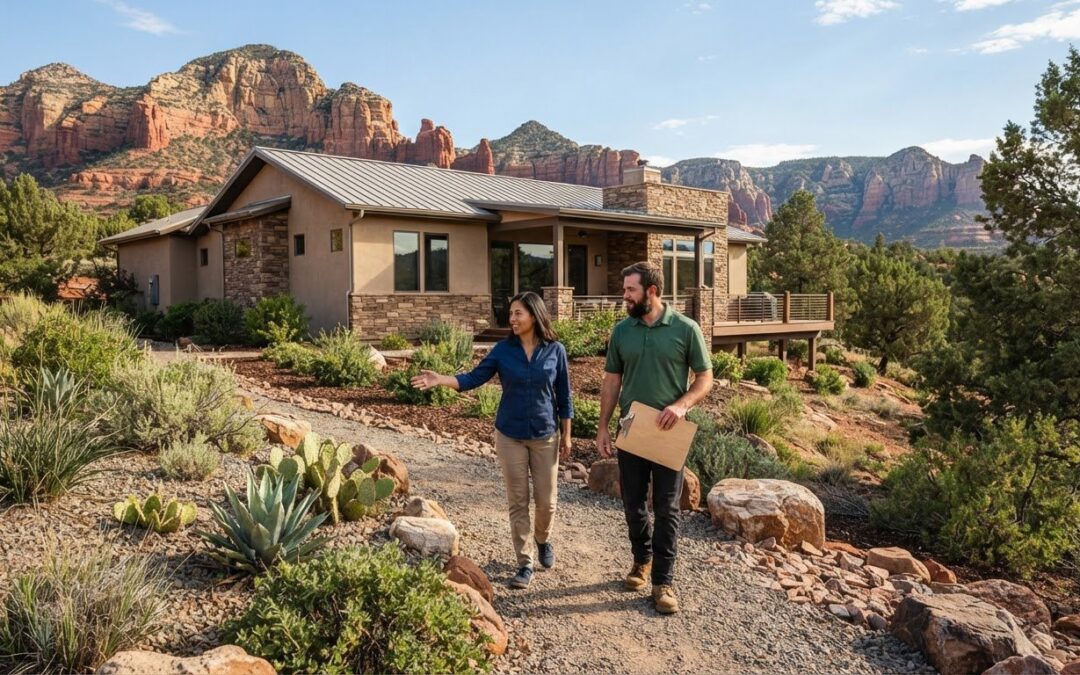
A defensible-space inspection isn’t a one-time sweep. Arizona’s seasonal growth, changing conditions on nearby wildland, and the slope of your property can all affect what needs attention. A practical defensible space inspection checklist Arizona homeowners can repeat helps turn wildfire concerns into clear, manageable checks.
Start by walking the property in a consistent order, recording what you see, and separating routine upkeep from issues that need local guidance or a broader landscape plan. Recommendations can vary by jurisdiction, so general zone guidance is a starting point, not a substitute for local rules. This checklist helps you document conditions and prioritize maintenance without treating every property the same.
Work outward from the home: check the immediate area, nearby vegetation and landscape features, then conditions farther across the property. Note seasonal changes, slope, access, and surrounding wildland. Whether you’re maintaining a home in Sedona, Camp Verde, Cottonwood, Flagstaff, or Prescott, a repeatable walk-through can help you keep track of changing conditions.
Key Takeaways
- Use a defensible space inspection checklist Arizona homeowners can repeat to record what needs attention and what can wait.
- Check for leaves, needles, dead plants, and other combustible debris near the home and beneath decks.
- Look beyond the immediate perimeter for connected vegetation, dead material, and plants that could carry fire toward tree canopies.
- Turn inspection notes into a seasonal plan: document findings, prioritize tasks, schedule the work, and reinspect as conditions change.
- Use local fire guidance and Firewise defensible-space landscaping to shape practical property improvements.
What an Arizona Defensible Space Inspection Should, and Should Not, Tell You
Defensible space is the maintained area around a home or other structure where vegetation and other potential fuels are managed to reduce exposure to wildfire. The goal isn’t to strip a landscape bare. It’s to identify conditions that could help fire or embers reach a structure, then plan practical upkeep suited to the property. This overview of Defensible space (fire control) introduces the concept and its commonly used zone-based approach.
A visual self-inspection is a homeowner’s review of visible maintenance concerns; an official assessment follows the applicable authority’s process and rules. A checklist can help you record dry growth, debris, and vegetation connections that need attention. It can’t guarantee a home’s safety, certify compliance, or replace an inspection required by a local fire authority.
Use a defensible space inspection checklist Arizona homeowners can repeat, and interpret the findings in context. Property layout, vegetation type and condition, slope, wind exposure, nearby open space, and local fire-authority guidance all affect what deserves attention. Treat each finding as a prompt to assess and prioritize, not as a universal pass-or-fail verdict.
How defensible-space zones help organize an inspection
Distance-based zones make a walk-around easier to organize: start close to the structure, then examine the surrounding landscape and farther areas of the property. Use zones as a planning framework, not as a single Arizona-wide rule. Recommended terminology and distances can vary, and slopes, outbuildings, vegetation, and local conditions may affect how guidance applies. Check current recommendations with your local fire authority before treating any distance as a requirement.
Which Arizona conditions deserve closer attention
Look for dry or dead vegetation, leaves and needles gathered near structures, and seasonal growth that has filled in since your last review. Notice whether shrubs, grasses, or branches form a continuous path toward the home or connect lower vegetation to tree canopies. These observations help identify maintenance priorities without assuming that every plant presents the same risk.
Walk the property with its setting in mind. On steep terrain, note how slope affects the placement and continuity of vegetation. In wind-exposed areas, look for dry material or open routes that could direct fire toward structures. Nearby open space can bring changing vegetation or fuel conditions to the property edge, so include that boundary in your review. For a regional perspective, see this Firewise landscaping guide for Cottonwood.
Arizona Defensible Space Checklist: Inspect the Home and Immediate Perimeter
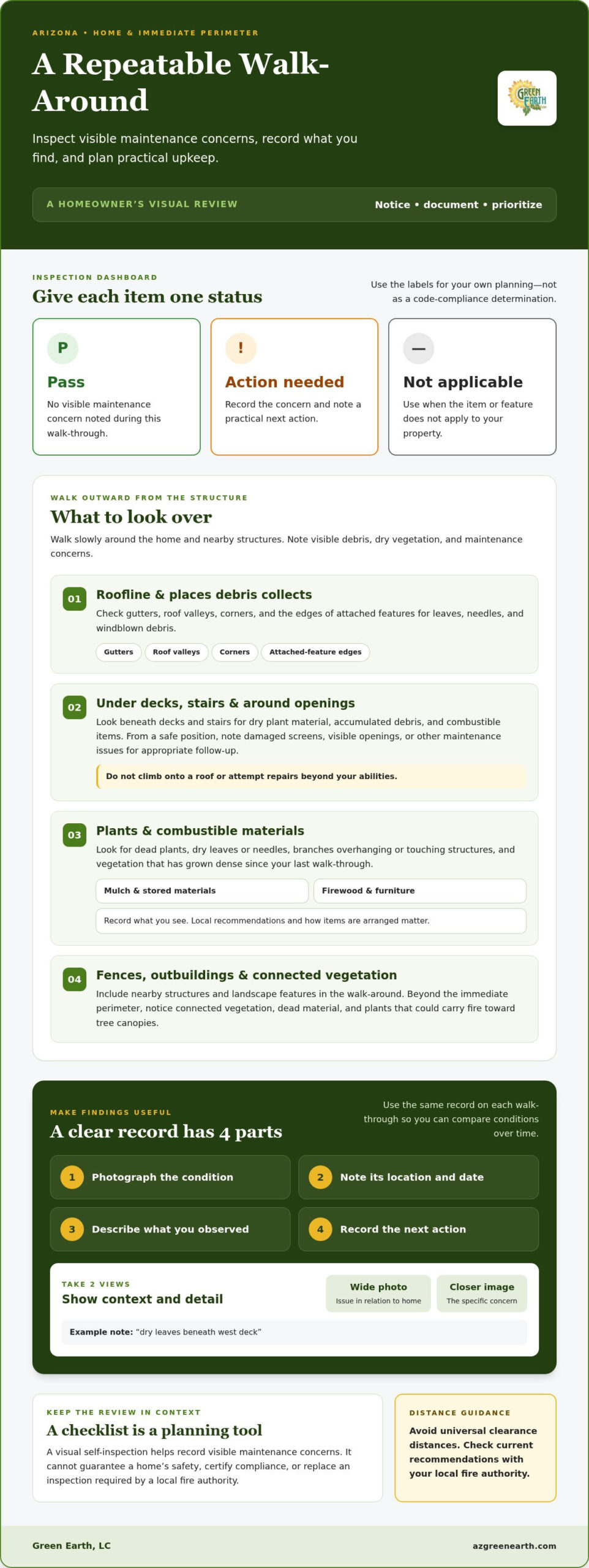
Walk slowly around the home and nearby structures. Check for visible debris, dry vegetation, and maintenance concerns. Mark each item Pass, Action needed, or Not applicable. These labels are for your own planning, not a code-compliance determination. Avoid applying a universal clearance distance; follow current local fire-authority guidance for distance-based recommendations.
Structure, roofline, and attached features
Check places where leaves, needles, and windblown debris collect, including gutters, roof valleys, corners, and the edges of attached features. Look beneath decks and stairs for dry plant material, accumulated debris, and combustible items stored there. From a safe position, note damaged screens, visible openings, or other maintenance issues for appropriate follow-up. Don’t climb onto a roof or attempt repairs beyond your abilities.
- Gutters, roof valleys, and corners: Pass / Action needed / Not applicable
- Under decks and stairs: Pass / Action needed / Not applicable
- Vents, screens, and visible openings: Pass / Action needed / Not applicable
- Fences, outbuildings, and attached features: Pass / Action needed / Not applicable
Plants and combustible materials near the home
Look for dead plants, dry leaves or needles, branches overhanging or touching structures, and vegetation that has grown dense since your last walk-through. Check mulch and stored materials, including firewood, furniture, or other combustible items close to buildings. Record what you see rather than assuming a particular plant or material is automatically unsafe. Local recommendations and the way items are arranged matter.
- Dead vegetation and accumulated debris: Pass / Action needed / Not applicable
- Branches or plants touching or crowding structures: Pass / Action needed / Not applicable
- Mulch, firewood, furniture, and stored items: Pass / Action needed / Not applicable
Use the same record for each walk-through: “Photograph the condition, note its location and date, describe what you observed, and record the next action.” Take a wide photo to show where the issue sits in relation to the home, then a closer image of the concern. Add a brief note, such as “dry leaves beneath west deck,” so you can compare conditions over time and track completed work.
For concerns involving vegetation management or broader property changes, Green Earth, LC provides Firewise defensible-space landscaping to help translate inspection observations into practical landscape priorities.
Check the Wider Defensible Space: Vegetation, Slope, and Access
After checking the immediate perimeter, widen your walk-through to include the rest of the property and its boundaries. Look for vegetation patterns, dry material, and access concerns that may change what deserves attention. The defensible space inspection checklist Arizona homeowners use should document observations, not turn them into a one-size-fits-all verdict. For recommendations, consult the Arizona Department of Forestry and Fire Management or your local fire agency, since property conditions and local guidance can differ.
Vegetation patterns and slope-related observations
Notice whether grasses, shrubs, and tree branches form a connected path across the landscape, or whether dead plant material has gathered in pockets. Record where lower vegetation appears to meet tree canopies, a pattern often described as ladder fuels. On sloped ground, note changes in terrain and vegetation as you move around the property. Don’t assume guidance intended for flat ground applies in the same way on a slope. Wind exposure and nearby open space can also affect which observations you prioritize.
| Observation | Why it matters | Reasonable next action |
|---|---|---|
| Connected grasses, shrubs, or branches | Continuous vegetation may create a route between landscape areas. | Photograph the pattern and identify where thoughtful thinning or separation may be appropriate. |
| Dead material beneath or between plants | Dry growth can add fuel within the landscape. | Record the location and plan suitable cleanup or maintenance. |
| Steep or changing terrain | Slope can affect how site conditions and recommendations apply. | Document the slope and consult current fire-agency guidance for site-specific direction. |
| Wind exposure or nearby open space | Conditions beyond the immediate yard may influence inspection priorities. | Note prevailing exposure and changes along the property edge. |
Access, address visibility, and property boundaries
Check whether your address can be seen from the approach, following local guidance. Note gates that are blocked, routes narrowed by overgrowth, or access areas where stored items or vegetation could impede movement. Verify emergency-access expectations with the relevant local authority rather than assuming one standard applies everywhere.
Include neighboring or adjacent unmanaged vegetation in your notes if it affects the setting around your home. Photograph it from your property and record its location, while distinguishing that observation from work you control. Clear documentation helps you describe site conditions accurately and focus on your own landscape priorities.
For a broader perspective on designing for Northern Arizona’s climate and landscape, explore this Northern Arizona sustainable landscape design guide.
How to Turn Inspection Findings into a Seasonal Action Plan
A walk-through is most useful when its observations lead to manageable next steps. Keep a dated log with each item’s location, a brief description, a photo, and the action you plan to take. Comparing notes from one inspection to the next can show how seasonal growth or completed maintenance has changed an area.
Use a repeatable sequence:
- Document: Record each observation and photograph it from a consistent viewpoint when possible.
- Prioritize: Consider how close it is to a structure, how much dry material is present, and whether it affects access.
- Schedule: Set a practical time for routine cleanup, or identify where you need more information or planning.
- Complete: Note what was addressed and keep unresolved or deferred items on the list.
- Reinspect: Review the area again after maintenance or when conditions change.
Prioritize findings without overreacting
Start with visible housekeeping, such as gathering debris you can safely reach and organizing combustible items near structures. Other findings may call for planning, local fire-authority guidance, or skilled landscape support, especially if they involve connected vegetation, slope, or broader property changes. Mark uncertain observations for review against current local recommendations. A checklist count or score isn’t a wildfire-risk rating, safety guarantee, or proof of compliance.
Schedule recurring checks through the year
Arizona’s seasonal timing varies with elevation, weather, and local conditions, so use changes on your property rather than relying on one statewide calendar. Reinspect after plant growth, landscape work, or significant weather changes. In drier periods, review debris and dead growth. After monsoon growth, look for vegetation that has become dense or overgrown where relevant to your area.
Carry unfinished items forward. If a task depends on local rules or a planned landscape change, record what guidance you need and revisit it during the next review. A defensible space inspection checklist Arizona homeowners can return to throughout the year helps turn observations into steady upkeep rather than a one-time response.
Green Earth, LC provides Firewise defensible-space landscaping to help turn landscape observations into a practical maintenance plan.
When Arizona Defensible Space Calls for Landscape Support
A completed checklist can show when routine upkeep may be enough and when the landscape needs a more considered plan. If debris returns quickly, vegetation has become dense, or several areas need coordinated attention, recurring maintenance can help keep tasks from accumulating. The defensible space inspection checklist Arizona homeowners use is a helpful record of conditions, not a substitute for an official fire inspection or emergency-response services.
Which inspection findings landscape maintenance can address
Seasonal cleanup and vegetation management can address dead plant material, overgrowth, and vegetation patterns that need ongoing attention. The right scope depends on the property’s layout and current local recommendations. A steep yard, nearby structures, or changing conditions along a property boundary may call for a different approach than a simple cleanup. Use local fire-authority guidance for jurisdiction-specific requirements. Landscape work supports property maintenance but doesn’t determine official compliance.
Planning Firewise landscape improvements in Northern Arizona
Some findings point to broader landscape decisions rather than a single maintenance task. Firewise defensible-space landscaping can help plan practical changes while considering how vegetation, site conditions, and the existing landscape fit together. Green Earth, LC brings more than 47 years of Verde Valley experience to landscape and defensible-space work, with an approach that values thoughtful stewardship alongside a functional, attractive property.
For a local example of these considerations, read the guide to Firewise landscaping in Cottonwood. It can help you think through how inspection observations might inform property-specific landscape improvements.
Keep your notes and photos available as you plan. They provide a useful starting point for discussing maintenance priorities and landscape changes that suit your property, while local fire authorities remain the source for jurisdiction-specific rules and official assessments.
Green Earth, LC provides Firewise defensible-space landscaping for properties in Sedona, Camp Verde, Cottonwood, Flagstaff, and Prescott.
Make Your Next Walk-Through Count
A useful defensible space inspection checklist Arizona homeowners can rely on is repeatable and specific to the property. Record what you notice, prioritize visible maintenance needs, and revisit your notes as vegetation and weather conditions change. Use local fire-authority guidance for jurisdiction-specific recommendations, especially where slope, nearby wildland, or property layout may affect the right next steps.
When findings call for more than routine cleanup, landscape support can help turn observations into a practical maintenance or improvement plan. Green Earth, LC provides Firewise defensible-space landscaping and brings more than 47 years of experience serving the Verde Valley. The company was also recognized statewide as a runner-up for sustainable landscape design, reflecting its commitment to landscapes that are carefully planned and environmentally mindful.
Consistent attention can make wildfire-conscious care a manageable part of looking after your Arizona home. Explore Green Earth, LC’s Firewise defensible-space landscaping services.
Frequently Asked Questions
What should be included in an Arizona defensible space inspection checklist?
Include checks for debris near structures, gutters and roof valleys, vegetation touching or crowding buildings, combustible storage, and conditions under decks and stairs. Also note connected vegetation, dead material, slope, property access, and address visibility. A defensible space inspection checklist Arizona homeowners can reuse should provide space to mark each item, record its location, add dated photos, and note a practical next step. Use local fire-authority guidance for recommendations that depend on your jurisdiction.
How often should I inspect defensible space in Arizona?
Reinspect regularly and after conditions change, rather than relying on one fixed schedule for every Arizona property. Seasonal growth, dry periods, monsoon rains, landscape work, and significant weather can all change what needs attention. Elevation and local climate matter, too. Keep dated notes and photos, then compare them during each walk-through. If growth or debris returns quickly, recurring landscape maintenance can help you keep up with it.
Are defensible-space distances the same everywhere in Arizona?
No. Distance-based zones can help organize an inspection, but they shouldn’t be treated as universal Arizona requirements. Local rules and recommendations may vary, and property features such as slope, structures, vegetation, and nearby wildland can affect how guidance applies. Before using a distance as a standard for your property, consult your local fire department or municipality for current direction. A homeowner checklist helps identify observations; it doesn’t establish local compliance.
What should I check first around my home?
Begin with the immediate area around the house and attached features. Look for leaves, needles, dead plants, and other debris in gutters, roof valleys, corners, and beneath decks or stairs. Notice plants or branches touching or crowding the structure, along with nearby firewood, furniture, or other combustible storage. Record visible maintenance concerns without treating the walk-through as an official assessment. Check from safe, accessible areas and leave roof work or repairs beyond your abilities to appropriate support.
Does defensible space mean removing every plant near a house?
No. Defensible space doesn’t mean stripping a property bare. The aim is to manage vegetation and other potential fuels thoughtfully, while considering plant condition, arrangement, proximity to structures, and local recommendations. During an inspection, note dead growth, dense or connected vegetation, and branches touching buildings. Those observations can guide appropriate maintenance or landscape planning. The right approach is specific to the property and should account for local guidance and the landscape’s health.
Can a homeowner checklist confirm that a property is Firewise compliant?
No. A homeowner checklist is a record of visible conditions and maintenance needs, not an official inspection, compliance determination, or safety guarantee. Firewise-related recommendations and local requirements can depend on the program, jurisdiction, and property. Use your notes to identify questions and track work, then consult the relevant local fire authority for official guidance. Avoid treating a checklist score or completed list as proof that a property meets a particular standard.
When should I get professional help with defensible-space landscaping?
Consider landscape support when upkeep is recurring, vegetation has become dense, or several parts of the property need coordinated changes. A project-specific plan can connect inspection findings with practical vegetation management and ongoing maintenance. Green Earth provides Firewise defensible-space landscaping in Sedona, Camp Verde, Cottonwood, Flagstaff, and Prescott, drawing on more than 47 years of Verde Valley experience. Local fire authorities remain the source for jurisdiction-specific rules and official assessments.
Recent Comments