
What if the very effort you’re putting into your landscape is what’s causing it to fail? Many homeowners in Northern Arizona find themselves trapped in a cycle of frequent watering that leads to high utility bills and, paradoxically, stressed or dying vegetation. It’s a common frustration, especially when trying to reconcile the needs of the lush Verde Valley with the high-altitude demands of Flagstaff or the intense heat of Sedona’s red rocks. Establishing a precise desert plant irrigation schedule isn’t just about keeping things green; it’s about respecting the unique ecological balance of our region while ensuring long-term sustainability.
We understand that managing a thriving landscape in our climate requires more than just a simple routine. With over 47 years of local experience, we’ve seen how a structured seasonal framework transforms a struggling yard into a resilient sanctuary. This guide provides a comprehensive roadmap to master desert hydration, offering a predictable watering calendar that eliminates confusion. You’ll learn how to adjust for seasonal shifts, troubleshoot your irrigation controller, and significantly reduce water waste. By the end of this article, you’ll have the professional insights needed to cultivate a landscape that flourishes through every season.
Key Takeaways
- Understand how regional soil variations, from Sedona’s red clay to Flagstaff’s volcanic rock, fundamentally change how you should hydrate your landscape.
- Learn to distinguish between the high-frequency needs of new transplants and the deep, infrequent watering required for mature, sustainable desert plants.
- Master a seasonal desert plant irrigation schedule that adapts to Northern Arizona’s unique climate shifts, including spring winds and monsoon moisture.
- Optimize your drip irrigation system by choosing the correct emitter flow rates to ensure every plant receives precise hydration without unnecessary waste.
- Explore how strategic watering and maintenance practices can lower your water bills while supporting vital Firewise defensible space around your home.
Understanding the Science of Desert Hydration
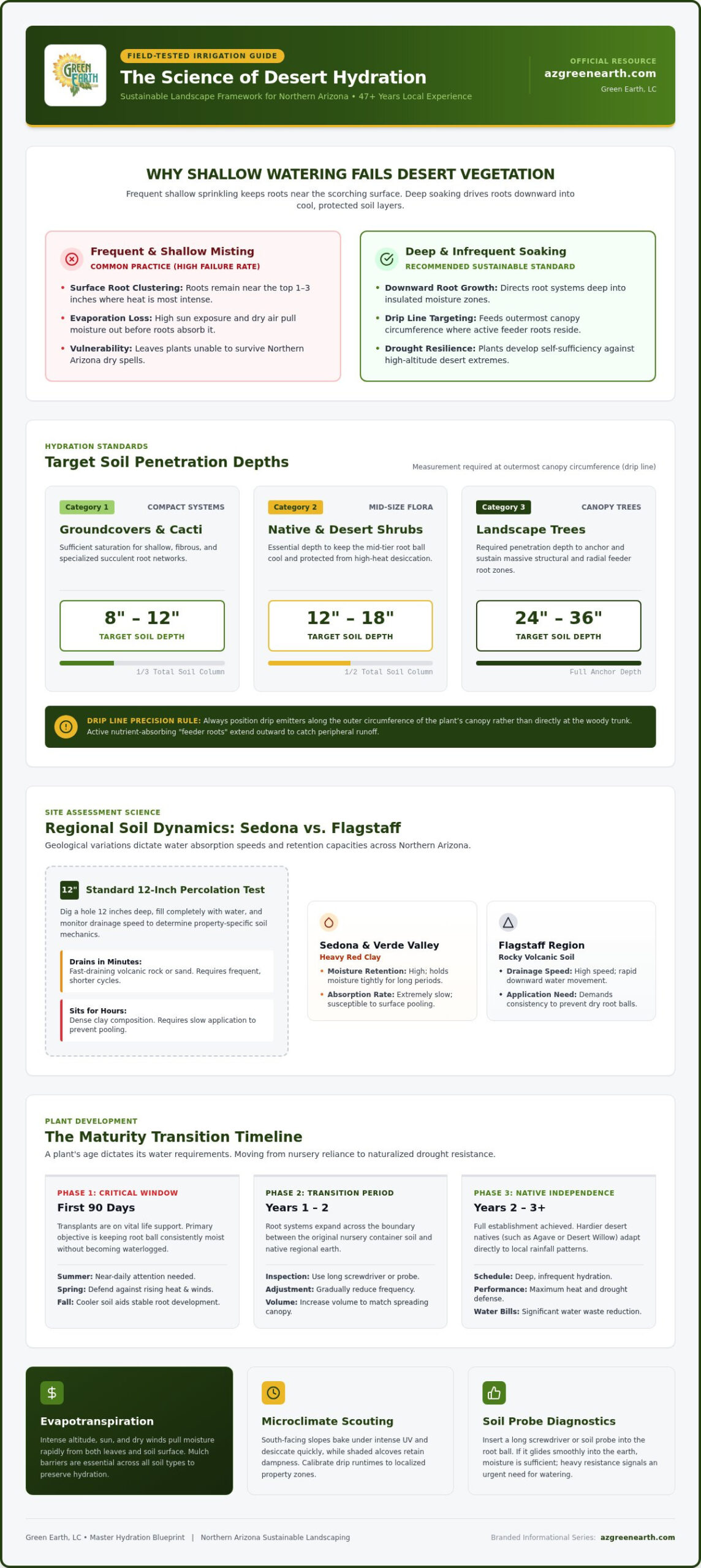
Successful landscaping in Northern Arizona begins with understanding that water doesn’t just disappear into the ground; it’s actively pulled away by the environment. This process, known as evapotranspiration, combines the evaporation of moisture from the soil with the transpiration of water through plant leaves. In high-altitude regions like Flagstaff or the wind-swept mesas of Sedona, intense sunlight and dry air accelerate this loss. Without a scientifically grounded desert plant irrigation schedule, your vegetation is constantly fighting a losing battle against the elements. Applying water without considering these factors often leads to surface runoff or rapid evaporation before the roots can benefit.
Your soil composition dictates how effectively that water is stored. In Sedona and parts of the Verde Valley, heavy red clay dominates the landscape. While clay is excellent at holding moisture, it absorbs water very slowly, often leading to pooling if the application rate is too high. Conversely, Flagstaff’s rocky volcanic soil drains with incredible speed, requiring a different approach to maintain consistency. Integrating organic mulch is essential across all these soil types; it acts as a protective barrier that regulates soil temperature and prevents the sun from baking the moisture out of the earth.
Soil Drainage and Water Retention
Determining your specific needs starts with a simple percolation test. Dig a hole roughly 12 inches deep, fill it with water, and track how long it takes to drain completely. If the water vanishes in minutes, you’re dealing with fast-draining volcanic or sandy soil; if it sits for hours, you have high clay content. This data allows you to identify microclimates on your property, such as south-facing slopes that bake in the sun or shaded alcoves that retain dampness. While clay soil holds moisture tightly for long periods but absorbs it slowly, sandy desert soils drain rapidly and require more frequent applications to keep plants hydrated.
The Importance of Deep Root Soaking
Many homeowners make the mistake of frequent, shallow misting. This practice encourages roots to stay near the surface where they are easily scorched by summer heat. To build true drought resistance, you must practice deep soaking that targets the drip line, which is the area directly beneath the outermost circumference of the plant’s canopy. This is where the active “feeder roots” reside, rather than at the woody trunk. Following established drip irrigation principles ensures that water reaches the necessary depths for long-term health.
A reliable desert plant irrigation schedule should aim for specific saturation depths based on the plant category:
- Trees: Water should penetrate 24 to 36 inches deep to support a massive root structure.
- Shrubs: Aim for a depth of 12 to 18 inches to ensure the root ball remains cool and hydrated.
- Groundcovers and Cacti: A depth of 8 to 12 inches is typically sufficient for these smaller systems.
By focusing on volume and depth rather than frequency, you encourage roots to grow downward into the cooler, protected layers of the earth, creating a landscape that can withstand the harshest Arizona dry spells.
The Maturity Factor: Watering New vs. Established Plants
A plant’s age is the most significant variable in your desert plant irrigation schedule, yet it’s often the most overlooked. New transplants are essentially on “life support” until their root systems bridge the gap between the nursery container and the native Northern Arizona soil. This critical first year requires a vigilant approach, often involving near-daily attention during the peak of summer to prevent the root ball from desiccating. Native species like Agave or Desert Willow reach independence faster than non-natives because they’re biologically tuned to our specific rainfall patterns. However, even these hardy varieties require a structured transition period of two to three years before they can truly be considered established.
The Establishment Phase (Year 1-2)
During the first 90 days after planting, your primary goal is to keep the root ball consistently moist but not waterlogged. For spring installations, you’re fighting rising temperatures and drying winds; fall plantings, by contrast, allow roots to develop in cooler, more stable soil conditions. To check moisture for new shrubs, insert a long screwdriver or soil probe directly into the root ball; if it doesn’t slide in easily or the soil feels bone-dry to the touch, the plant needs immediate hydration. Following EPA WaterSense outdoor watering practices helps prevent the runoff common with over-saturation in our regional clay soils. If you find your timer settings confusing during this high-stakes phase, our team specializes in irrigation controller troubleshooting to help you find the perfect balance for your new landscape.
Irrigation for Established Landscapes (Year 3+)
By the third year, most desert-adapted plants should be ready for a “deep and infrequent” watering cycle. This method mimics natural heavy rain events, encouraging roots to seek moisture deep underground where temperatures are lower and more stable. Overwatering is the primary cause of death for mature desert plants, as it leads to root rot that often goes unnoticed until the plant is beyond saving. For established cacti and succulents, look for shriveling or a “deflated” appearance as a sign of water stress. Conversely, soft, mushy tissues usually indicate that the plant is receiving too much water. Shifting your focus from frequency to volume ensures a resilient, sustainable landscape that mirrors the natural beauty of the Verde Valley and Sedona’s red rock country.
The 4-Season Northern Arizona Irrigation Framework
Operating a landscape across varying elevations requires a desert plant irrigation schedule that functions as a living document rather than a set-and-forget timer. In Northern Arizona, we experience dramatic shifts between the awakening of spring and the deep dormancy of winter. Spring (March-May) is the time to gradually increase frequency as soil temperatures rise and winds accelerate moisture loss. Summer (June-August) demands peak volume to combat intense solar radiation, while fall (September-November) requires a deliberate reduction in water to “harden off” plants, preventing tender new growth from being decimated by the first frost. Even winter (December-February) shouldn’t be ignored; evergreens and newly planted specimens still require occasional hydration if monthly snowfall or rain is insufficient.
Seasonal Frequency and Duration Table
The following table outlines general frequencies for established plants. Note that Sedona’s 4,500-foot elevation stays warmer longer than Flagstaff’s 7,000-foot alpine climate, where irrigation systems must often be winterized earlier to prevent pipe bursts. Utilizing University of Arizona Cooperative Extension guidelines for desert plant watering ensures your specific plant types receive the correct depth of saturation.
| Season | Trees | Shrubs | Cacti/Succulents |
|---|---|---|---|
| Spring | Every 14–21 days | Every 7–14 days | Every 21–30 days |
| Summer | Every 7–12 days | Every 4–7 days | Every 14–21 days |
| Fall | Every 14–21 days | Every 7–14 days | Every 21–30 days |
| Winter | Every 30–60 days | Every 30–45 days | Only if bone dry |
Smart controllers can automate these shifts by pulling local weather data, but they aren’t foolproof. Elevation differences mean a controller in the Verde Valley needs different parameters than one in the high country. We often assist clients with irrigation controller troubleshooting to ensure these “smart” features don’t inadvertently overwater during a cool spell or underwater during a heatwave.
The Monsoon Adjustment
Arizona’s summer monsoons provide a vital reprieve, but they also introduce high humidity and fungal risks. When your property receives more than half an inch of rain, it’s best to bypass your scheduled cycle for at least one week. Excessive moisture sitting in heavy Sedona clay can lead to root rot or fungal blooms on succulents. Proper drainage grading Arizona is critical during this time; it ensures that heavy downpours move away from your home’s foundation while still allowing deep infiltration into the root zones of your desert trees. Monitoring the sky is just as important as monitoring your timer during these volatile summer months.
Optimizing Your Drip Irrigation System
Precision is the cornerstone of a sustainable desert plant irrigation schedule. Drip irrigation remains the gold standard for desert landscape design Northern Arizona because it applies water slowly and directly to the root zone. This method virtually eliminates the evaporation losses common with overhead sprayers; it’s particularly effective in our windy, high-altitude environment. By matching the emitter output to the specific needs of each plant, you ensure that every drop serves a purpose. Most systems utilize 1 GPH (gallons per hour) emitters for small perennials, 2 GPH for medium shrubs, and 4 GPH for larger trees to achieve the deep saturation required for healthy growth.
To maximize efficiency, especially on sloped properties or heavy clay soil, we recommend the ‘Cycle and Soak’ method. Instead of running a single long cycle that leads to runoff, program your controller to run for several short intervals with 30 to 60-minute breaks in between. This allows the ground to absorb the moisture before the next application begins. However, even the best systems face challenges like mineral salt buildup, which can calcify around emitters and restrict flow. Local wildlife, including javelinas and rodents, often chew through poly-tubing in search of water, creating significant leaks that can spike your utility bills overnight.
Drip System Maintenance Checklist
Regular oversight is the best defense against landscape failure. Perform monthly inspections by manually running each zone and checking for pooling water or dry spots that indicate a clog. Periodically flush the system by removing the end caps from your lateral lines to clear out any accumulated sediment or debris. If you discover broken lines or uneven pressure, our experts provide comprehensive irrigation repair Flagstaff services to restore your system’s integrity and prevent water waste.
Troubleshooting the Controller
Your irrigation controller is the brain of your landscape, but it requires periodic maintenance to function correctly. Always replace the backup battery annually to prevent your settings from reverting to a factory default during a power flicker. Check for ‘ghost’ programs; these are hidden start times that can cause your system to run twice as often as intended. Large properties often benefit from multiple start times to ensure high-demand zones receive adequate pressure. When technical glitches arise or your schedule feels out of sync, seek professional irrigation controller troubleshooting Arizona to protect your investment. Contact Green Earth, LC today to schedule a professional system audit and ensure your landscape remains a thriving, water-efficient sanctuary.
Sustainable Maintenance for Long-Term Beauty
Maintaining a vibrant desert landscape requires a holistic approach that extends far beyond the initial installation. A precise desert plant irrigation schedule ensures that your vegetation remains hydrated and resilient, which is a critical component of firewise landscaping Cottonwood AZ. When plants receive the correct amount of moisture, they’re less likely to become dry, brittle fuel for wildfires. However, hydration must be balanced with strategic maintenance. Pruning and thinning are essential practices; by removing excess growth and dead wood, you effectively reduce the plant’s total water footprint. This allows the root system to support a more compact, healthy canopy that can better withstand the intense Arizona sun.
For larger properties and community associations, the complexity of managing these systems often necessitates professional HOA landscape maintenance Arizona. A well-maintained landscape acts as a natural deterrent against invasive weeds and pests, which often target stressed or overwatered vegetation. By ensuring your drip system is functioning at peak efficiency, you create a sustainable environment where native species can thrive without the need for excessive chemical interventions. Implementing a customized desert plant irrigation schedule allows you to move beyond reactionary watering and toward a proactive model of environmental stewardship.
Partnering for Landscape Health
A professional irrigation audit is the most effective way to identify hidden inefficiencies in your system. Whether you manage a commercial complex or a residential estate, our team brings 47 years of local wisdom to every evaluation. We integrate modern technology with a deep understanding of Northern Arizona’s unique terrain to provide actionable insights. We invite you to request a custom consultation to ensure your property benefits from a visionary approach to land management, prioritizing both aesthetic excellence and ecological responsibility.
A Vision for Sustainable Landscapes
Our commitment to the Verde Valley and the high country goes beyond simple service provision. We believe in moving past the outdated “rocks and cacti” stereotype to create lush, water-wise environments that enhance local biodiversity. Responsible water management has a profound environmental impact, preserving our regional resources for future generations while increasing your property’s long-term value. We’re dedicated to being your partner in this journey toward a more sustainable and beautiful future. Contact Green Earth, LC for your custom irrigation schedule today.
Cultivate a Resilient Northern Arizona Sanctuary
Mastering regional hydration requires moving beyond a “set and forget” mentality. By aligning your watering cycles with the specific soil types of the Verde Valley or the high-altitude demands of Flagstaff, you protect both your investment and our shared natural resources. Implementing a professional desert plant irrigation schedule ensures your landscape remains healthy, fire-safe, and water-efficient throughout the year. You now have the framework to transition from basic survival to a landscape that truly flourishes in our unique red rock and alpine climates.
With over 47 years of local experience and a reputation as a statewide runner-up for Best Sustainable Landscape Designer, Green Earth, LC provides the specialized expertise needed to optimize high-efficiency drip systems. Our team is ready to help you navigate the complexities of seasonal shifts and technical troubleshooting. Schedule a Professional Irrigation Audit with Green Earth, LC to transform your outdoor space into a thriving, sustainable environment. Your vision of a beautiful, drought-resistant landscape is well within reach, and we’re here to ensure its long-term success.
Frequently Asked Questions
How often should I water my desert plants in the summer?
During the peak summer heat, established desert trees typically need water every 7 to 12 days, while shrubs require attention every 4 to 7 days. This frequency ensures deep soil penetration before the intense afternoon sun triggers rapid evaporation. Your specific desert plant irrigation schedule should also account for the monsoon season; if your property receives significant rainfall, you can often skip a cycle to prevent root saturation in heavy clay soils.
Do I need to water my desert landscape in the winter?
Yes, desert landscapes still require occasional hydration during the winter months, especially for evergreens and newly planted specimens. While most plants are dormant, the dry Northern Arizona air and winter winds can pull moisture from the root zone. Watering once every 30 to 60 days is usually sufficient if there hasn’t been significant snowfall or rain. This practice prevents root desiccation and ensures your landscape is ready for a healthy spring awakening.
How can I tell if my cactus is overwatered or underwatered?
An overwatered cactus often feels soft or mushy and may show signs of yellowing or black rot at the base. Conversely, an underwatered cactus will appear shriveled, thin, or “deflated” as it consumes its internal water reserves. Striking the right balance is essential for long-term health. If you notice these symptoms, it’s a clear sign that your desert plant irrigation schedule needs adjustment to better match the specific drainage characteristics of your soil.
What is the best time of day to water desert plants?
The ideal time to water is in the early morning, specifically between 4:00 AM and 8:00 AM. Watering during these hours allows the moisture to soak deeply into the root zone before the heat of the day increases evaporation rates. Evening watering is an alternative, but it can sometimes encourage fungal growth if the foliage stays damp overnight. Morning irrigation ensures that plants are fully hydrated before facing the intense midday solar radiation common in Sedona.
How long should I run my drip irrigation system?
Drip systems should run long enough to saturate the soil to the appropriate depth for the plant type. For trees, this often means 2 to 4 hours, while shrubs may only need 1 to 2 hours. The exact duration depends on your emitter flow rates, such as 1 GPH or 4 GPH. Using a cycle and soak method helps prevent runoff, ensuring that water reaches the deep feeder roots rather than pooling on the surface.
Do native Arizona plants need an irrigation system?
While native plants are adapted to our climate, they still require supplemental irrigation during their first two to three years of establishment. Once mature, many native species can survive on rainfall alone, but they’ll look significantly healthier and more vibrant with occasional deep watering during extended dry spells. An irrigation system provides the consistency needed to maintain a lush, sustainable landscape that supports local biodiversity and enhances your property’s overall aesthetic appeal.
Why are the leaves on my desert shrubs turning yellow?
Yellowing leaves, or chlorosis, are often a sign of either overwatering or a nutrient deficiency caused by poor soil drainage. In the heavy red clay of the Verde Valley, water can pool around roots and “drown” them, preventing oxygen intake. It can also indicate that the plant is stressed by salt buildup from hard water. Checking the moisture levels 12 inches deep with a soil probe can help you determine if the soil is staying too wet.
How do I adjust my watering schedule for high-altitude Flagstaff winters?
Flagstaff’s 7,000-foot elevation requires winterizing irrigation systems much earlier than in the lower deserts. You should drain your lines and insulate backflow preventers before the first hard freeze, usually by late October. During the winter, use a hose to manually water your trees and shrubs on days when the temperature is above 40 degrees and the ground isn’t frozen. This manual supplement replaces the automated system while protecting your pipes from freeze damage.
Recent Comments