
A landscape change may suit Northern Arizona’s conditions and still conflict with an HOA rule. When guidelines are vague or spread across several documents, even routine maintenance can become difficult to manage. Effective HOA landscaping guidelines compliance starts with a consistent review process: identify the applicable standard, assess the site, record the decision, and track the work.
Boards and residents want attractive, well-maintained shared spaces. Water use, wildfire concerns, and varied terrain can make landscape decisions more complex, however. A repeatable process helps everyone understand what is permitted, what needs approval, and how maintenance expectations apply across the community.
This checklist covers how to organize governing documents, review proposed work, plan maintenance, and document board decisions and resident communications. It also addresses Northern Arizona considerations such as irrigation efficiency, drainage, and fire-conscious landscape care. Clear expectations and thoughtful coordination help an HOA maintain a cohesive landscape that fits both its standards and local conditions.
Key Takeaways
- Gather governing documents and approved plans before reviewing a landscape request, so decisions have a clear, consistent reference.
- Use a repeatable site review to connect written standards with Northern Arizona conditions such as elevation, intense sun, seasonal freezes, and fire exposure.
- Compare routine maintenance, targeted repairs, and larger renovations by considering urgency, disruption, and future upkeep.
- Support HOA landscaping guidelines compliance with inspection notes that record the date, location, observed condition, relevant standard, and next action.
- Coordinate maintenance and landscape projects around board-approved expectations to keep shared spaces attractive, functional, and well documented.
HOA Landscaping Guidelines Compliance in Northern Arizona: Start with the Rules
Before approving a planting change, scheduling a repair, or responding to a resident concern, identify the standard that applies. HOA landscaping guidelines compliance means following governing documents and applicable requirements while keeping shared landscapes safe, functional, and properly maintained. The goal is not simply to enforce a preferred appearance. It is to make consistent decisions that connect the written rule to the work being reviewed.
Landscape expectations may appear in CC&Rs, bylaws, association rules, architectural standards, resolutions, approved landscape plans, and maintenance contracts. Each serves a different purpose. A plan may identify approved plants or site features, while a contract may define the maintenance assigned to a service provider. A general Homeowner Association (HOA) Overview provides background on how associations commonly govern community matters, but decisions should be based on the HOA’s current documents.
Which HOA documents govern landscape decisions?
Create a shared reference file before reviewing an issue. Locate the relevant landscape provisions and note each document’s date, amendment history, approval records, and review process. If a newer rule appears to conflict with an older plan or provision, do not assume which one controls. Have the conflict reviewed by qualified legal counsel.
Record who has authority to act. A board, architectural review committee, or manager may have different responsibilities under the association’s procedures. Document who reviews an application, who approves work, and who tracks follow-up. This helps distinguish official decisions from informal expectations.
How do Arizona requirements fit with HOA rules?
Association documents are not the only requirements that may apply. State statutes and county or municipal rules can also affect a landscape decision, and requirements may differ across Northern Arizona communities. Before stating that a planting, irrigation method, or landscape feature is legally required or prohibited, verify the current authority and consult qualified legal counsel when interpretation is needed.
Keep written standards separate from design preferences and informal resident expectations. A board member may prefer a particular plant palette, for example, but that preference should not be presented as a binding rule unless an applicable document or requirement supports it. Clear distinctions help protect the decision-making process and keep communication with residents respectful.
- Identify the source: Cite the specific document, provision, approved plan, or external requirement.
- Check its status: Confirm the version and relevant approval or amendment history.
- Clarify responsibility: Record who reviews, approves, and follows up.
- Separate facts from preference: Label aesthetic recommendations clearly when they are not written standards.
Once the rules are organized, connect them to practical maintenance planning for irrigation, drainage, and fire-conscious care. Green Earth, LC’s Northern Arizona HOA landscape maintenance guide offers broader context for planning that work.
How to Interpret HOA Landscape Standards for Northern Arizona Conditions
Read each landscape standard in the context of the site it governs. A planting bed in a sheltered Sedona courtyard may face different conditions from one on an exposed slope. Drainage problems may also become more apparent after monsoon rainfall. Local conditions can inform an assessment, but they do not replace the governing documents or applicable requirements.
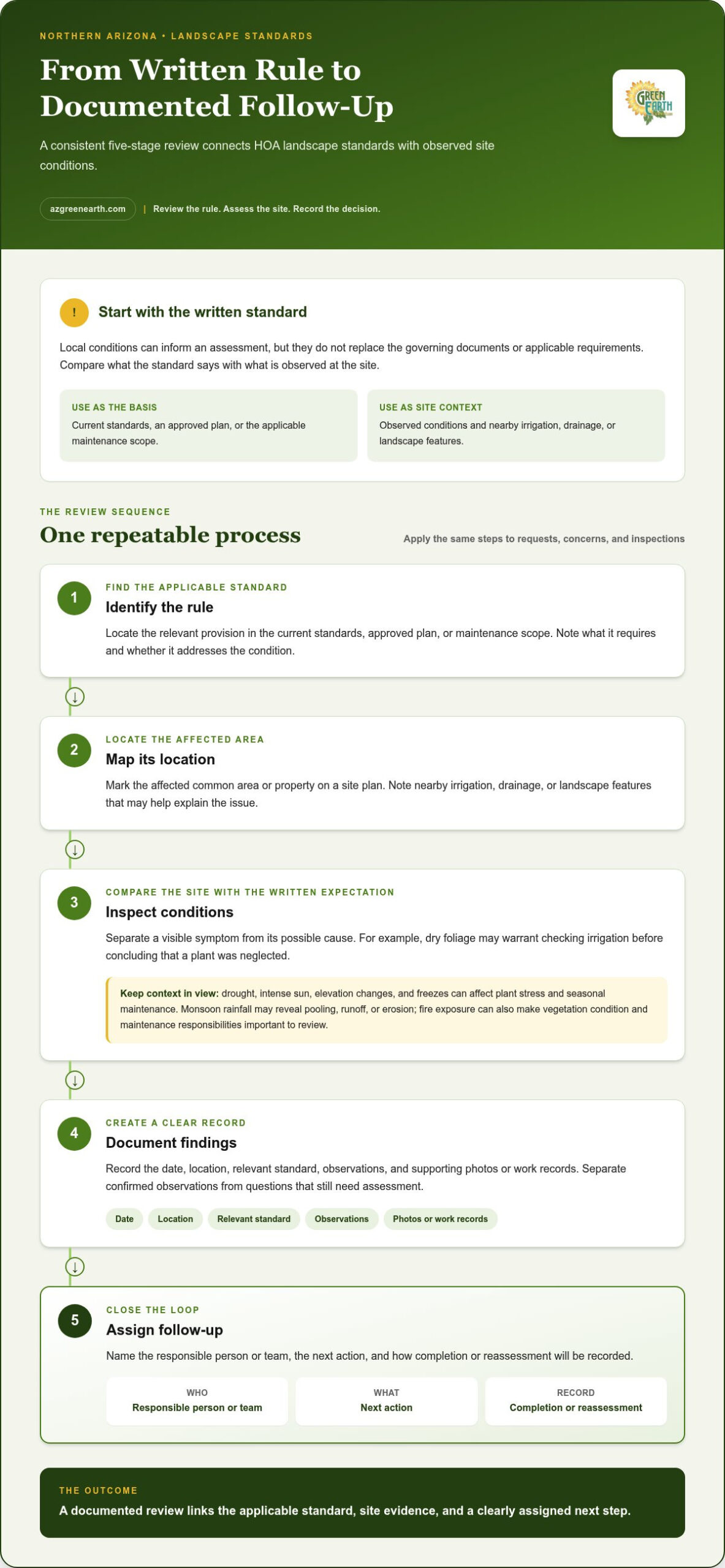
A compliance review compares written standards with observed conditions and records the findings. Use the same steps for resident requests, maintenance concerns, and common-area inspections so decisions rest on evidence rather than impressions.
- Identify the rule. Find the relevant provision in the current standards, approved plan, or maintenance scope. Note what it requires and whether it addresses the condition.
- Map its location. Mark the affected common area or property on a site plan. Note nearby irrigation, drainage, or landscape features that may help explain the issue.
- Inspect conditions. Compare the site with the written expectation and distinguish a visible symptom from its possible cause. Dry foliage, for example, may warrant checking irrigation before concluding that a plant was neglected.
- Document findings. Record the date, location, relevant standard, observations, and supporting photos or work records. Separate confirmed observations from questions that still need assessment.
- Assign follow-up. Name the responsible person or team, the next action, and how completion or reassessment will be recorded.
Drought, intense sun, elevation changes, and freezes can affect plant stress and seasonal maintenance in Northern Arizona. Monsoon rainfall may reveal pooling, runoff, or erosion that was not apparent during dry weather. Fire exposure can also make vegetation condition and maintenance responsibilities important to review. Regional design context helps explain site conditions, while written HOA standards remain the basis for compliance decisions in communities from Sedona and Camp Verde to Flagstaff and Prescott.
Assess water, drainage, and plant conditions
Compare irrigation schedules and visible plant stress with the written maintenance expectations. Record dry areas, pooling, runoff, erosion, or damaged irrigation components. Assign an appropriate assessment and document follow-up rather than assuming the cause from appearance alone. The Cottonwood Firewise defensible-space guide also discusses regional landscape considerations that can inform a broader site review.
Handle fire-conscious landscape concerns clearly
Start by identifying where association standards address vegetation, clearances, and maintenance responsibilities. Distinguish upkeep of community-owned or shared landscapes from property-specific defensible-space expectations. Do not present a preferred vegetation treatment as a binding rule unless the governing documents or applicable authority support it. The National Association of Landscape Professionals offers industry resources that can inform maintenance discussions and project planning.
For boards coordinating landscape observations with ongoing maintenance, a consistent process turns approved expectations into clear work records. Green Earth, LC provides coordinated HOA landscape maintenance for Northern Arizona communities.
Compare HOA Landscape Compliance Approaches Before Changing the Property
A reported landscape issue does not automatically require a redesign. A struggling planting bed, damaged drip line, or runoff crossing a walkway may each call for a different response. The right choice depends on the governing documents and a site assessment. For HOA landscaping guidelines compliance, match the work to the documented condition rather than selecting the broadest or most visible solution.
The least disruptive response that meets the applicable standard may be routine upkeep, a repair, or a documented project. Compare options before authorizing work. Consider how each fits the approved landscape plan, how urgent the condition is, and what care it will require afterward.
| Approach | Rule fit | Urgency | Disruption | Documentation and upkeep |
|---|---|---|---|---|
| Routine maintenance | Best suited to recurring care that preserves existing approved conditions. | Schedule according to the maintenance plan; raise priority if an observed issue creates a safety or functional concern. | Usually limited to the area being maintained. | Record completed tasks and exceptions; continue the established care cycle. |
| Targeted repair | Addresses a specific failure while retaining the agreed landscape plan. | Set priority based on the condition and its effect on function, such as a damaged irrigation line or drainage problem. | Focused work may still affect nearby planting, paths, or access. | Document the condition, repair scope, and completion; track whether further assessment is needed. |
| Planned landscape renovation | Appropriate when documented needs require a change to the approved landscape. | Plan around review and approval steps, site conditions, and project sequencing. | May affect multiple landscape areas and require coordinated work. | Keep the approved design, scope, decisions, and maintenance responsibilities on file; plan ongoing care for the revised landscape. |
When is maintenance enough, and when is a project needed?
Use routine maintenance when the existing landscape meets approved standards and needs regular care, such as scheduled trimming or irrigation adjustments within the existing system. Consider targeted repair when a failed component undermines the plan, such as a leak leaving part of a bed dry or drainage damage affecting a shared path. Consider redesign or construction when a documented need cannot be resolved through upkeep or repair without changing the approved landscape.
What should a board compare when reviewing landscape proposals?
Start with the specific rule and observed condition. Then define the intended result in practical terms, such as restoring irrigation coverage in an affected bed or correcting drainage in a named area. Compare proposals by scope, water-management details, schedule assumptions, reporting methods, and responsibility for ongoing maintenance. Confirm the board’s or architectural committee’s authority before work begins, and keep the decision and approved scope with the community’s records.
In Northern Arizona, a seasonal symptom may need investigation before the board selects a permanent change. A dry area, for example, could call for maintenance, irrigation repair, or a broader landscape adjustment. Document the condition and assess its cause first, then choose the response that meets the applicable standard with the least unnecessary disruption.
HOA Landscaping Guidelines Compliance Checklist for Board Members
A dependable inspection process gives board members a shared way to review conditions, assign work, and explain decisions. For HOA landscaping guidelines compliance, tie each finding to an approved plan or written standard, and distinguish what was observed from what still needs assessment. A useful record includes the date, the location, the relevant standard, and a clearly assigned next action.
Use this checklist as a repeatable starting point, adapting it to the association’s documents and approval process.
- Gather current references. Have the relevant governing documents, approved landscape plans, maintenance scope, and prior decisions available for the area under review.
- Locate the inspection area. Identify the common-area bed, irrigation zone, path, slope, or other site feature so the finding can be revisited consistently.
- Observe landscape conditions. Review visible plant health, irrigation operation, drainage, hardscape condition, and cleanliness. Record specific conditions instead of broad judgments such as “poorly maintained.”
- Compare with written standards. Record the relevant plan or requirement and explain how the observed condition relates to it. Do not substitute a personal design preference for an adopted standard.
- Capture supporting records. Keep dated notes and relevant photos with prior approvals, work summaries, and related resident reports.
- Classify the follow-up. Separate urgent safety or property concerns from routine maintenance findings. Describe the observed risk or condition and follow the HOA’s established process without inventing a response deadline.
- Assign responsibility. Name the person, committee, manager, or maintenance team responsible for the next action, and record whether approval is needed before work proceeds.
- Track status. Mark each item as open, under review, approved, in progress, or complete. Carry unresolved findings into the next inspection or board review.
What belongs on a recurring HOA landscape inspection?
Use the same route or site plan where practical. Check visible plant condition, irrigation operation, drainage patterns, hardscape, and cleanliness, then compare each observation with approved plans and written community standards. A dry planting area, for instance, is a condition to record and assess, not proof by itself of a rule violation. Assign findings and status so the next reviewer can see what changed.
How can boards document decisions and resident concerns?
Keep inspection notes, relevant photos, approvals, work summaries, and follow-up in one organized record. Apply the same written criteria to comparable locations and similar resident concerns. When the board approves an exception or makes a decision, record the outcome and rationale through the HOA’s established process. Consistent documentation helps residents understand how a concern was reviewed and gives future board members a clear history.
For coordinated care that supports documented community standards, explore HOA landscape maintenance support from Green Earth, LC.
Make HOA Landscape Compliance Easier with a Northern Arizona Maintenance Partner
Standards are easier to apply when the people doing the landscape work understand what the board has approved and what the site needs. Green Earth, LC provides HOA landscape maintenance, irrigation services, and landscape construction for project needs. Coordinating recurring care with targeted repairs or approved improvements helps connect written expectations, site observations, and completed work.
A productive partnership starts with the board’s documented priorities. Share applicable landscape plans, maintenance expectations, and known site concerns to give the work a clear reference point. Observations from routine care can help the board decide whether a condition calls for regular upkeep, irrigation attention, or a larger project for review. The association directs decisions and approvals through its established process.
What should an HOA expect from a landscape maintenance partnership?
Set a scope that reflects the property, board priorities, and documented landscape expectations. Recurring care can include pruning and seasonal maintenance, while observations can flag irrigation concerns that need attention. If an approved landscape, hardscape, or drainage need calls for project work, keep that scope distinct from routine maintenance. Clear responsibilities make it easier for the board to track the work through completion.
How can local experience support lasting compliance?
Northern Arizona properties vary in elevation, water needs, drainage patterns, and seasonal conditions. Local knowledge can inform practical maintenance and project decisions, while sustainable choices must still fit HOA standards and applicable requirements. A clear scope, shared expectations, and consistent service records help boards review completed work and plan follow-up without losing sight of long-term landscape goals.
Green Earth, LC serves HOA properties in Sedona, Camp Verde, Cottonwood, Flagstaff, and Prescott, coordinating maintenance and project work to support attractive, functional shared spaces. Boards can establish a straightforward working rhythm by identifying approved standards, communicating site priorities, and keeping records of observations and completed tasks. This supports consistent care while allowing the association to review exceptions and proposed changes through its own process.
To discuss HOA landscape maintenance with Green Earth, LC, connect with our team about your community’s needs and priorities.
Build a Landscape Process Your Community Can Sustain
Take a practical first step: choose a shared place to keep current landscape standards, inspection notes, approvals, and completed-work records. When board members and residents can refer to the same information, questions are easier to review and expectations are easier to communicate. A consistent process also gives future board members a useful record of past decisions.
Good HOA landscaping guidelines compliance is not a one-time approval. It is an ongoing way to care for shared spaces while responding thoughtfully to changing site conditions. As community priorities evolve, revisit the process through the association’s established review channels and ground decisions in written standards and observed needs.
Green Earth, LC works with HOA communities on landscape maintenance and related property needs, helping align planned work with board-approved expectations. Discuss HOA landscape maintenance with Green Earth and take a considered next step toward consistent care for your community’s shared landscape.
Frequently Asked Questions
Do HOA landscaping rules override city or county requirements?
Public requirements and HOA standards generally address separate obligations, so do not assume that one cancels the other. A landscaping change in Sedona, for example, may need to satisfy both association approval procedures and requirements that apply to its location. Compare the property, proposed work, and rules involved, then verify current public requirements with the relevant authority. If the standards appear inconsistent, pause the decision and seek qualified legal guidance.
Can an HOA require residents to use specific plants or landscaping materials?
An HOA may set plant or material standards when its governing documents and applicable law support them. The answer depends on the community and the proposed change. Check whether the rule names particular plants, limits materials, or gives an architectural committee discretion. For a resident proposal in Cottonwood or Prescott, apply the same written criteria used for comparable requests and explain any approval conditions in writing.
How often should an HOA inspect its landscaping?
Set an inspection schedule that fits the property’s needs, maintenance plan, and governing documents rather than relying on a universal interval. A community with several distinct landscape areas might include them on a recurring route, then add a focused review after a resident report or noticeable seasonal change. Record when each area was last checked so the board can identify gaps and adjust the schedule based on actual conditions.
What should an HOA do when landscaping does not meet its guidelines?
Identify the applicable standard and confirm which condition appears inconsistent before deciding how to respond. A resident complaint about an unwatered planting area, for example, may call for checking the assigned maintenance responsibility before sending a notice. Follow the association’s established communication and review procedures, and distinguish the finding from assumptions about its cause. If the rule or enforcement authority is uncertain, seek legal guidance before taking action.
Can an HOA require drought-conscious landscaping in Arizona?
Whether an HOA can require a particular landscape approach depends on its governing documents and current state or local requirements. A board considering a water-wise standard should define it in practical terms, such as criteria for irrigation or approved plant choices, and review the language through its established process. HOA landscaping guidelines compliance should account for both the written standard and applicable requirements rather than assuming one rule fits every Arizona community.
Who is responsible for landscaping in an HOA community?
Responsibility depends on the property documents and maintenance agreements, which may assign different duties to the association and individual owners. Start with a site map that marks shared areas, privately maintained yards, and spaces with divided responsibilities. In a community with several landscape zones, this can clarify who reports an issue, who arranges care, and where the relevant maintenance terms are recorded.
What records should an HOA keep for landscape compliance?
Keep records that show both the rule applied and the association’s response to a specific condition. Along with current plans and approvals, retain dated resident communications, inspection photos, work summaries, and notes explaining a decision or exception. Organizing materials by location or issue helps new board members understand the history without relying on verbal recollections. Follow the association’s document-retention practices for storing and managing records.
Recent Comments