
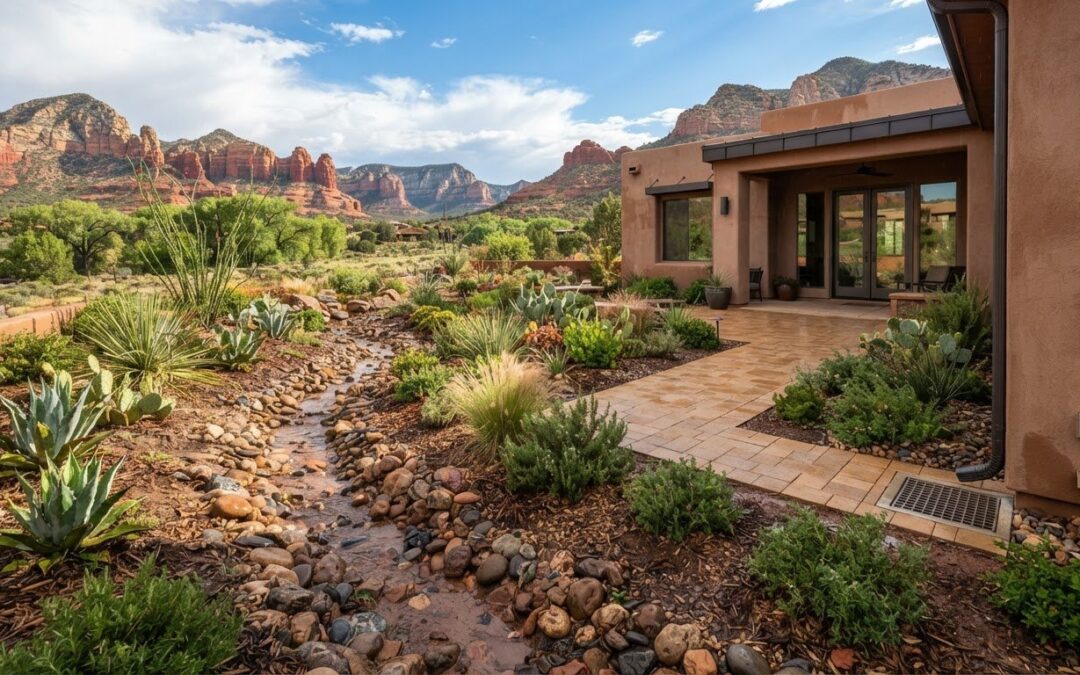
Water pooling in your yard can put more than your landscaping at risk. In Cottonwood, intense monsoon runoff can move quickly across clay-heavy soils, leaving standing water that attracts mosquitoes, erodes soil around plants, or flows toward your home’s foundation. Effective yard drainage repair cottonwood properties need is not simply about moving water away. It is about guiding runoff responsibly through the landscape.
If you’re concerned about flooding after a storm, start by understanding how water moves across your property, where it collects, and whether grading can redirect it. The goal is to manage runoff while making thoughtful use of water in a desert environment, creating a yard that is drier and easier to use while helping protect the foundation.
This article explains how Cottonwood’s terrain and soil can affect drainage, which repairs and grading approaches can address common trouble spots, and why a carefully planned system matters for long-term property care. Green Earth, LC brings more than 47 years of Verde Valley experience to drainage grading and sustainable landscape construction.
Key Takeaways
- Learn how Cottonwood’s clay-heavy and caliche soils can affect water movement, and why monsoon runoff calls for thoughtful drainage planning.
- Compare French drains, swales, and grading to see how surface and subsurface solutions address different drainage problems.
- Recognize warning signs such as spongy turf, salt deposits, and wall cracks that may point to a drainage issue.
- Explore how sustainable landscaping and permeable pavers can help manage runoff while complementing your outdoor space.
- See how yard drainage repair cottonwood projects can benefit from local Verde Valley experience and careful site analysis and grading.
The Unique Challenges of Yard Drainage in Cottonwood, AZ
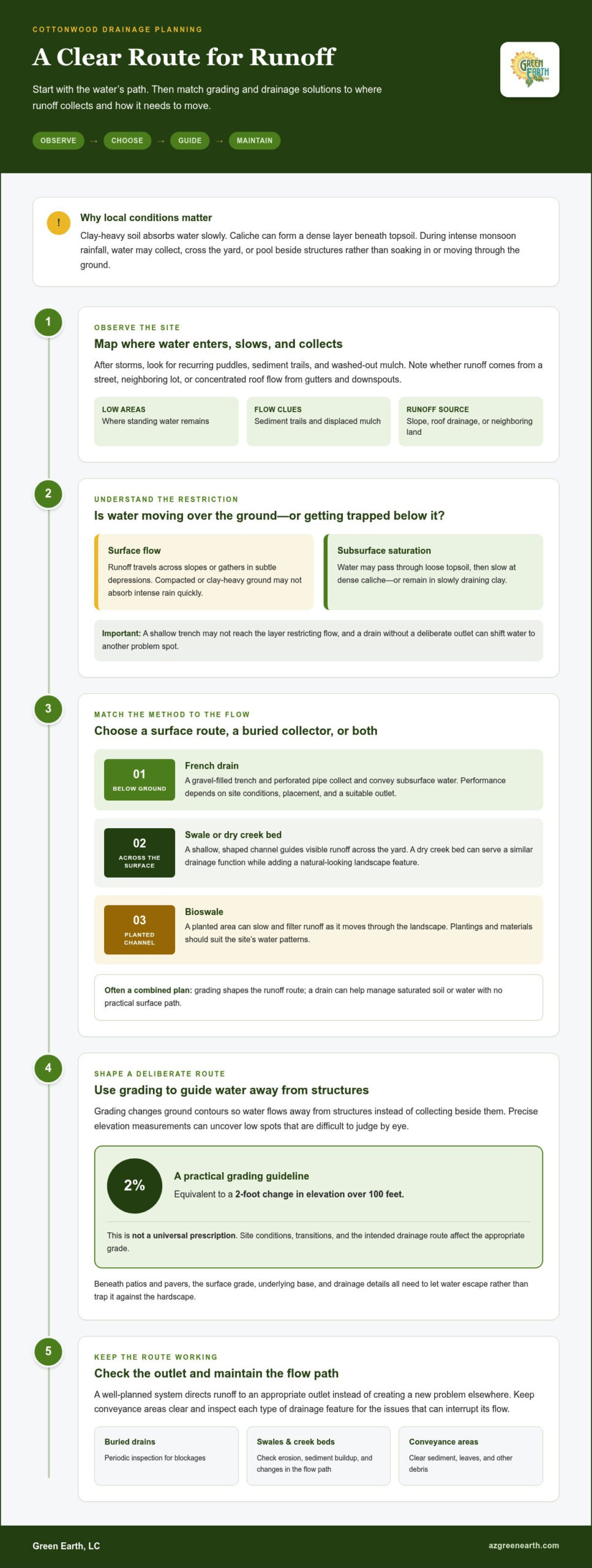
Drainage problems in Cottonwood often start below the surface. Clay-heavy soil absorbs water slowly, while caliche, a naturally cemented layer of soil and minerals, can form a dense barrier beneath topsoil. When stormwater cannot soak in or move through the ground easily, it may collect in low areas, travel across the yard, or pool beside structures. Effective yard drainage repair cottonwood homeowners need starts with understanding these local conditions, not simply adding a pipe or digging a trench.
Caliche and Clay: The Verde Valley Drainage Barrier
Caliche can form a hard layer beneath looser topsoil. Water may pass through the surface, then slow or stop when it reaches this compacted zone. Clay presents a different challenge: it drains slowly and can swell when wet, then shrink as it dries. Repeated changes in soil moisture can shift the ground around paths, planting beds, and foundations.
Water that remains in soil beside a foundation can create hydrostatic pressure, the force exerted by water-saturated soil against a structure. Persistent pressure can contribute to moisture intrusion and put stress on foundation walls. Cracks should be assessed rather than assumed to have a single cause. A shallow DIY trench may not reach the layer restricting flow, and a drain without a deliberate outlet can move water to another problem spot. A properly designed French drain is one subsurface approach, but its performance depends on site conditions, placement, and where collected water can go.
Monsoon Preparedness: Managing Flash Runoff
Steady rain gives soil time to absorb water gradually. During Arizona’s monsoon season, intense rainfall can produce runoff faster than compacted or clay-heavy ground can absorb it. Gutters and downspouts may concentrate roof runoff in one place, overwhelming a small planting area or sending a fast stream toward a wall, walkway, or low point.
That’s why desert drainage repair must consider velocity control, not just the direction water travels. Slowing and guiding runoff can reduce its erosive force and help protect soil, plants, and hardscape. The right approach depends on slope, surface materials, and existing drainage paths. Thoughtful drainage grading in Arizona can create more reliable routes for stormwater instead of leaving it to find its own.
Cottonwood’s varied terrain adds another complication. A yard that slopes down from a street or neighboring lot can funnel water into a low corner, where runoff gathers faster than it can escape. Even a mostly level yard may have subtle depressions that hold water after a storm. Look for recurring puddles, sediment trails, or washed-out mulch to identify where water enters, slows, and collects. Mapping these patterns can help distinguish a grading issue from a blocked drainage path and point to a repair suited to the property, rather than a one-size-fits-all fix.
Effective Yard Drainage Solutions: French Drains, Swales, and Grading
The right drainage fix depends on where water collects and how it needs to move. Surface systems guide visible runoff across the landscape; subsurface systems collect water below ground and carry it through a buried pipe. In Cottonwood, grading and drains often work together: grading shapes the route, while a drain can help manage water that saturates soil or has no practical surface path. A well-planned solution also directs runoff to an appropriate outlet instead of creating a new problem elsewhere.
French Drains vs. Surface Swales
A French drain uses a gravel-filled trench and perforated pipe to collect and convey subsurface water. It can help where soil stays saturated below the surface, including near a basement or crawlspace, if the site layout and a suitable outlet support the design. A surface swale is a shallow, shaped channel that guides runoff across the yard. A dry creek bed can serve a similar drainage function while adding a natural-looking landscape feature.
Bioswales can slow and filter runoff as it moves through a planted area, making them a useful option to consider for sustainable desert landscapes. Choose plantings and materials suited to the site’s water patterns, and keep conveyance areas clear of sediment, leaves, and other debris. Buried drains need periodic inspection for blockages. Swales and creek beds benefit from checks for erosion, sediment buildup, and changes to their flow path.
How Grading Creates a Reliable Runoff Path
Grading changes the ground’s contours so water flows away from structures instead of collecting beside them. A drain captures and carries water through a constructed channel or pipe. The distinction matters beneath patios and pavers: a sound surface grade helps shed water, while the underlying base and drainage details also need to let water escape rather than trap it against the hardscape.
A 2% slope is often used as a practical grading guideline, equivalent to a 2-foot change in elevation over 100 feet. It is not a universal prescription: site conditions, transitions, and the intended drainage route affect the appropriate grade. Precise elevation measurements can reveal low spots that are difficult to judge by eye. Professional drainage grading in Arizona uses the site’s contours to create a deliberate runoff path and reduce pooling near a home’s stem wall.
Match the Design to the Landscape
Before settling on a system, consider where runoff starts, whether it travels over or through the soil, and where it can be directed safely. A swale may suit broad surface flow, while a buried drain may address subsurface saturation. Some yards need coordinated grading and drainage features. Green Earth, LC brings long-standing Verde Valley experience to drainage grading and sustainable landscape construction. Explore drainage grading solutions as part of a site-specific plan for your Cottonwood property.
Identifying and Repairing Failed Drainage Systems
A drainage system can fail gradually, so look for patterns rather than judging it by one puddle after a storm. Turf that stays spongy long after nearby areas dry, recurring ponding, soil washed from planting beds, or white salt deposits on masonry can signal persistent moisture or poor water movement. Salt deposits can have other causes, and no single sign proves a drainage failure. Repeated symptoms together can help show where closer inspection is needed.
Check whether water enters a catch basin but drains slowly, or bypasses the inlet entirely. Sediment, roots, or debris may obstruct underground pipes. A basin can also shift or collapse, disrupting the flow path. If surface symptoms return after visible debris is cleared, the blockage or damage may be farther along the system. Finding the source before adding a new drain helps avoid treating only the symptom.
Simple Observations and a Soil Infiltration Check
A basic bucket test can help compare how quickly water moves into soil in different parts of the yard. Choose representative spots away from buried utilities, loosen the surface, and pour the same measured amount of water into each shallow test area. Observe and record how quickly it disappears, then compare the results. This is a rough screening method, not a formal soil test. Caliche, compacted layers, and recent soil moisture can affect what you see. Avoid digging where underground utilities may be present.
Signs of Foundation Stress from Poor Drainage
Cracks deserve attention, especially if they change over time. Stair-step cracking in masonry, cracks in stucco, or doors and windows that suddenly stick can accompany ground movement, but they can also have other causes. Poor drainage can contribute to excess moisture near a foundation, and indoor dampness or mildew may indicate water intrusion. These signs do not establish the cause on their own. Track when they appear and whether they worsen after wet weather, and seek an appropriate structural assessment for concerning changes.
Clean-Out or a Larger Redesign?
A clean-out may be enough when an otherwise functional system has a localized blockage and water moves normally again once it is cleared. Repeated ponding, multiple blocked sections, a damaged basin, or water flowing toward the house may point to a broader issue with pipe placement, capacity, or grading. In those cases, repairing one component can leave the underlying flow problem unresolved.
Addressing recurring drainage trouble early can help limit ongoing soil erosion and prolonged moisture near the home. That does not mean every puddle will lead to foundation damage or that drainage work can prevent every crack. Persistent ponding is worth investigating before the next storm cycle. For yard drainage repair cottonwood properties, a site assessment can trace the water’s route, identify whether the system is clogged or poorly graded, and guide a targeted repair or a more complete redesign.
Sustainable Drainage: Protecting the Cottonwood Environment
In the Verde Valley, good drainage should protect a property without treating every drop of rain as waste. A sustainable plan manages runoff where it falls, moves excess water away from vulnerable areas, and considers how landscape choices affect soil, plants, and nearby spaces. Integrating sustainable landscaping in Arizona with drainage work can make a yard more resilient and better suited to its local environment.
Permeable pavers allow water to pass through joints or openings into a prepared base, reducing the amount that runs across hard surfaces. Depending on site conditions, some water may then infiltrate the ground. Permeable pavers can suit walkways or patios where conventional paving would shed runoff, but the base and grading still need to be designed to avoid directing water toward the home.
Water Harvesting Through Drainage
Runoff can sometimes be guided toward planting areas rather than sent directly off-site. For example, a system may direct rainwater toward deep-root irrigation zones for established desert trees, while a rain garden can temporarily collect and filter water in a suitable part of the yard. These features need an appropriate location and overflow path; they are not suited to every soil, slope, or drainage condition.
Capturing precipitation can help make better use of natural rainfall and may reduce reliance on city water for some landscape needs. Native or locally adapted plants in a bioswale can help slow runoff and trap sediment as water passes through. Plant selection and placement should reflect the area’s water flow and maintenance needs, rather than assuming one planting plan suits every property.
Materials and Firewise Landscape Planning
Locally sourced rock and gravel can give a dry creek bed a natural appearance while forming a durable channel for surface flow. For underground systems, pipe material should suit the installation’s intended use, site conditions, and maintenance access. Comparing materials involves more than the product itself: transport, expected service life, replacement needs, and installation all shape its environmental footprint.
Drainage planning can also complement Firewise defensible space. Grading can guide water away from structures, while landscape planning can account for vegetation and fuel management around the property. These goals work best as coordinated decisions: a drainage feature should not create a persistently wet area or conflict with how the surrounding space is maintained.
For Green Earth, LC, sustainable landscape construction means considering the whole site, including how runoff moves, which materials are used, and how the finished landscape will function over time. This approach supports thoughtful yard drainage repair cottonwood projects for residential, commercial, and HOA properties. Green Earth, LC is a statewide runner-up in Green Living Magazine’s “Best Sustainable Landscape Designer” category. Plan sustainable drainage grading for your Cottonwood property with a landscape solution shaped around its conditions.
Professional Yard Drainage Repair with Green Earth, LC
Reliable drainage work begins with understanding the property as a whole. In Cottonwood, a repair must account for the route water takes across the site, how existing landscape and hardscape affect that flow, and where runoff can be directed responsibly. Green Earth, LC brings more than 47 years of local experience to drainage grading and sustainable landscape construction in the Verde Valley.
The Green Earth Advantage in Cottonwood
Local knowledge matters because every site has its own grades, soil conditions, structures, and water patterns. Green Earth, LC applies that perspective to residential yards as well as HOA and commercial landscapes, where drainage decisions may affect shared areas and adjoining features. Experience in hardscape construction in Cottonwood, AZ also informs how drainage can work alongside pavers and retaining walls, helping the landscape function as an integrated system.
The goal is more than removing a puddle. A well-planned repair should respond to the site while supporting a durable, attractive landscape and responsible water management. Green Earth, LC’s sustainable design work has earned statewide runner-up recognition in Green Living Magazine’s “Best Sustainable Landscape Designer” category, reflecting a commitment to environmental stewardship and careful construction.
From Site Analysis to Installation
A drainage project starts with an examination of the property’s existing conditions and the problems the owner sees during or after rainfall. The design can then identify a suitable approach, such as adjusting grades, improving a flow route, or coordinating drainage with hardscape. During construction, the plan is carried out through grading and installation tailored to the site, with attention to how each feature connects to the next.
For HOA and commercial properties, planning also means considering shared landscape areas and how a change in one location may affect water movement elsewhere. Residential projects receive the same site-specific attention. Requirements can depend on the project and its location, so drainage plans should account for applicable Cottonwood and Yavapai County requirements, particularly when work involves areas beyond private property. No single design or approval process fits every site.
Getting Started with Your Drainage Project
To prepare for a site evaluation, note where water collects, how long it remains, and whether the pattern changes after different storms. Photos, observations about affected planting or hardscape, and details about previous repairs can help describe the issue. Green Earth, LC uses that context alongside a site review to shape a practical drainage grading plan for your property.
Once the design is established, construction focuses on carrying it out in a way that fits the landscape and intended runoff path. For experienced yard drainage repair cottonwood shaped by local conditions, request a consultation for yard drainage repair in Cottonwood.
Take the Next Step Toward a More Resilient Yard
Use the next clear day to note where water gathers, which areas stay damp, and how runoff moves across your property. These observations can help turn a recurring frustration into a practical plan that makes outdoor spaces easier to use and supports thoughtful water management.
For yard drainage repair cottonwood homeowners can tailor to their property’s conditions, start by focusing on the outcome you want: less standing water, healthier landscape areas, and a clear path for storm runoff. A well-planned project can address immediate trouble spots while considering how the yard should function through future seasons.
Green Earth, LC brings a stewardship-minded approach to drainage grading and landscape construction in the Verde Valley, serving properties in Cottonwood, Sedona, Camp Verde, Flagstaff, and Prescott. Contact Green Earth, LC to plan yard drainage repair in Cottonwood and take a confident step toward a drier, more usable outdoor space.
Frequently Asked Questions
How do I know if my yard needs professional drainage repair?
Consider a professional assessment if water repeatedly enters the same area, affects a walkway or planting bed, or remains after the rest of the yard has dried. Note where the water appears, how long it stays, and whether the pattern changes after storms. This record can help distinguish a one-time weather event from a persistent drainage issue. In Cottonwood, recurring problems may warrant checking the full route water takes across the property.
Will regrading my yard ruin my existing landscaping?
Regrading does not automatically require removing all existing landscaping, but some areas may need adjustment to create a functional surface. Before work begins, identify valued plants, irrigation lines, paths, and features you want to preserve. Their locations can inform the grading plan and construction sequence. Some planting or surface restoration may still be needed, depending on the changes. A site-specific plan helps balance drainage goals with the character and usability of your outdoor space.
What is the best type of drainage system for Cottonwood’s clay soil?
There is no single best system for every Cottonwood property. The right choice depends on where water collects, the slope, soil layers, and a suitable route for directing runoff. Surface grading or a swale may address water moving across the yard, while a subsurface drain may suit a different condition. Match the system to the cause and site rather than installing a familiar drain without considering how it will discharge.
Can poor yard drainage really damage my home’s foundation?
Yes, persistent water near a foundation can contribute to moisture intrusion and stress on foundation walls, though drainage alone does not explain every crack or structural change. Pay attention to recurring dampness, new or widening cracks, and changes that appear alongside drainage trouble. If you notice structural symptoms, document when they occur and arrange an appropriate assessment. Addressing the water pathway can help reduce continued exposure, but it is not a substitute for structural evaluation.
How much does yard drainage repair typically cost in Arizona?
There is no reliable single price for yard drainage repair in Arizona because the scope depends on the property and the work required. Clearing an existing obstruction differs from changing grades, replacing damaged components, or coordinating drainage with hardscape. Green Earth, LC provides drainage grading as a project-based landscape construction service. A site review can clarify the work involved and support a project-specific estimate, without relying on broad averages that may not reflect a Cottonwood property.
How long does a typical drainage repair project take to complete?
Project duration depends on the design and site conditions, so one timeline does not fit every repair. A focused correction may involve less work than a project that includes extensive grading, drainage installation, or coordination with pavers and planting. Access, existing landscape features, and construction scope also affect scheduling. Once the proposed work is defined, the project plan can explain the sequence and expected timing for that property.
Do I need a permit for yard drainage work in Cottonwood, AZ?
Permit requirements depend on where the work takes place and what it involves. In Cottonwood, construction in the public right-of-way, including alterations to drainage structures there, requires a right-of-way permit. That rule does not by itself establish whether work entirely within a private yard needs a permit. Before planning work that reaches a public area, identify the project location and applicable local requirements. Drainage changes should also respect any relevant easements.
Can I combine drainage repair with a new paver patio installation?
Yes. Planning drainage alongside a new paver patio can help the finished hardscape and surrounding yard work together. The patio’s slope, base, edges, and nearby grades all influence where rainwater travels, so it is useful to plan them as one project rather than treating drainage as an afterthought. Green Earth, LC provides pavers hardscape and drainage grading for properties in Cottonwood and throughout the Verde Valley, including Sedona and Camp Verde.
Recent Comments