
In the Arizona desert, a single hour of monsoon rain can exert more structural pressure on your home’s foundation than an entire year of dry weather. You’ve likely watched with concern as water pools against your stem wall or carves deep, unsightly gullies through your property. It’s stressful to invest in your landscape only to see the earth wash away during a summer storm. Professional drainage grading Arizona is the essential foundation for any resilient property, ensuring that heavy runoff is a managed resource rather than a destructive force.
We understand the anxiety regarding hidden foundation damage and the confusion surrounding complex local building codes. In this guide, you’ll learn how precise grading protects your home from costly settling and helps you stay compliant with the latest 2026 Maricopa County drainage regulations. We’ll explore how to blend structural engineering with natural aesthetics to create a yard that’s both beautiful and functional. We’re also covering how proper grading supports modern Firewise standards to keep your home safe from every element the Arizona climate throws your way.
Key Takeaways
- Understand the “Positive Grade” rule and why directing water away from your stem wall is the first step in preventing permanent foundation settling.
- Discover how to transform functional swales and berms into beautiful, natural-looking dry creek beds that enhance your property’s aesthetic value.
- Compare the benefits of gravity-based surface grading against subsurface catch basins to determine the most sustainable solution for your landscape.
- Identify regional strategies for managing the dense caliche of the Verde Valley and the unique moisture requirements of high-altitude snowmelt.
- Learn how professional drainage grading Arizona integrates passive water harvesting to turn destructive runoff into a life-giving resource for native vegetation.
What is Drainage Grading and Why is it Critical in Arizona?
Drainage grading Arizona is the calculated process of reshaping the land to manage how water moves across your property. It isn’t just about making a yard look level; it’s a vital engineering step that directs runoff toward safe exit points. By adjusting the elevation and pitch of the soil, we ensure that gravity works for your home rather than against it. This professional land management creates a functional skeleton for your entire outdoor space, protecting everything from your foundation to your expensive custom masonry.
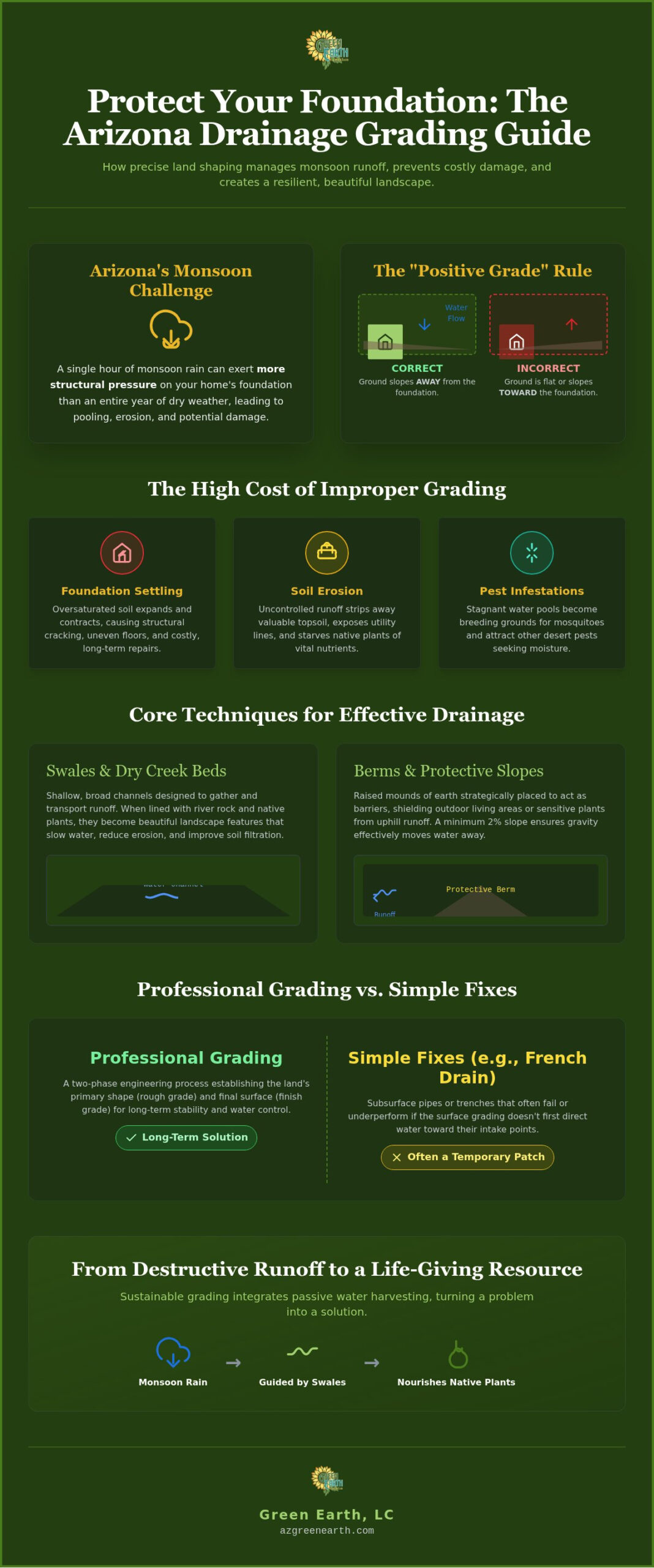
The cornerstone of this process is the “Positive Grade” rule. For a property to remain structurally sound, the ground must slope away from the foundation at a specific, consistent pitch. If the land is flat or, worse, slopes toward the stem wall, water will inevitably pool against the concrete. This constant moisture weakens the soil’s load-bearing capacity and leads to expensive structural issues that are difficult to reverse once they begin.
Our local climate makes this precision even more vital. Arizona monsoons deliver intense, high-volume rainfall in very short windows, often overwhelming standard landscapes. These sudden flash floods can move massive amounts of sediment and debris in minutes. Without professional drainage grading Arizona, your property lacks the “hydraulic highway” needed to evacuate this water safely before it can infiltrate your home’s perimeter or erode your yard.
Drainage grading is the essential precursor to any stable landscape construction.
The Risks of Improper Yard Grading
Neglecting the slope of your land creates a ripple effect of property damage. In our unique desert soils, improper grading often leads to several critical failures:
- Foundation Settling: Oversaturated soil expands and contracts, causing structural cracking and uneven floors.
- Soil Erosion: Rapid runoff strips away topsoil, which can expose buried utility lines or starve native vegetation of necessary nutrients.
- Pest Infestations: Stagnant water pools become primary breeding grounds for mosquitoes and attract other desert pests looking for moisture.
Grading vs. Simple Yard Drainage
Many homeowners believe a French drain is a universal fix for wet spots. However, a buried pipe often fails if the surface grading doesn’t first direct water toward the intake. Professional grading involves two distinct phases. Rough grading establishes the primary shape and “bones” of the land for major runoff control. Finish grading provides the final, smooth surface that prepares the area for pavers, plants, or decorative rock. While minor trenching might seem like a DIY weekend project, structural grading requires specialized equipment and an expert eye for elevation to ensure long-term stability.
Core Techniques for Effective Arizona Drainage Solutions
Mastering drainage grading Arizona requires a blend of heavy equipment precision and an artistic touch. We don’t just move dirt; we engineer the land to interact gracefully with the elements. By using a combination of natural diversion and structural barriers, a property can withstand the most aggressive monsoon season without losing its visual appeal. The primary goal is always to control the velocity and volume of water before it reaches your home’s foundation or sensitive outdoor living spaces.
Swales and Dry Creek Beds: Aesthetic Drainage
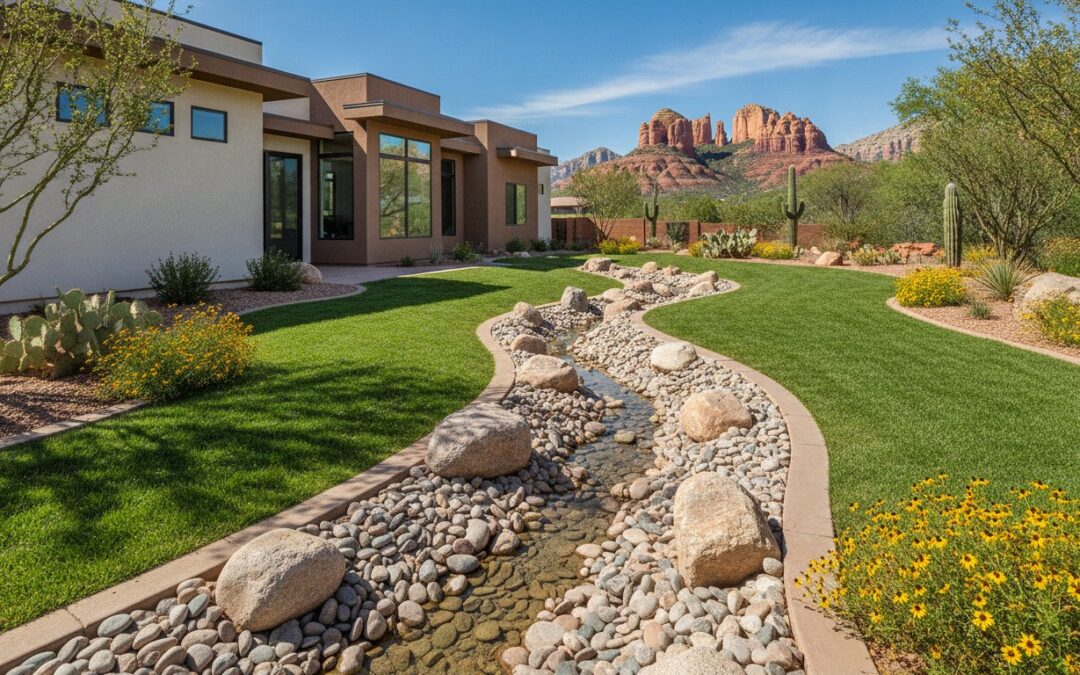
A swale is essentially a shallow, broad channel designed to gather and transport runoff. While purely functional, these don’t have to look like industrial ditches. We often design them as dry creek beds, lining the path with varying sizes of river rock and drought-tolerant native plants. This approach creates a beautiful feature during the dry months that transforms into a vital waterway during a storm. These are particularly effective yard drainage solutions Sedona residents prefer because they mirror the natural red rock washes found throughout the region. By slowing the water’s speed, swales also allow for better soil filtration and reduced erosion across the property.
Berms and Slopes: Directing the Flow
Berms are the opposite of swales; they are raised mounds of earth that act as protective barriers. We use these strategically to shield outdoor living areas like fire features or kitchens from uphill runoff. To ensure effectiveness, we typically calculate a slope percentage of at least 2% for residential lots. This provides enough pitch for gravity to take over without creating a steep, unstable hill. Integrating these features into your desert landscape design Northern Arizona ensures that your hardscape investments remain dry and secure. If you’re concerned about how water moves across your lot, a quick consultation for professional drainage grading can provide the clarity you need.
On larger Northern Arizona properties, we often implement retention or detention basins. These areas are designed to hold a specific volume of water, allowing it to slowly dissipate into the ground or evaporate rather than flooding neighboring lots. In the Verde Valley, successful grading also depends heavily on proper soil compaction. Because our soils can be deceptively loose or packed with caliche, we use specialized equipment to stabilize the earth. This prevents the newly graded slopes from slumping or washing away during their first encounter with a heavy desert downpour.
Comparing Surface Grading vs. Subsurface Systems
Choosing between surface-level land adjustments and underground infrastructure is a pivotal decision for any property owner. Surface drainage grading Arizona relies on the natural pull of gravity to move water across the landscape. It’s a low-maintenance, permanent solution because there are no pipes to clog or basins to clean. However, when a property has limited space or complex architectural features that prevent a natural slope, subsurface systems become necessary. These catch basins and buried pipes act as a secondary network to capture water in low spots and whisk it away to a safe discharge point.
The most resilient properties in the Verde Valley often utilize a hybrid approach. This strategy uses primary surface grading to manage the bulk of monsoon runoff while subsurface drains handle “hot spots” where water naturally congregates, such as enclosed courtyards or near downspouts. From a cost-benefit perspective, professional grading is a foundational investment. While the upfront effort is greater than a temporary patch, it prevents the cycle of repeated landscape repairs and protects the home from foundation settling that can cost tens of thousands of dollars to remediate. Investing in the land’s shape once is far more economical than fighting the same erosion battles every summer.
When Surface Grading is the Best Choice
Large residential lots and commercial developments benefit most from a gravity-first approach. It is particularly effective for HOA landscape maintenance Arizona boards looking to minimize long-term operational costs. Without mechanical pumps or plastic pipes to degrade in the intense desert sun, a well-graded surface remains functional for decades. It creates a self-sustaining system where water flows naturally toward exit points or retention areas without the need for frequent human intervention or mechanical repairs.
The Role of Retaining Walls in Drainage
In areas with dramatic elevation changes like Flagstaff or Sedona, simple grading isn’t always enough to hold the earth in place. This is where structural retaining wall installation Northern Arizona becomes essential. These walls do more than just hold back soil; they are sophisticated drainage tools. Every wall must include gravel backfill and “weep holes” to prevent hydrostatic pressure from building up behind the stone. Without these escape routes, the weight of trapped water could cause the entire structure to fail or shift during a heavy storm.
Regional Challenges: Sedona, Flagstaff, and the Verde Valley
Arizona’s diverse geography means that a drainage solution in the low desert won’t necessarily function in the high country. Effective drainage grading Arizona requires an intimate understanding of the local geology and climate patterns unique to each community. From the limestone-heavy soils of the Verde Valley to the volcanic peaks of Flagstaff, the land presents distinct obstacles that demand specialized engineering. We approach every project with the perspective of a neighbor who has navigated these terrains for over 47 years.
One of the most persistent hurdles in Northern Arizona is the “caliche factor.” Often referred to as “desert concrete,” this hardened layer of calcium carbonate creates a nearly impenetrable barrier just below the surface. When heavy rains hit, caliche prevents water from soaking into the ground, leading to rapid sheet flooding. Professional grading in these areas often requires heavy machinery to break through this layer. This ensures that water is directed away from foundations rather than sitting on top of an invisible shelf of stone.
Managing High-Altitude Drainage in Flagstaff
In higher elevations, the primary concern shifts from sudden monsoon bursts to the slow, relentless pressure of snowmelt. If runoff isn’t managed correctly, water can seep into small crevices and freeze, leading to destructive freeze-thaw cycles. This process causes “frost heaving” that can buckle driveways and crack stem walls. Proper landscaping Flagstaff AZ must prioritize runoff paths that keep moisture away from structural concrete during the long winter months. Establishing these paths early prevents ice dams from forming in critical drainage channels.
Sedona’s Unique Runoff Requirements
Sedona presents a different set of challenges with its non-porous red rock and steep slopes. Runoff here moves with incredible velocity, which can quickly carve deep gullies into the delicate landscape. To maintain aesthetic harmony, we utilize local stone and native boulders to armor these drainage channels. This approach ensures your property remains compliant with Sedona’s strict environmental codes while protecting the natural beauty of the land. It’s about creating a system that looks like it has always been part of the red rock vista.
If you’re noticing new gullies forming on your property or suspect caliche is causing water to pool, it’s time to act. Contact our expert team today to schedule a site evaluation and protect your Northern Arizona investment.
Sustainable Grading: The Green Earth, LC Approach
At Green Earth, LC, we view drainage grading Arizona as more than a structural necessity. It’s a design opportunity to enhance the ecological health of your property. With over 47 years of experience navigating the complex terrains of Northern Arizona, we’ve refined a methodology that respects the local environment while providing unshakeable foundation protection. Our approach moves beyond simple water diversion; we focus on water stewardship. By treating every drop of monsoon rain as a valuable resource, we create landscapes that are as resilient as they are beautiful.
Passive water harvesting is a core pillar of our sustainable strategy. Instead of simply channeling runoff into the street or a storm drain, we contour the land to direct water toward native planting zones. This technique turns a potentially destructive surge into a localized irrigation source, deeply hydrating the soil and supporting long-term plant health. Using local stone and permeable solutions ensures these features blend seamlessly with the natural Arizona vista. This commitment to craftsmanship ensures that your drainage system remains a functional asset for decades, provided it receives basic seasonal maintenance to clear debris from swales and basins.
Eco-Friendly Water Management
Professional grading significantly impacts your property’s microclimate and water needs. By integrating rain gardens into a professional grading plan, we filter pollutants and allow moisture to seep slowly into the earth. This sustainable design can reduce the frequency of supplemental irrigation repair Flagstaff by keeping native vegetation thriving on natural cycles. Additionally, smart landscape contouring helps mitigate the “heat island” effect by encouraging healthy plant growth that naturally cools your outdoor living areas.
Getting Started with Your Grading Project
Every successful project begins with a meticulous site assessment. Our team evaluates soil composition, existing elevation changes, and the specific drainage requirements of your local municipality. We take the stress out of the process by coordinating directly with civil engineers and city planners to ensure your project meets all 2026 building codes. This thorough preparation is the first step toward a sustainable outdoor living space that stands the test of time. When you’re ready to secure your property’s future, we are here to transform your landscape into a functional, eco-friendly masterpiece.
Secure Your Property’s Future Against the Elements
Professional drainage grading Arizona is the most effective way to safeguard your home’s foundation from the unpredictable intensity of our local climate. By addressing soil compaction, implementing natural swales, and respecting the unique geological hurdles of the Verde Valley, you are investing in a landscape that works in harmony with nature. Proper land contouring does more than just move water; it provides peace of mind that your structural assets remain dry and stable for decades to come.
As a locally owned and operated firm since 1979, Green Earth, LC brings 47+ years of Northern Arizona experience to every site assessment. We are eco-friendly and sustainable design specialists who understand how to balance modern engineering with the natural beauty of our region. Schedule your professional drainage assessment with Green Earth, LC today to begin transforming your property into a resilient, functional masterpiece. You don’t have to face the next monsoon season with uncertainty. With a professionally graded foundation in place, your home will be ready to handle whatever the Arizona sky delivers.
Frequently Asked Questions
How much does drainage grading cost in Arizona?
The investment for drainage grading varies significantly based on your lot size, the presence of hard caliche soil, and the complexity of the required engineering. Factors such as equipment access and the need for integrated retaining walls also play a role in determining the scope of work. Because every property in the Verde Valley has unique elevation challenges, a professional on-site assessment is the only way to receive an accurate estimate tailored to your specific terrain.
Can I fix my yard’s drainage issues myself?
While minor surface adjustments are possible for some homeowners, structural drainage grading Arizona requires specialized heavy equipment and laser-level precision. Improper DIY attempts often result in accidental negative grading that directs water toward the foundation rather than away from it. For projects involving structural protection or compliance with local building codes, professional intervention is necessary to prevent long-term foundation damage and costly repairs.
What is the difference between grading and a French drain?
Grading is a surface-level solution that reshapes the land to use gravity for water movement, while a French drain is a subsurface trench containing a perforated pipe and gravel. Grading is a permanent, low-maintenance approach that addresses the root cause of pooling. French drains are typically used as a secondary supplement in tight spaces where the land’s natural slope cannot be adjusted enough to move water effectively on its own.
Does poor grading affect my home’s resale value in Sedona?
Yes, inadequate drainage is a major red flag during real estate inspections and can lead to lower appraisal values or even cancelled sales. In Sedona, where monsoon runoff is intense, buyers prioritize properties with established water management systems. Evidence of soil erosion or moisture near the foundation suggests high future maintenance costs, making a professionally graded lot a significant selling point for savvy Northern Arizona buyers.
How do I know if my property has a ‘negative grade’?
You have a negative grade if the soil slopes toward your home’s foundation rather than away from it. You can identify this by watching where water collects during a heavy rain; if it pools against your stem wall, your grade is failing. Another method is to use a long level or string line to measure the elevation change over a ten-foot distance from your home to ensure the ground drops sufficiently.
Will grading my yard require a permit in Flagstaff or Prescott?
Permit requirements in Flagstaff and Prescott depend on the volume of earth being moved and the project’s proximity to property lines. Significant land disturbance or changes that affect how water enters the municipal storm system often require a grading and drainage permit. It’s essential to check with your local planning department or work with an experienced contractor who understands the specific Coconino and Yavapai county regulations for your area.
How often should I check my drainage swales for maintenance?
You should inspect your swales and dry creek beds at least twice a year, specifically before the summer monsoons and after the winter snowmelt. Look for accumulated debris, silt, or overgrown vegetation that could block the intended path of the water. Keeping these channels clear ensures your drainage grading Arizona remains fully functional and prevents water from backing up into areas where it could cause structural damage.
Can drainage grading be done without removing my existing trees?
Yes, we can design grading plans that protect the critical root zones of your mature trees while still effectively managing runoff. By using strategic swale placement and avoiding heavy soil buildup over root flares, we preserve the health of your existing canopy. Since mature trees provide natural soil stabilization and significant aesthetic value, protecting them is a top priority during the land-reshaping process on any Northern Arizona property.
Recent Comments