
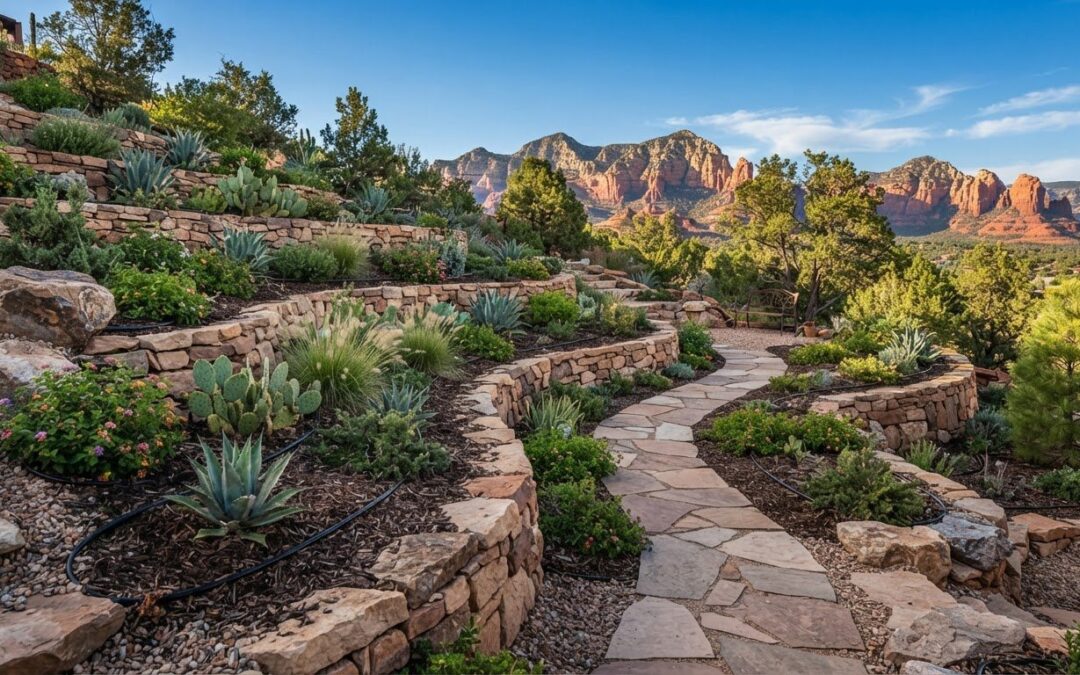
A sloped yard is shaped by water as much as by grade. To learn how to landscape a sloped yard, plan planting, terraces, drainage, and irrigation as one system. Choose plants suited to the slope’s sun and moisture, use terraces or retaining walls where the grade calls for stronger erosion control, and deliver water slowly with drip irrigation to limit runoff.
It’s natural to focus first on what to plant or where to create level space, but irrigation deserves equal attention. Water that runs off instead of soaking in can stress plants and worsen erosion. This guide explains how to assess the slope, place plants, choose between a planted hillside and terraces, and plan irrigation to support healthy growth. It also covers how paths and drainage fit into a practical, attractive landscape.
Key Takeaways
- Match plants to sunlight and moisture across the slope, and use spreading groundcover or well-placed stones to help hold soil in place.
- Use terraces and retaining walls to create usable level areas, while planning drainage to guide runoff safely away.
- Assess steepness and access before choosing paths or lawn areas; contour-following routes can make movement across the yard more manageable.
- Plan irrigation to soak soil gradually: drip systems deliver water close to plant roots and can help limit surface runoff.
1. Plant placement by sunlight and water needs
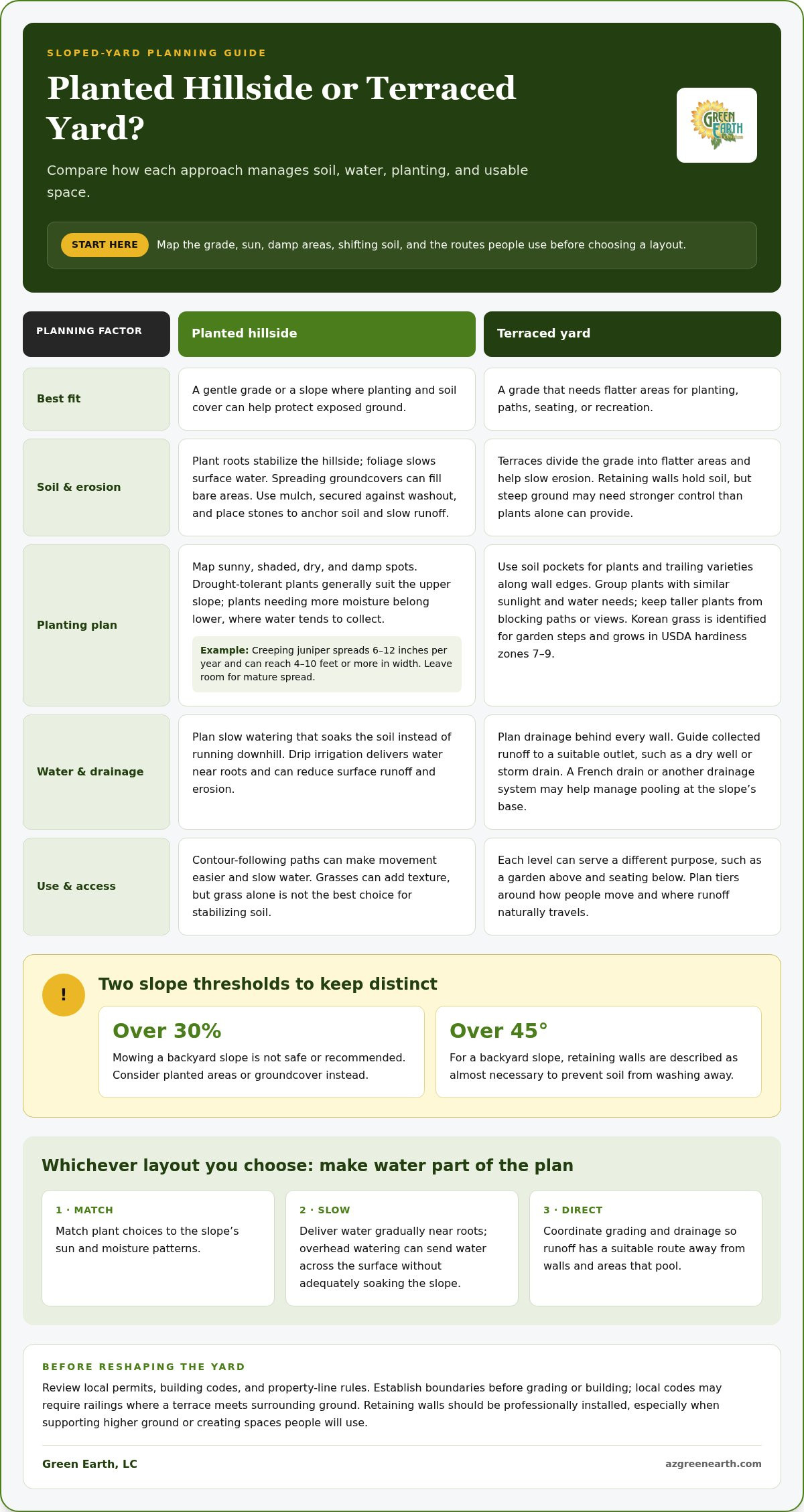
Start by mapping sunny, shaded, dry, and damp areas across the yard. Observe how sunlight shifts during the day, then choose plants suited to each spot. Drought-tolerant plants generally suit the upper slope, where soil dries sooner. Place plants that need more moisture lower down, where water tends to collect. Matching plant needs to existing moisture patterns can help reduce drainage problems caused by mismatched watering.
On a gentle grade, mulch, rocks, and plants can help protect exposed soil. Spread mulch to retain moisture and limit topsoil loss, securing it so rain does not wash it downhill. Place large stones or boulders to anchor soil, slow runoff, and create small planting pockets. On steeper ground, angular rocks are less likely to roll than smooth ones. Plant roots help stabilize the hillside, while foliage slows water moving over the surface.
For an unterraced slope, select hardy plants that establish quickly, tolerate changing soil moisture, and need little care after establishment. Native plants suited to local growing conditions can reduce erosion and may ease irrigation demands. Spreading groundcovers can fill bare areas; creeping juniper, for example, spreads 6 to 12 inches per year and can reach 4 to 10 feet or more in width. Allow room for that mature spread before planting. Grasses can add texture, but grass alone isn’t the best choice for stabilizing soil.
Planting can also soften retaining walls and create a living backdrop. Set plants in available soil pockets, then use trailing varieties along wall edges to visually connect the tiers. Keep taller plants from blocking paths or views, and group choices with similar sunlight and water needs for simpler care. Korean grass is identified for garden steps and grows in USDA hardiness zones 7 to 9. On a difficult slope, combine plants with stone features rather than relying on groundcover alone to hold the entire hillside.
2. Retaining walls and tiered yards
A retaining wall holds back soil and can create level ground in a sloped yard. Terracing divides the grade into flatter areas, helping slow erosion while making room for planting, seating, or recreation. Each terrace can serve a different purpose, such as a garden above and a seating area below. Plan the tiers around how people will move through the yard and where runoff naturally travels.
Drainage behind each retaining wall matters as much as its visible face. Without a way for water to move through or away from the structure, pressure can build and contribute to cracking or collapse. Direct collected runoff toward a suitable outlet, such as a dry well or storm drain. At the base of a slope, a French drain or another drainage system may help manage pooling. Coordinate these choices with the yard’s overall grading rather than treating each wall as a separate feature.
Steeper ground often needs stronger erosion control than plants alone can provide. For a backyard slope over 45 degrees, retaining walls are almost necessary to prevent soil from washing away. Wall design should account for the slope, soil, drainage, and intended use of each tier. Retaining walls on a sloped yard should be professionally installed, especially when they support higher ground or create spaces people will use. Flat areas between walls can become growing beds, paths, or outdoor living spaces.
Permits, building codes, and property-line rules depend on the local jurisdiction and the project’s location and design. Before grading or building, review local permitting and code requirements, and establish property boundaries so the work stays within your land. A grade change between a terrace and the surrounding ground may require railings under local building codes.
For a project involving both soil support and water movement, explore retaining wall and drainage grading work as a coordinated approach to the yard.
3. Assessing slope steepness, access, and budget
To decide how to landscape a sloped yard, first map the grade from the upper edge to the lowest point. Mark areas that stay damp, places where soil has shifted, and routes people use regularly. Note where equipment can enter and where materials can be staged. These details help show whether the project can focus on planting or needs more extensive grading, structural work, or access improvements.
Steepness shapes how the yard can be maintained. Mowing is not safe or recommended on a backyard slope greater than 30 percent, so consider planted areas or groundcover instead. A steep downward grade may suit a properly supported deck that creates level outdoor space. Its design needs to accommodate drainage and water runoff. Compare these options by the way they use the existing slope, not only by their appearance.
Plan paths around destinations such as a garden entrance, patio, or seating area. Routes that follow the slope’s contour, rather than run straight uphill, can make access easier and slow water movement. On steeper ground, switchbacks create a less direct route between levels. Walk the proposed route before finalizing it, and adjust turns where the terrain feels awkward or runoff crosses the path.
Set priorities by ranking work according to its purpose. Address soil movement and water flow before decorative details, then consider which improvements can be phased. Grading, drainage, planting, paths, and structures all affect the project’s scope. Site access, soil conditions, and the amount of ground being reshaped also influence the work involved. Knowing how to landscape a sloped yard means weighing these factors together so each phase supports the next and the finished space remains practical.
4. Planning irrigation on a slope
On sloping ground, irrigation should soak into the soil instead of racing downhill. Drip irrigation delivers water near plant roots and applies it gradually, helping water penetrate while reducing surface runoff and erosion. Overhead watering and sprinklers, by contrast, can send water across the surface without adequately soaking the slope. For outdoor spaces with mixed grades, plan water delivery around planting areas and the direction runoff naturally travels.
Divide a terraced garden into separate watering areas. A sunny upper terrace with drought-tolerant native plants has different needs from a lower bed that stays moist. Drip lines or soaker hoses can give each planting area a steady, low-volume supply. Consider groundcover and shrubs when placing emitters so water reaches their roots rather than bare soil between plants. Slow, targeted watering supports plant establishment without saturating one patch.
Before settling on a layout, observe how the soil responds to watering. If water pools at a terrace edge or runs toward a path, adjust where it is delivered and review the drainage route. Check whether the ground absorbs water evenly, then group plants with similar moisture needs along the same line. A landscape designer can use these observations to coordinate irrigation with planting beds, retaining features, and usable spaces.
Choose an irrigation system that suits both the plants and the slope. Drip irrigation, soaker hoses, and other low-volume systems can provide consistent moisture across planted areas. Where runoff collects, coordinate irrigation with drainage rather than adding water to an already wet spot. The key is to deliver water slowly at the root zone and organize each terrace around its plants’ moisture needs.
If a drip line or controller isn’t distributing water as intended, get help with irrigation drip system repair or controller troubleshooting.
Green Earth, LC: HOA Landscape Maintenance
Green Earth, LC provides HOA Landscape Maintenance for communities managing shared outdoor spaces, including sloped planting areas and established landscapes. When an HOA needs ongoing care for common grounds, this service helps maintain the property as plants grow and seasonal needs change.
For irrigation concerns, Green Earth, LC offers Irrigation Drip System Repair and Irrigation Controller Troubleshooting. These services can help when drip lines or controllers aren’t delivering water as intended across planted areas. Commercial properties can also use Commercial Landscape Maintenance, while Firewise Defensible Space supports landscape care focused on defensible space.
Contact Green Earth, LC to discuss landscape maintenance or irrigation needs for your property.
Shape Your Slope Into a Lasting Outdoor Space
The next step is to turn your ideas into a plan that fits the land and how you want to use it. Knowing how to landscape a sloped yard is only part of the process; choosing an approach that can be maintained over time matters just as much. Consider how the finished space will serve residents, visitors, or daily property needs, then make choices that support its long-term care.
Green Earth, LC provides HOA Landscape Maintenance and Commercial Landscape Maintenance for shared and commercial grounds, along with Firewise Defensible Space. These services support property owners and managers maintaining outdoor areas with care and purpose.
To discuss your landscape needs, contact Green Earth, LC. A well-planned slope can become a more useful, welcoming part of your property.
Frequently Asked Questions
How do you assess the slope, soil, drainage, and sun before landscaping a sloped yard?
Walk the property and record how conditions change from the upper edge to the lowest point. Sketch sunny and shaded areas, note where water flows after rain, and look for exposed roots, soft patches, or standing water. Check the soil by hand: sandy soil feels gritty, while clay tends to clump when damp. These observations help shape a plan for a specific site in Sedona, Camp Verde, Cottonwood, Flagstaff, or Prescott.
What are the best landscaping ideas for a steep or gently sloped yard?
The best approach depends on the grade and how you want to use the space. A gentle slope can support a layered garden with groundcover, stepping areas, and planted borders. A steeper yard may work better with distinct terraces, garden steps, or a raised bed that creates a defined growing area. Choose features that suit the site’s access and maintenance needs instead of adding level spaces that disrupt the yard’s natural flow.
How do you prevent soil erosion on a sloped yard with plants, mulch, or ground covers?
Cover bare soil promptly, then combine rooted plants with mulch or stones to protect vulnerable areas. Choose spreading groundcover for open patches, and position mulch so it stays in place during rain. Landscape fabric may help on gentle or moderate slopes, but it can break down, compact soil, and interfere with root growth over time. For persistent washouts, identify where runoff enters and exits before adding more plants.
How do you build a retaining wall on a slope, and when is professional engineering required?
Assess the soil, wall location, retained grade, and drainage route, then design the footing and wall structure for those conditions. Proper drainage behind the wall helps reduce water pressure that can contribute to failure. Professional installation is important on sloped ground. Engineering input is especially relevant when a wall supports significant soil, sits near a structure, or forms part of a complex terraced design.
What are the costs of landscaping a sloped yard, including grading, retaining walls, and drainage?
Project scope depends on the amount of grading, wall design, drainage requirements, materials, site access, and work needed to prepare the ground. A planting-focused project differs from one that reshapes the slope and adds structural features. Green Earth, LC provides project pricing after a quote request, based on the specific scope. Retaining Walls and Drainage Grading address structural support and water movement.
How do you install steps, pathways, or switchback trails on a sloped yard safely?
Plan the route around stable ground and the places people need to reach, such as a patio or garden entrance. Use a walking surface with dependable traction, secure each step against movement, and avoid directing water across the path. Switchbacks can make a steep route less direct. Keep edges visible and transitions between steps and landings clear, especially where shade or irrigation may leave surfaces damp.
Recent Comments