
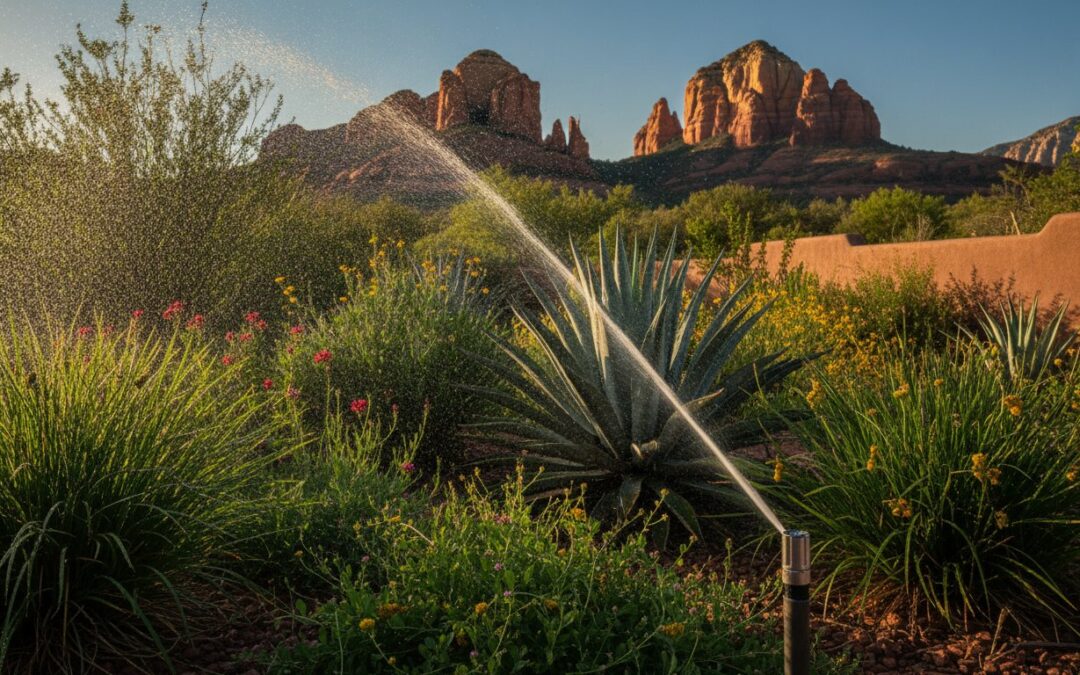
Did you know that over 50% of the water used for Arizona landscapes is wasted before it ever reaches a root? It’s frustrating to watch your Sedona or Cottonwood garden struggle while your monthly utility bills continue to climb. You’ve likely invested significant time into your property, only to find that undetected leaks or mineral buildup are undermining your efforts. Our unique climate and “very hard” water, often measuring 10 grains per gallon or higher, make maintenance a constant battle. Effective sprinkler system repair Verde Valley landscapes require involves more than just patching leaks. It’s about re-engineering your system to survive these extreme conditions.
This guide will show you how to master your irrigation by addressing the specific challenges of our region. We’ll identify common failure points, from caliche-impacted pipes to clogged emitters, and offer professional solutions that prioritize long-term efficiency. You’ll discover how to troubleshoot your drip lines, optimize your controller settings, and implement sustainable strategies that restore your landscape’s health while lowering your monthly expenses. By the end, you’ll have a clear roadmap to a more resilient, water-wise desert oasis.
Key Takeaways
- Learn to distinguish between obvious surface “geysers” and the subtle underground leaks that silently drive up your monthly utility costs.
- Gain insights into how the Verde Valley’s high mineral content and caliche soil require specific maintenance strategies to prevent permanent equipment clogs.
- Explore why professional sprinkler system repair Verde Valley services are essential for troubleshooting complex drip irrigation failures caused by local wildlife and pressure changes.
- Discover how to properly adjust your irrigation controller for the Arizona Monsoon and prepare your pipes for Northern Arizona’s seasonal winter freezes.
- Understand the long-term benefits of partnering with established experts for specialized HOA and commercial irrigation management across Sedona and Cottonwood.
Common Signs You Need Sprinkler System Repair in the Verde Valley
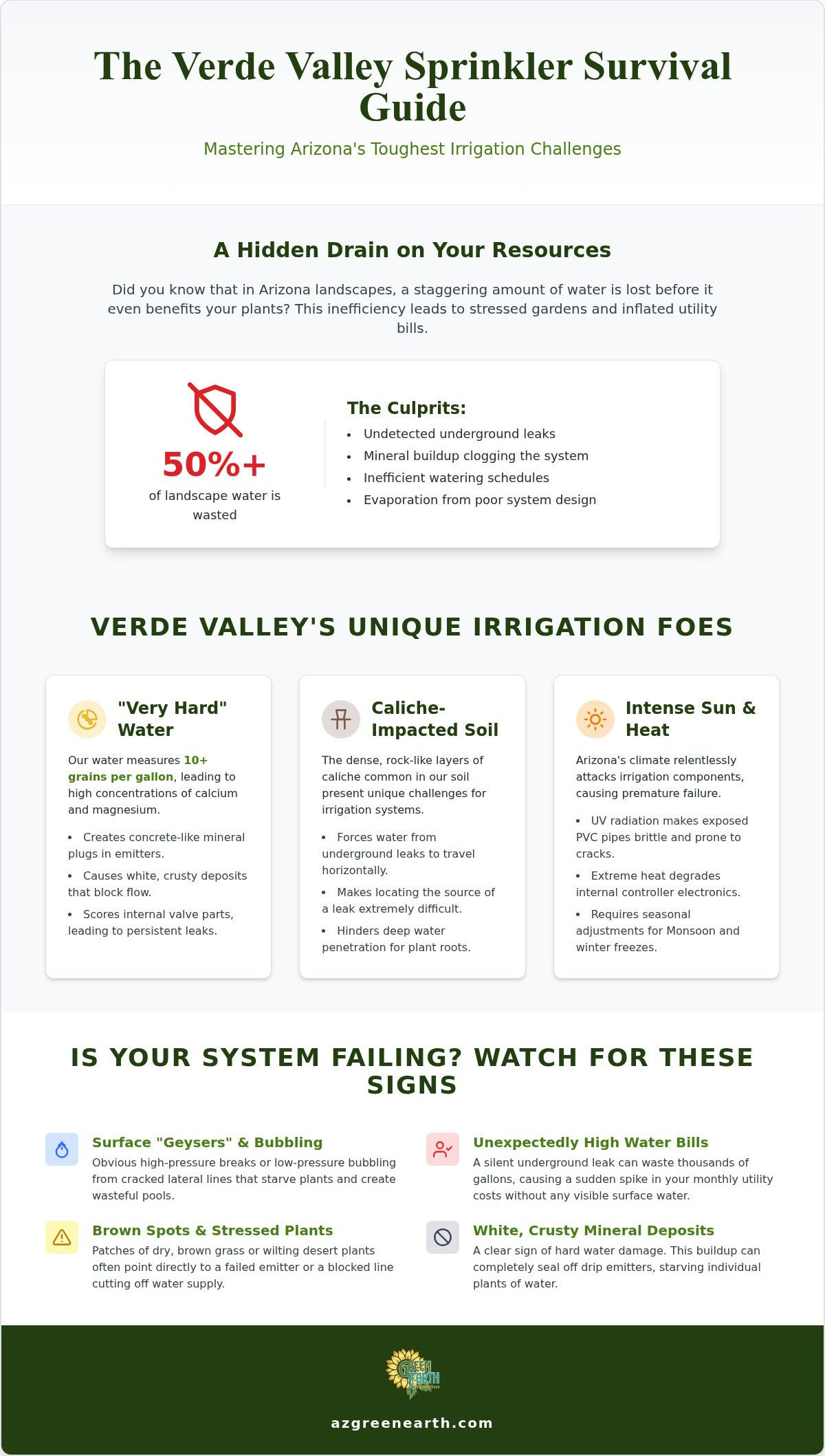
Identifying irrigation failure in the Verde Valley requires a keen eye for both the dramatic and the subtle. While a “geyser” shooting high into the air is an unmistakable sign you need sprinkler system repair Verde Valley homeowners often face, low-pressure bubbling is equally destructive. This bubbling usually indicates a cracked lateral line or a clogged head, which starves your plants of necessary hydration while saturating the soil in a localized, wasteful pool. Modern Irrigation sprinkler systems are designed for precision, but mechanical wear and environmental stress eventually take their toll on even the most robust designs.
If your water bill spikes unexpectedly during the summer months, don’t just blame the heat. A hidden underground leak can waste thousands of gallons before it ever reaches the surface. Since our soil often contains caliche, water may travel horizontally along rock layers rather than surfacing directly above the break. This makes these leaks particularly difficult to locate without professional diagnostic equipment. Similarly, brown spots in your desert zones might not be a sign of a dying plant. Instead, they often point to a failed emitter or a blocked line that has quietly cut off the water supply to that specific area.
Visual Cues in Desert Landscaping
Your plants are often the first to signal a system failure. Desert-adapted species like agave and yucca are highly susceptible to “wet feet” if a valve fails to close properly, leading to root rot in what should be dry soil. You should also inspect your drip emitters for white, crusty deposits. This salt and mineral buildup is a hallmark of the Verde Valley’s hard water, which can completely seal off an emitter over time. Additionally, look for sun-bleached or warped PVC pipes. The intense Arizona UV radiation makes exposed plastic brittle, leading to hairline fractures that eventually burst under pressure.
Diagnostic Tools for Irrigation Troubleshooting
Professional sprinkler system repair Verde Valley specialists use several techniques to detect these issues early. You can perform a basic audit of your system using simple diagnostic steps. First, turn off all water inside your home and check your water meter. If the leak indicator is spinning, you likely have a silent underground break. For electronic issues, we focus on irrigation controller troubleshooting to identify wire faults or solenoid failures. The extreme Arizona heat often causes the internal components of older controllers to degrade, resulting in zone faults or erratic watering schedules that ignore your programmed settings. Testing the electrical continuity of your valves can confirm whether the issue is a simple wire repair or a more complex electronic failure.
The Impact of Verde Valley’s Hard Water and Soil on Irrigation Systems
Hard water in Arizona is among the most severe in the nation. It often measures 10 grains per gallon or higher, which is classified as “very hard” by industry standards. This high concentration of calcium and magnesium is the primary reason why Verde Valley’s hard water is so destructive to landscape infrastructure. As water evaporates at the emitter tip, it leaves behind solid mineral deposits. Over time, these crystals fuse together, creating a concrete-like plug that standard cleaning cannot remove. This is why sprinkler system repair Verde Valley specialists prioritize high-quality filtration and components over cheap, temporary fixes. Without a robust filtration system, these minerals eventually migrate into the valves, where they can score the internal diaphragms and cause persistent, costly leaks.
Combating Mineral Buildup
Many homeowners turn to big-box stores for replacement parts, but these mass-produced emitters often fail within a single season. They lack the internal diaphragm strength to resist mineral scale. In the hilly terrain surrounding Sedona, we recommend pressure-compensating emitters. These specialized components maintain a consistent flow rate regardless of elevation changes. They also feature a self-flushing mechanism that helps clear small particles before they can bond to the plastic. Regular valve maintenance is also critical. If you notice a zone won’t turn off, it’s likely that mineral grit has compromised the internal seal. If you’re seeing these issues, our experts can help with irrigation drip system repair to restore your system’s integrity.
Soil Conditions and Trenching Challenges
The geography of Cottonwood and Camp Verde presents unique physical obstacles. The presence of caliche, a rock-like layer of calcium carbonate, makes traditional trenching incredibly difficult. This hardened soil requires specialized equipment and a deep understanding of local geology to avoid damaging existing lines. Soil composition also dictates how your pipes behave. The clay-heavy soils in certain parts of the valley expand and contract significantly with moisture changes. This movement puts immense stress on PVC joints, often leading to hairline fractures. In rocky areas, “point loading” occurs when a sharp stone presses against a pipe under the weight of the soil, eventually causing a puncture. To prevent future breaks, we utilize flexible swing joints and sustainable drainage grading. This approach manages runoff effectively and protects the structural health of your underground network.
Troubleshooting High Water Bills: Drip Irrigation vs. Sprinkler Heads
When water bills skyrocket, identifying the source of waste depends heavily on your system type. Traditional sprinkler heads often suffer from surface-level inefficiencies, while drip systems hide their failures beneath mulch or soil. Understanding these differences is the first step toward the effective sprinkler system repair Verde Valley property owners need to maintain a sustainable landscape. Industry data indicates that outdoor watering accounts for nearly 30% of household consumption. Unfortunately, over 50% of that is often wasted due to poor system efficiency or undetected failures. While traditional sprinklers are roughly 60% to 70% efficient, a well-maintained drip system can reach 90% efficiency by delivering water directly to the root zone.
Traditional spray heads lose significant volume to surface evaporation and wind drift, especially during dry afternoons in Sedona or Cottonwood. You might notice overspray on sidewalks or “mist” blowing away before it hits the grass. Conversely, drip irrigation is highly efficient but faces unique vulnerabilities. Local rodents often chew through poly-tubing in search of moisture, creating small, persistent leaks that are difficult to spot. Emitters can also “pop off” if the system pressure isn’t regulated, leading to localized flooding that bypasses the plant entirely. Calculating the ROI of switching to high-efficiency drip systems often reveals that the water savings pay for the repair costs within a few seasons.
Drip Irrigation Repair and Maintenance
Maintaining a drip system requires a focus on pressure and filtration. Punctured poly-tubing or micro-lines can be patched with couplers, but frequent failures suggest it’s time for a more durable line upgrade. We recommend switching to self-flushing emitters to combat the hard water mineral buildup discussed in previous sections. These components are specifically designed to clear small particles before they can bond to the plastic. Proper pressure regulation is also vital. Without a dedicated regulator, the delicate connections in a drip zone will eventually fail under the strain of standard municipal water pressure, leading to blown emitters and wasted water.
Sprinkler Head and Valve Restoration
For turf areas, replacing outdated spray heads with high-efficiency rotary nozzles can reduce water use by 30% to 40%. These nozzles deliver larger water droplets that resist wind drift and soak into the soil more effectively. Troubleshooting also involves checking for “weeping” heads, which indicate a valve that isn’t sealing properly due to debris or a worn diaphragm. Beyond efficiency, we ensure your system meets safety standards by inspecting backflow prevention devices. This protects our local water supply from potential contamination, a critical responsibility for every property owner in the Verde Valley landscape.
Sustainable Irrigation Maintenance: Protecting Your Desert Landscape
Sustainability in the high desert requires more than just reactive fixes. Our 47 years of history in Northern Arizona has proven that the most resilient landscapes are those managed with seasonal precision. Professional sprinkler system repair Verde Valley services often start with a proactive maintenance schedule rather than an emergency repair. By anticipating the shifting needs of your plants, you can reduce water waste and prevent the mechanical failures discussed in previous sections. This methodical approach ensures your irrigation infrastructure remains an asset rather than a liability.
The Arizona Monsoon season introduces significant humidity and localized rainfall. During this time, it’s vital to scale back irrigation to prevent fungal growth and root rot. Conversely, the transition from spring to the peak summer heat requires a gradual increase in volume to combat higher evaporation rates. Mulch plays a critical role here. A three-inch layer of organic mulch can significantly reduce soil moisture loss, allowing you to water less frequently while keeping root temperatures stable. This simple addition acts as a protective barrier against the intense Sedona sun.
While we focus on heat, Northern Arizona winters bring freezing temperatures that can shatter exposed backflow assemblies and PVC lines. Proper winterization involves draining these vulnerable components and insulating main lines to avoid the pipe fractures common in our region. If you need help preparing your system for the changing seasons, our team offers comprehensive irrigation controller troubleshooting to keep your landscape thriving year-round.
Seasonal Controller Adjustments
Many homeowners set their timers in March and forget them, but this leads to significant waste. Transitioning from spring growth to summer peak heat requires shifting to deep, infrequent watering cycles. This practice encourages roots to grow deeper into the soil where moisture is more consistent and protected from surface heat. Integrating smart controllers with local weather data can automate these adjustments, ensuring your sprinkler system repair Verde Valley investment is protected by a system that reacts to real-time rainfall and temperature shifts.
Long-term System Audits
Annual audits are the backbone of a healthy landscape. We perform pressure testing to ensure your zones aren’t over-stressed and evaluate each emitter’s output for consistency. It’s common for mature plant growth to obstruct sprinkler patterns over time, creating dry “shadows” where water cannot reach. Evapotranspiration is the sum of evaporation from the land surface plus transpiration from plants. Monitoring this rate allows us to calculate exactly how much water your specific landscape requires based on daily atmospheric conditions in the Verde Valley, preventing both over-watering and plant stress.
Professional Irrigation Services in Sedona, Cottonwood, and Camp Verde
Selecting a partner for sprinkler system repair Verde Valley property owners can trust involves looking beyond a quick fix. Since 1979, Green Earth, LC has operated with a deep commitment to the ecological health of Northern Arizona. Our 47-year history isn’t just a mark of longevity. It represents decades of refined knowledge regarding the specific challenges discussed in this article, from caliche-impacted soil to mineral-heavy water. We’ve seen how systems fail over decades and have developed repair strategies that prioritize durability and water conservation. This local heritage allows us to act as a visionary partner for your property, transforming a failing irrigation setup into a high-performance asset.
Commercial and HOA Irrigation Solutions
Large-scale properties face high stakes when irrigation systems fail. A single undetected leak in a multi-zone HOA common area can drain thousands of dollars from a budget in a single billing cycle. We specialize in managing these complex water budgets by providing methodical oversight and technical precision. Our team is equipped to handle the intricate wiring and valve configurations found in expansive commercial developments. For board members looking to balance aesthetics with fiscal responsibility, our guide on HOA landscape maintenance Arizona offers essential resources for long-term planning. We ensure that every repair aligns with the broader goals of the community, maintaining vibrant greenery without compromising environmental integrity.
The Green Earth Advantage
Our service area extends across the entire region, providing the expert sprinkler system repair Verde Valley residents need from Sedona to Cottonwood and Camp Verde, reaching up into Prescott. We don’t believe in one-size-fits-all solutions. Instead, we integrate smart technology with our commitment to desert landscape design Northern Arizona to create outdoor spaces that are both beautiful and efficient. This approach saves water and lowers monthly costs while enhancing the natural beauty of the desert. If your current system is showing signs of age or inefficiency, booking a professional irrigation audit is the first step toward restoration. We’ll evaluate your pressure, check for hidden leaks, and provide a roadmap for a more sustainable future. Contact us today to secure the health of your landscape for the next generation.
Secure Your Landscape’s Health with Expert Irrigation Care
Maintaining a vibrant desert landscape requires a balance between technical precision and environmental stewardship. Throughout this guide, we’ve explored how identifying subtle leaks and combating the persistent mineral buildup from our hard water can prevent catastrophic system failures. By prioritizing seasonal adjustments and high-efficiency components, you protect both your property’s aesthetic value and your monthly budget. Expert sprinkler system repair Verde Valley isn’t just about a quick fix; it’s about building a resilient infrastructure that thrives in our unique Northern Arizona climate.
Green Earth, LC brings 47+ years of local experience to every project. As award-winning sustainable landscape designers and certified irrigation troubleshooting specialists, we understand the nuances of Sedona and Cottonwood soil conditions better than anyone else. Don’t let undetected leaks or outdated controllers drain your resources. Schedule your professional irrigation audit with Green Earth, LC today to ensure your outdoor space remains a beautiful, water-wise sanctuary for years to come. Your landscape is an investment in the local environment, and with the right care, it’ll continue to flourish.
Frequently Asked Questions
How much does sprinkler system repair cost in the Verde Valley?
Industry averages for most irrigation repairs typically range between $75 and $400 per service visit. A standard service call in Arizona often starts at approximately $60. Specific components like broken sprinkler heads usually cost between $60 and $150 to replace. If you’re dealing with a faulty valve, expect to pay between $80 and $300. These figures represent regional market trends and vary based on the failure’s complexity and the specific hardware required.
Why is my drip irrigation system making a whistling sound?
A whistling sound usually indicates that your water pressure is too high or air is trapped within the lines. Drip systems are designed to operate at low pressures, typically under 30 PSI. If the pressure regulator fails, water forcing through small emitters creates a high-pitched vibration. You should also check for mineral scaling in the emitter’s internal diaphragm. High-velocity water passing through these narrow obstructions often produces audible noise before the component fails completely.
Can I repair a broken sprinkler pipe myself in Arizona soil?
While homeowners can perform basic repairs, the presence of caliche in our local soil makes digging exceptionally difficult. This rock-like layer of calcium carbonate often requires specialized power tools to reach deep lateral lines. If you attempt a DIY fix, ensure you use the correct primer and cement for our extreme temperature swings. Improperly bonded joints frequently fail during the summer heat. Many residents find that professional sprinkler system repair Verde Valley services save significant time.
How often should I check my irrigation system for leaks in Sedona?
You should perform a visual inspection of your entire system at least once a month. In Sedona’s arid climate, small leaks can quickly escalate into expensive water waste. Look for unusually green patches of weeds or damp spots in your rock mulch. Check your water meter’s leak indicator while all indoor faucets are off. Regular audits are especially important during the transition into the monsoon season when humidity and soil expansion stress older joints.
What is the best type of sprinkler head for hard water areas?
High-efficiency rotary nozzles are the superior choice for areas with high mineral content. These nozzles produce larger, wind-resistant droplets and have fewer small apertures that can clog with calcium deposits. Unlike traditional spray heads, rotary models use multiple rotating streams that are less prone to sticking due to scale buildup. These components can improve your system’s efficiency by 30% to 40% while resisting the very hard water common throughout the Verde Valley region.
Do I need to winterize my sprinkler system in Cottonwood or Camp Verde?
Yes, winterization is essential for protecting your investment from freezing temperatures. While the Verde Valley is warmer than Flagstaff, Cottonwood and Camp Verde still experience multiple hard freezes each winter. You must drain your backflow assembly and insulate any exposed main lines. Failure to do so can lead to expanded ice shattering your valves or cracking PVC pipes. Taking these steps in late autumn prevents the need for costly emergency repairs when you restart the system.
Why are my plants dying even though the irrigation is running?
Plants often struggle due to either “wet feet” from overwatering or localized failure of specific emitters. If a valve fails to close, the soil remains saturated, which starves the roots of oxygen and leads to rot. Conversely, mineral buildup can completely block a drip emitter while the rest of the zone appears functional. You should check the soil moisture directly at the root ball. Consistent sprinkler system repair Verde Valley ensures that every plant receives water.
What are the Yavapai County regulations for backflow prevention?
Yavapai County requires that all irrigation systems connected to a public water supply have an approved backflow prevention assembly. This device prevents contaminated irrigation water from siphoning back into the clean drinking water system. Most local water providers require these assemblies to be tested annually by a certified professional to ensure they’re functioning correctly. Maintaining a functional backflow device is a legal responsibility for property owners and is a critical component of a safe, managed system.
Recent Comments