
The most effective commercial landscape maintenance contracts function more as comprehensive risk-management tools than simple service checklists. You likely understand the frustration of opening a monthly statement only to find unexpected irrigation repair fees, or the stress of realizing a crew hasn’t cleared the walkways before a major tenant event. It’s exhausting to juggle the aesthetic demands of your property while worrying about evolving Firewise regulations and local water-use restrictions in regions like Sedona or Flagstaff.
We’ve spent over 47 years helping property managers in Northern Arizona navigate these exact challenges, and we know that a well-structured agreement is the foundation of a thriving site. This guide will teach you how to master the essentials of your landscaping agreements so you can protect your property value and manage your budget with total confidence. We’ll examine the critical components of a modern contract, from proactive drainage grading to irrigation troubleshooting, that turn your landscape from a potential liability into a high-performing asset.
Key Takeaways
- Learn why a precise Scope of Work (SOW) is the most critical element of commercial landscape maintenance contracts to prevent billing surprises and service gaps.
- Identify the core differences between standard residential upkeep and high-level commercial agreements, including necessary insurance coverage and specialized site requirements.
- Discover how to tailor your contract for Northern Arizona’s unique climate by prioritizing local Firewise compliance and efficient irrigation management.
- Master the process of evaluating maintenance proposals to avoid the “low-bid trap” that often leads to property neglect and higher long-term repair costs.
- Understand how partnering with a visionary expert can transform your landscape into a sustainable, high-value asset that consistently attracts premium tenants.
What is a Commercial Landscape Maintenance Contract?
A commercial landscape maintenance contract is a legally binding agreement between a property owner or manager and a professional landscaping firm. Unlike simple residential work, these agreements outline a structured schedule for recurring upkeep, ensuring that every square foot of your property remains safe, compliant, and aesthetically pleasing. These documents serve as the definitive roadmap for your site’s health, establishing clear expectations for both parties while protecting the long-term value of the real estate.
The core difference between commercial and residential agreements lies in the level of detail and the scope of liability. Commercial properties face higher foot traffic, stricter municipal codes, and more complex environmental demands. Consequently, commercial landscape maintenance contracts require significantly higher insurance coverage and more exhaustive scopes of work. At Green Earth, LC, we view ourselves as a visionary partner rather than a vendor. This mindset shifts the focus from basic tasks to long-term asset management. A well-structured contract reduces property manager stress and prevents the tenant complaints that arise from inconsistent service or neglected grounds.
Contract vs. Service Agreement: Know the Difference
It’s vital to distinguish between a one-time service agreement and a comprehensive maintenance contract. A service agreement usually covers a specific, isolated project, such as installing retaining walls or addressing a drainage grading issue. In contrast, maintenance contracts focus on the continuity of care. Relying on verbal agreements or informal “handshake deals” represents a massive liability risk for HOA boards and commercial entities. Without a written contract, you lose the power to enforce property standards and lack a clear trail of accountability when expectations aren’t met.
The ROI of Professional Maintenance
Investing in a high-tier maintenance plan pays dividends through increased property value and tenant retention. Curb appeal isn’t just about aesthetics; it directly influences commercial lease rates. A pristine exterior signals to prospective clients that the property is managed with precision and care. This professional image starts at the curb and extends to every corner of the lot.
Strategic upkeep also prevents the high costs of reactive repairs. Proactive irrigation drip system repair and regular irrigation controller troubleshooting can save thousands of dollars in water waste and plant loss. Beyond the financial benefits, these contracts mitigate liability. By ensuring consistent sidewalk clearance and adhering to local Firewise defensible space standards in Sedona and Flagstaff, you protect your organization from trip-and-fall lawsuits and wildfire risks.
Essential Components of a Professional Maintenance Agreement
A robust contract acts as a safeguard for your investment. It translates vague expectations into measurable outcomes. When drafting or reviewing commercial landscape maintenance contracts, several non-negotiable elements must be present to ensure clarity and professional accountability. These components protect your property from neglect and shield your organization from legal and financial risks.
Defining the Scope of Work (SOW)
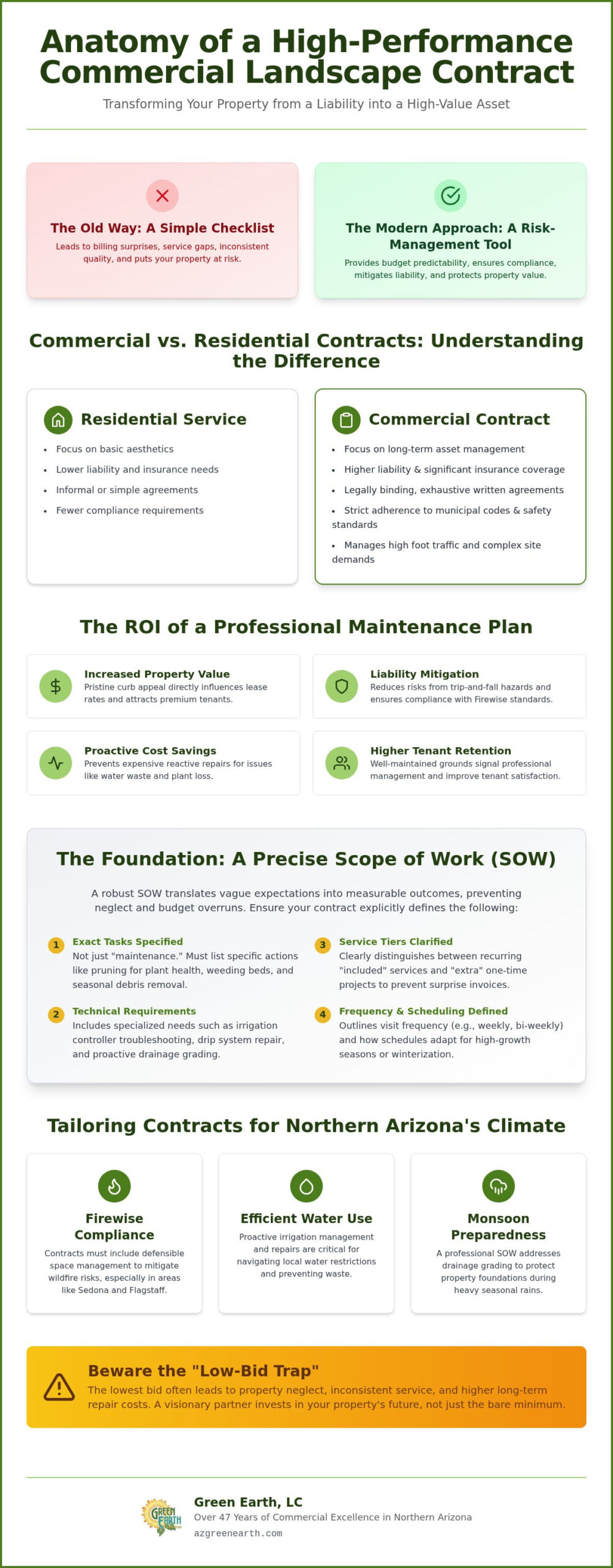
The SOW is the foundation of the entire partnership. It shouldn’t just list “maintenance” as a broad category. Instead, it needs to specify exact tasks: pruning shrubs for plant health, weeding garden beds, and seasonal debris removal. It should also address technical requirements like irrigation monitoring and drainage grading Arizona properties specifically require during the monsoon season. A professional contract clearly distinguishes between “included” recurring tasks and “extra” one-time services. This distinction prevents surprise invoices and ensures your budget remains predictable.
Frequency and scheduling are equally vital. Your agreement should define whether the crew will be on-site weekly or bi-weekly. It should also outline how the schedule shifts during different times of the year, such as increased visits during the high-growth spring months or specialized winterization steps. Clear scheduling allows you to plan tenant events or customer promotions without worrying about the noise of power equipment or the presence of green waste.
Liability is a major concern in any commercial setting. The contract must verify that the contractor carries adequate general liability and workers’ compensation insurance. Indemnification clauses are essential to protect the property owner from legal fallout if an accident happens during service. Without these protections, a simple maintenance visit could turn into a significant legal headache.
Performance Standards and Reporting
How do you measure “good” landscaping? Professional agreements set measurable goals for plant health, turf color, and overall property cleanliness. High-standard firms provide digital reporting after each visit, often including photos of completed work or flagged issues. This level of transparency is essential for modern property management. For instance, proactive reporting on irrigation controller troubleshooting can catch a leak before it impacts your water bill or damages your hardscape.
A clean exit strategy is just as important as the service itself. Termination clauses should allow for a 30-day notice if performance standards aren’t met. Finally, clear billing and payment terms ensure you know exactly when monthly fees are due. Mastering the details of commercial landscape maintenance contracts ensures your property remains a safe, attractive asset year-round. If you’re looking for a partner who prioritizes this level of transparency, our team specializes in detailed, professional maintenance agreements.
Navigating Regional Challenges: Water, Fire, and Climate
Standardized national agreements often overlook the brutal realities of the High Desert and the Mogollon Rim. In regions like Sedona and Flagstaff, a generic approach to landscaping doesn’t just lead to dead plants; it creates significant financial and legal risks. Effective commercial landscape maintenance contracts in Northern Arizona must be tailored to address extreme temperature swings, intense UV exposure, and highly specific seasonal weather patterns. Without these regional considerations, property managers often find themselves paying for services that don’t align with the actual needs of their land.
Water management stands as the most critical contractual priority for any Arizona property. As water rates continue to rise and conservation mandates become stricter, your agreement should move beyond simple “mow and blow” tasks. It needs to emphasize precision irrigation. Managing the high cost of desert irrigation requires a partner who understands how to balance plant health with aggressive water-saving goals. This expertise ensures your site remains lush without inflating your utility budget.
Irrigation Maintenance and Water Efficiency
A reliable contract must treat water systems as dynamic assets that require constant attention. Including irrigation repair Flagstaff professionals provide as a recurring line item prevents small leaks from becoming catastrophic failures. High-altitude landscapes and desert sites alike depend on meticulously managed drip systems. These systems require regular calibration to ensure plant survival during intense summer heatwaves. Transitioning to water-wise landscaping isn’t just an environmental choice; it’s a strategic move that reduces long-term maintenance costs and minimizes the need for expensive, high-water-use turf.
Firewise Defensible Space for Commercial Properties
Wildfire safety is a non-negotiable aspect of property management in the Verde Valley. Your contract should explicitly outline adherence to firewise landscaping Cottonwood AZ standards to protect your buildings and occupants. This includes mandatory requirements for clearing dry brush, thinning dense vegetation, and maintaining defensible zones around structures. For multi-family complexes and HOA assets, strategic plant placement and consistent pruning are essential tools for mitigating fire hazards. By codifying these safety measures into your maintenance agreement, you ensure your property doesn’t become a wildfire liability.
Monsoon season preparation represents another vital regional layer. Before the heavy rains arrive, your maintenance crew should focus on clearing debris from drainage channels and inspecting existing grading. Proactive attention to these areas prevents the erosion and flooding that can damage foundations and parking lots. When commercial landscape maintenance contracts account for these specific Arizona challenges, they provide a level of security that generic agreements simply cannot match.
How to Evaluate and Compare Maintenance Proposals
Evaluating commercial landscape maintenance contracts requires a discerning eye that looks far beyond the bottom line. While a low bid is initially attractive, it often signals a “Low-Bid Trap.” This occurs when a contractor underquotes to win the job but lacks the resources or expertise to provide consistent care. The result is a cycle of neglected turf, dying plants, and mounting repair bills that far exceed the original savings. You aren’t just buying a service; you’re investing in the long-term health of your property’s exterior assets.
Instead of focusing solely on price, prioritize local expertise and operational capacity. A firm with 47 years of experience in the Verde Valley understands the nuances of our regional terrain better than a national provider. Look for sustainable certifications that demonstrate a commitment to environmental health and innovation. When reviewing references, ask current HOA or commercial clients about the contractor’s responsiveness to irrigation emergencies and their ability to scale their equipment for larger sites. Ensure the company has the crew size necessary to handle your property’s specific demands without compromising quality.
Red Flags in Commercial Proposals
Vague language is the primary enemy of a successful contract. If a proposal uses terms like “as needed” or “periodically” instead of defining specific frequencies, it’s a major red flag. These terms allow contractors to skip visits during busy seasons without technically violating the agreement. Additionally, never sign a contract that doesn’t provide explicit proof of worker’s compensation and general liability insurance. Finally, a proposal that ignores water management or irrigation monitoring is incomplete. In Arizona, neglecting these technical areas leads to guaranteed financial waste and plant loss.
Questions to Ask During the Walkthrough
The site walkthrough is your best opportunity to gauge a partner’s technical proficiency and professional alignment. Ask specifically how they handle emergency irrigation repairs after hours to protect your landscape during a crisis. Inquire about their experience with HOA landscape maintenance Arizona boards specifically require, including their willingness to attend board meetings and provide digital reports. You should also ask how they incorporate sustainable practices, such as organic soil amendments or water-saving technology, into their standard schedule. If you’re ready to partner with a team that values transparency and local expertise, contact our specialists for a comprehensive proposal review today.
Green Earth, LC: 47 Years of Commercial Excellence in Northern Arizona
Green Earth, LC has served the unique ecosystems of Sedona, Flagstaff, and the Verde Valley since 1979. With over 47 years of experience, we’ve established ourselves as the region’s authoritative voice on high-altitude and desert land management. Our history isn’t just about longevity; it’s about a deep-seated commitment to environmental stewardship and craftsmanship. We’ve earned recognition as a statewide runner-up for Best Sustainable Landscape Designer, a distinction that directly benefits our clients through award-winning, eco-friendly designs that naturally lower long-term maintenance needs.
Our capabilities extend far beyond basic upkeep. We provide a full spectrum of services, from precise irrigation troubleshooting to complex hardscape construction Cottonwood AZ property owners trust for durability and style. This comprehensive approach ensures that every element of your site, whether it’s a structural retaining wall or a delicate drip system, is managed by experts who understand how these components interact with the Northern Arizona climate.
Our Professional Maintenance Approach
We believe that successful commercial landscape maintenance contracts are built on a foundation of proactive communication. Property managers shouldn’t have to chase down their landscape crews for updates. Our team provides detailed site reporting after every visit, ensuring you have a clear record of work performed and any issues flagged for attention. We deploy specialized crews specifically trained in irrigation management, fire mitigation, and desert plant health. As a locally owned firm, our roots in the community run deep. We aren’t just a service provider; we’re your neighbors who care about the ecological health and visual beauty of our shared environment.
Custom Solutions for Every Property
Every commercial site has its own set of challenges, from steep drainage gradients to specific aesthetic requirements. We don’t believe in one-size-fits-all agreements. Instead, we develop tailored contracts that address your property’s specific drainage, grading, and design goals. This might involve integrating the care of high-quality pavers and retaining walls into your recurring maintenance plan to ensure these structural assets remain in peak condition. We act as a visionary partner, taking your property’s potential and turning it into a functional reality through disciplined execution.
If you’re ready to elevate the standards of your property, request a professional walkthrough and maintenance proposal from Green Earth, LC. Let’s work together to protect your property value through the most reliable commercial landscape maintenance contracts in Northern Arizona.
Elevate Your Property Standards for 2026 and Beyond
Mastering your maintenance agreement transforms the landscape from a simple line item into a strategic asset. By prioritizing regional expertise in water management and Firewise safety, you protect your tenants and your bottom line. A well-structured approach to commercial landscape maintenance contracts ensures predictable costs while maintaining the pristine curb appeal your property deserves. You now have the tools to evaluate proposals with confidence and avoid the long-term pitfalls of low-bid traps.
Green Earth, LC brings over 47 years of experience to every HOA and commercial-scale project in Northern Arizona. As a statewide runner-up for Best Sustainable Landscape Designer, we combine technical proficiency with a deep commitment to environmental health. We’re here to act as your visionary partner, ensuring your grounds remain a safe, beautiful, and high-value reflection of your brand. It’s time to move beyond basic upkeep and invest in a partnership that values the long-term vitality of our local environment.
Secure Your Property’s Future with a Professional Maintenance Proposal from Green Earth, LC
Frequently Asked Questions
What is the typical duration of a commercial landscape maintenance contract?
Most commercial landscape maintenance contracts are structured for a 12 month term, though multi-year agreements are common for budget stability. A one year duration allows property managers to evaluate performance annually before renewing. We recommend including an annual review clause to adjust for shifting plant needs or municipal water regulations. This ensures the agreement remains aligned with the property’s evolving health and aesthetic goals throughout the year.
Should irrigation repairs be included in the monthly maintenance fee?
Minor adjustments and controller troubleshooting are typically part of the monthly fee. However, significant irrigation drip system repairs or component replacements are usually billed as additional project costs. It’s best to define a repair cap in your contract. This allows the contractor to fix small leaks immediately up to a certain dollar amount without needing prior approval, preventing water waste and plant loss in the intense desert heat.
How do commercial landscape contracts handle seasonal changes in Arizona?
Professional agreements in Northern Arizona must account for the distinct shift between the dry heat and monsoon season. During the summer, crews focus on drainage grading and intense irrigation monitoring to handle sudden downpours. In winter, the schedule shifts toward dormant pruning and frost protection. A well-structured contract adjusts visit frequencies and specific tasks based on these climate cycles to ensure the property remains resilient and attractive during every season.
What insurance coverage should I require from a landscaping contractor?
You should require a minimum of one million dollars in general liability insurance, though many commercial properties prefer higher limits. Workers’ compensation for all crew members is also mandatory to protect the property owner from injury claims. Always request a current certificate of insurance that names your entity as an additional insured. This verification step is a critical component of professional commercial landscape maintenance contracts that shouldn’t be overlooked.
How often should a commercial property be mowed and pruned in Sedona?
In Sedona, mowing typically occurs weekly during the active growing season from spring through early autumn. Pruning schedules depend on the specific plant species but generally follow a quarterly cycle to maintain structural integrity and aesthetic appeal. During the slower winter months, service frequency might drop to bi-weekly or even monthly. This methodical approach ensures your curb appeal remains high without over-stressing the local vegetation or your property budget.
Can a maintenance contract help with Firewise certification for an HOA?
Yes, a professional maintenance partner can be instrumental in achieving and maintaining Firewise certification. The contract should include specific line items for Firewise defensible space maintenance, such as clearing dry brush and thinning ladder fuels. By codifying these tasks into your recurring agreement, you ensure that your HOA or commercial property consistently meets local safety standards. This proactive care reduces wildfire risks and helps protect the long-term value of your assets.
What happens if the landscape company fails to meet the standards in the contract?
If a contractor fails to meet the agreed-upon standards, the contract should outline a clear remediation process. This usually begins with a written notice of deficiency followed by a specific timeframe, such as 15 or 30 days, for the contractor to correct the issue. If the performance doesn’t improve, a standard termination clause allows the property manager to end the partnership without penalty. Clear performance metrics and digital reporting help document these situations objectively.
Is there a difference between commercial gardening and landscape maintenance?
Commercial gardening often focuses specifically on the cultivation and aesthetic arrangement of flowers and plants. Landscape maintenance is a much broader service area that includes technical infrastructure. This includes irrigation controller troubleshooting, drainage grading, and hardscape care. While gardening is a component of the work, maintenance ensures the entire property remains safe and compliant with regional environmental regulations. It is about managing the landscape as a high-performing real estate asset.
Recent Comments