
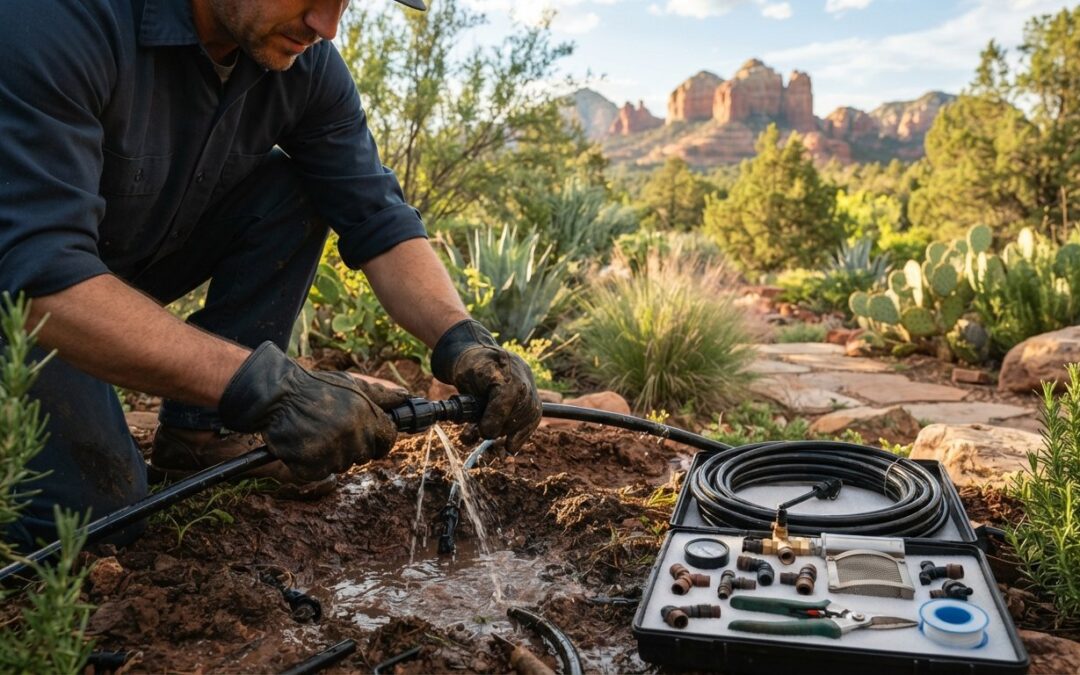
Did you know that between 50% and 70% of total residential water use in Arizona is dedicated to outdoor landscaping? When a silent pinhole leak develops in your poly tubing, it can waste over 4,300 gallons of water every month before you even notice a damp spot. For homeowners in Sedona and Prescott, mastering drip system leak repair isn’t just about home maintenance; it’s a vital part of environmental stewardship. You’ve likely felt the frustration of an unexplained spike in your utility bill or noticed a favorite desert willow looking scorched despite a steady watering schedule.
It’s exhausting to play a game of “whack-a-mole” with cracked fittings and UV-damaged lines, especially when the Northern Arizona sun pushes ground temperatures to extremes. We understand that your landscape is an investment in your property’s beauty and the local ecosystem. This guide promises to help you master the art of identifying and fixing irrigation leaks to protect your plants and lower your monthly costs. We will walk through professional troubleshooting steps, from checking for mineral calcification to preventing high-pressure blowouts, so you can maintain a resilient, water-efficient desert oasis.
Key Takeaways
- Identify the hidden signs of “silent” leaks that often go unnoticed during the Arizona monsoon season to prevent long-term landscape damage.
- Master a methodical approach to drip system leak repair using zone-by-zone pressure testing to pinpoint failures without unnecessary digging.
- Build a professional-grade repair kit and learn specific splice techniques to fix punctured poly tubing permanently and reliably.
- Protect your irrigation investment with desert-proofing strategies, such as strategic mulching and sediment filtration, to prevent future system blowouts.
- Recognize the technical complexities of large-scale HOA or commercial systems where master valves and flow sensors require expert calibration.
The High Cost of Silent Drip System Leaks in Arizona
Unlike a broken sprinkler head that creates a visible geyser, a failure in drip irrigation systems is often a subtle, underground thief. These systems operate at low pressure; a cracked fitting or a rodent chew might only produce a slow, steady seep. Because the water is often hidden beneath layers of decorative rock or decomposed granite, the first sign of trouble isn’t a puddle. It’s a spike in your monthly utility bill that catches you off guard.
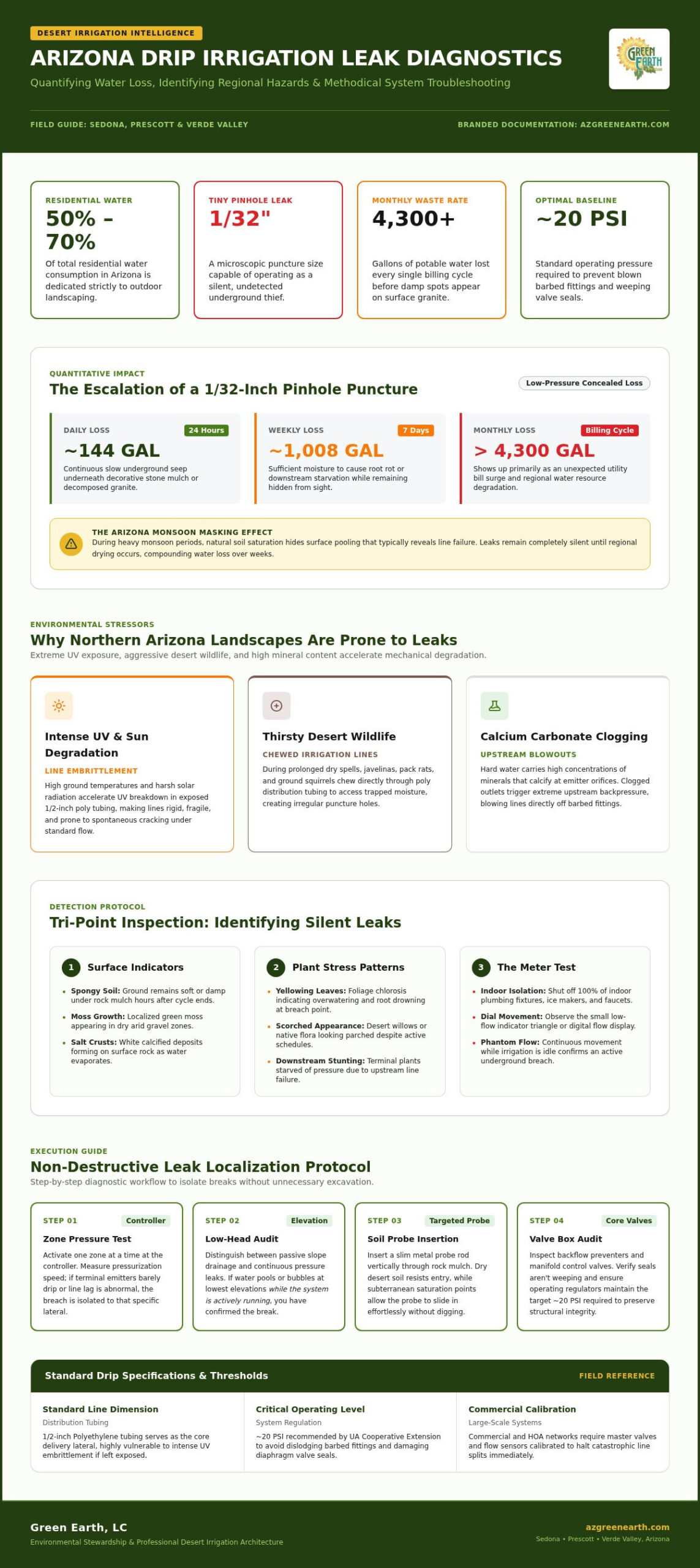
During the Arizona monsoon season, identifying a need for drip system leak repair becomes even more difficult. Heavy rains saturate the soil, masking the pooling water that would normally signal a line failure. By the time the ground dries out and the leak becomes apparent, you may have wasted thousands of gallons. A single 1/32-inch pinhole puncture can waste roughly 144 gallons per day. Over a single billing cycle, that is more than 4,300 gallons of potable water lost to the desert floor. In Northern Arizona, where water conservation is a cornerstone of our community values, these silent failures represent a significant blow to both your wallet and our regional sustainability efforts.
Common Symptoms of an Irrigation Leak
Detecting a leak requires a keen eye for subtle changes in the landscape environment. You should watch for these specific indicators:
- Visual cues: Look for spongy soil, localized moss growth, or white salt crusting on the surface of your rock mulch.
- Plant health: Yellowing leaves or stunted growth in a specific zone often indicate that a line has failed downstream, starving the plant or drowning it.
- Meter testing: Turn off all indoor water and check your meter’s flow indicator. If the dial or digital read-out is moving, you likely have a “phantom” flow.
Why Arizona Landscapes are Prone to Leaks
Our unique climate and geography create specific challenges for irrigation longevity. In the Verde Valley and high desert areas like Prescott and Flagstaff, environmental factors play a major role in system degradation. The intense 2026 sun levels accelerate UV breakdown in exposed 1/2-inch poly tubing, making it brittle and prone to cracking. Additionally, thirsty javelinas, pack rats, and ground squirrels frequently chew through lines to access moisture during dry spells. Finally, high levels of calcium carbonate in our local water supply can clog emitters. This increases upstream pressure and leads to blowouts at the barbed fittings. Professional drip system leak repair ensures that your system remains a tool for growth rather than a source of waste.
How to Troubleshoot and Locate Your Drip System Leak
Locating a failure in a complex irrigation network requires a methodical approach. Simply walking the yard looking for mud is often ineffective on large properties or where lines are buried deep. Start at the controller by performing a zone-by-zone pressure test. Activate one zone at a time and observe the system’s behavior. If a zone takes longer than usual to reach full pressure or if the emitters at the far end are barely dripping, you likely have a significant breach. This initial test narrows down the search area and is the first step in successful drip system leak repair.
Once you’ve identified the problematic zone, inspect the “low-head drainage” points. In many Arizona landscapes, water naturally pools at the lowest elevation of a sloped run after the system shuts off. However, if water continues to pool or bubble while the system is active, you’ve found your leak. For more precise detection without destructive digging, use a soil probe. A simple metal rod pushed into the ground can help you find hidden saturation points. If the probe slides in easily compared to surrounding dry areas, you’ve located the underground break. This technique is far more reliable than the surface-level inspections suggested by many DIY guides.
Don’t forget to check the heart of your system. Inspect valves and backflow preventers for weeping seals or dampness inside the valve box. According to the University of Arizona Cooperative Extension’s guide to landscape drip systems, maintaining proper operating pressure, typically around 20 psi, is critical for preventing these seal failures. If you find your system is still underperforming, it may be time to consult with a professional irrigation partner to evaluate your mainline integrity.
The ‘Dry Zone’ Paradox
A common misconception is that a leak always results in a wet spot. In reality, a major break upstream often creates a “dry zone” at the end of the line. Because the water escapes through the breach, there isn’t enough pressure to push moisture to the final emitters. You can verify this by using a simple catch-can method. Place small containers under emitters at different points along the run. If the output drops significantly at the end, you have a pressure loss issue. Identifying these pressure drops is essential for effective drip system leak repair in expansive Northern Arizona gardens.
Identifying Valve and Controller Failures
Sometimes the issue isn’t in the tubing but in the hardware. A worn valve diaphragm can prevent a zone from closing fully, leading to constant water waste. Similarly, a faulty solenoid might produce an audible electrical hum without actually opening the valve. If your system seems to have a mind of its own, you may need to dig deeper into your hardware settings. Our Irrigation Controller Troubleshooting Arizona Guide provides specific insights for managing these complex electrical components in high-altitude environments.
Step-by-Step Drip Irrigation Repair for Common Issues
To execute a lasting drip system leak repair, you need more than just a roll of electrical tape. A professional-grade toolkit for Arizona homeowners should include heavy-duty ratcheting pipe cutters, various sized couplers, and a handful of “goof plugs” to seal holes where emitters have been relocated. When you find a punctured section of poly tubing, the most reliable fix is the “double-barb” splice technique. This involves cutting out the damaged section entirely and inserting a barbed coupler into both ends of the remaining healthy pipe. In our arid climate, where soil shifts and expands, this mechanical connection is far superior to simple adhesive patches.
While you’re working on the lines, take a moment to inspect your emitters. If a 2-GPH dripper is clogged with calcium carbonate, don’t waste time trying to clean it with a needle. The internal diaphragms are delicate; physical cleaning often ruins the flow regulation, leading to uneven watering. Instead, replace the unit entirely to ensure your plants receive the precise volume of water they need. Once repairs are complete, secure the lines using 6-inch galvanized stakes every three to four feet. This prevents “line crawl,” a phenomenon where extreme temperature swings cause poly tubing to expand and contract, eventually pulling emitters away from the root zones of your desert flora.
Fixing Main Line vs. Lateral Line Leaks
Repair strategies differ depending on where the breach occurs. Main lines often consist of rigid PVC or thick-walled 3/4-inch poly designed to handle constant pressure. For rigid pipe failures, a “slip-fix” telescopic coupling allows you to bridge a gap without needing to bend the pipe, which is nearly impossible in compacted desert soil. Conversely, lateral repairs involve managing the 1/4-inch “spaghetti” lines that deliver water to individual pots or shrubs. These smaller lines are often the primary victims of sun-rot and require frequent replacement to maintain system efficiency.
Managing Pressure Regulators and Backflow Preventers
If you notice emitters popping off their barbed fittings throughout your entire yard, your pressure regulator has likely failed. Without this component, high municipal pressure can shred your irrigation network. Following EPA WaterSense leak detection methods can help you confirm if these systemic issues are causing hidden water waste at the meter. For our neighbors in higher elevations like Flagstaff, specialized care is required. You should prioritize winterization to prevent ice-related cracks in your backflow preventer. If you aren’t sure how to handle these technical components, exploring Professional Irrigation Repair in Flagstaff can provide the high-altitude expertise your landscape needs to survive the winter season.
Desert-Proofing: Preventing Future Irrigation Failures
Effective drip system leak repair is only half the battle; the other half is ensuring those repairs survive the harsh Arizona elements. The most immediate threat to your poly tubing is UV degradation from our intense high-altitude sun. You can shield your lines by applying at least 3 inches of mulch, such as wood chips or decomposed granite. This layer acts as a protective barrier, preventing the plastic from becoming brittle and cracking under heat stress. Additionally, maintaining your system at the “sweet spot” of 25 to 30 PSI prevents the systemic stress that leads to blown emitters and split lines.
In the Verde Valley, fine sediment and silt can quickly compromise your irrigation efficiency. Installing a high-quality mesh filter at the valve box is a critical upgrade that catches these particles before they reach your emitters. Adjusting your controller’s run times as we approach the pre-monsoon heat is also vital. Increasing frequency during these dry weeks ensures your plants remain resilient, reducing the likelihood of root-zone stress that can make a minor leak fatal to your landscape. If your system feels overwhelmed by these seasonal shifts, scheduling a professional system audit can identify vulnerabilities before they become emergencies.
Combating Hard Water and Calcium Buildup
The chemistry of Arizona tap water is notoriously rich in minerals. Over time, lime scale chokes the narrow passages within your drippers, causing them to fail shut. This blockage increases back-pressure on your lateral lines, which often triggers a need for drip system leak repair elsewhere in the zone. While professionals may use specialized acid-flush treatments to clear commercial lines, residential owners should prioritize preventative filtration. Investing in self-flushing emitters is a wise choice for high-mineral areas, as these components are designed to expel small particles during every cycle.
Sustainable Landscape Integration
A truly desert-proof yard starts with smart planning. By matching your drip output to specific plant hydrozones, you ensure that high-water species aren’t drowning while succulents are thirsting. This logical grouping minimizes the total run time required, which reduces the wear and tear on your tubing. Integrating Desert Landscape Design Northern Arizona principles allows you to transition toward drought-tolerant species. These native plants are naturally adapted to our climate, significantly lowering your irrigation demand and the associated “leak anxiety.” For a system that stands the test of time, contact our team for a sustainable irrigation consultation.
When to Call a Professional: HOA and Commercial Solutions
While small residential fixes can often be handled with a basic toolkit, the stakes change significantly when managing the expansive landscapes of commercial complexes or HOA properties. These large-scale networks are far more complex than a standard backyard setup. They often feature master valves and high-sensitivity flow sensors that require precise calibration to function as intended. A master valve serves as a critical fail-safe, remaining closed until the controller signals a specific zone to open. If a leak occurs in the mainline, a properly tuned system can detect the pressure drop and shut down the entire flow. For property managers, professional drip system leak repair at this level is about protecting community assets and maintaining a predictable utility budget.
Liability is another major factor for HOA boards and commercial owners. Water waste in the desert is not just an environmental concern; it can lead to significant fines and structural damage. An uncorrected leak can quickly become a legal and financial burden, making DIY “fixes” a risky proposition for shared properties. Green Earth, LC brings a 47-year legacy to the Verde Valley, offering a level of institutional knowledge that is rare in the industry. From the red rocks of Sedona to the river valley of Cottonwood, we understand how local soil chemistry and terrain affect the longevity of your irrigation infrastructure. A recurring maintenance contract ensures that small issues are caught before they escalate into system-wide failures.
Advanced Diagnostic Tools
In cases where a leak is suspected but not visible on the surface, we utilize ultrasonic leak detection technology. This advanced equipment allows our technicians to pinpoint breaches in deep-buried commercial lines without the need for exploratory trenching. We also specialize in smart controller integration, which provides real-time alerts to your smartphone or management office the moment a surge is detected. This precision is especially vital when irrigation failures threaten structural elements. Persistent leaks can undermine walkways or destabilize foundations. Our expertise in Drainage Grading Arizona ensures that your water management strategy protects the structural integrity of your entire property.
The Green Earth Advantage
Choosing a professional partner means benefiting from eco-friendly practices that minimize site disturbance. We take pride in our role as a community fixture, providing specialized knowledge of the soil types from Camp Verde to Prescott. Whether we are troubleshooting a complex manifold or performing a routine drip system leak repair, our goal is to deliver excellence and reliability. We act as a visionary partner, helping you transition your landscape into a sustainable, water-wise reality that thrives in the Northern Arizona climate. To ensure your system is operating at peak efficiency, schedule your professional irrigation audit with Green Earth today.
Securing the Future of Your High Desert Oasis
Maintaining a vibrant landscape in Northern Arizona requires a proactive approach to irrigation health. By mastering the signs of silent failures and implementing the desert-proofing strategies we’ve explored, you can protect your outdoor investment from the harsh climate. Whether you’re managing a residential garden or a sprawling commercial property, consistent drip system leak repair is the key to balancing ecological responsibility with aesthetic beauty. Identifying leaks early not only saves thousands of gallons of water but also prevents the soil erosion and foundation issues that can compromise your property’s value.
Green Earth, LC has spent over 47 years serving Northern Arizona as a recognized leader and award winner in sustainable landscape design. Our specialized expertise in HOA and commercial maintenance ensures that your irrigation infrastructure remains efficient, reliable, and compliant with local water standards. We’re here to serve as your partner in creating a resilient and beautiful outdoor environment. Protect your landscape and save water; contact Green Earth for expert irrigation repair today. Your commitment to water-wise practices ensures a greener, more sustainable Arizona for years to come.
Frequently Asked Questions
How do I know if my drip system has a leak if I don’t see water?
You can detect a leak by checking your water meter for “phantom” flow when all indoor fixtures aren’t on. Look for subtle visual cues like localized moss growth or white salt crusting on the surface of your rock mulch. If specific plants look scorched while others thrive, it often indicates a pressure loss from an upstream breach. These signs are critical for catching issues before your utility bill spikes significantly.
What is the most common cause of drip system failure in Arizona?
UV degradation and wildlife interference are the leading causes of system damage in Northern Arizona. Intense sun makes poly tubing brittle and prone to cracking over time. Additionally, desert rodents like pack rats and ground squirrels often chew through lines searching for moisture during dry spells. Hard water mineral buildup also clogs emitters, which increases line pressure and triggers a need for drip system leak repair.
Can I repair a 1/2-inch poly line myself, or do I need a pro?
Minor lateral repairs are manageable for many homeowners using basic couplers and goof plugs to seal small breaches. However, complex troubleshooting involving master valves, flow sensors, or mainline PVC failures often requires professional intervention. If you’re finding yourself fixing multiple leaks every month, the tubing’s likely reached the end of its functional lifespan. In these cases, consulting a professional partner like Rimpau Landscaping & Maintenance ensures a reliable, long-term solution for your landscape.
How much water does a leaking drip system actually waste?
A tiny 1/32-inch pinhole puncture in underground poly tubing can waste approximately 144 gallons of water every day. Over a standard monthly billing cycle, that amounts to more than 4,300 gallons of wasted potable water. Because these leaks are often hidden beneath decorative gravel or rock mulch, they’re frequently unnoticed until you receive a surprisingly high utility bill or notice a significant decline in plant health.
Will a leak in my irrigation system damage my home’s foundation?
Yes, persistent subsurface leaks can saturate the soil near your home’s foundation, leading to structural instability. In areas with high shrink-swell clay soils, this moisture causes the ground to expand and lift concrete walkways or walls. Proper drip system leak repair and drainage grading are essential to prevent these minor irrigation issues from evolving into expensive structural repairs for your property. Maintaining a dry perimeter’s vital for foundation health.
How often should I inspect my drip irrigation system in Sedona?
We recommend a thorough system inspection at least once per month during the peak growing season. In Sedona and the surrounding Verde Valley, seasonal shifts and monsoon rains can hide failures until damage’s severe. Regular checks should include cleaning filtration screens, testing emitter output, and observing the water meter for unexpected flow. For HOAs and commercial properties, a recurring maintenance contract provides continuous monitoring and early detection of failures.
What is the best way to protect my drip lines from the Arizona sun?
The most effective protection’s burying the lines or covering them with a thick layer of mulch. Applying at least 3 inches of wood chips or rock mulch shields the poly tubing from direct UV exposure, which prevents the plastic from becoming brittle. For new installations, using Schedule 40 PVC for mainlines and bringing rigid pipe closer to plant clusters provides a more durable, sun-resistant infrastructure for your Flagstaff or Prescott yard.
Is it better to repair an old drip system or replace the whole thing?
It depends on the age and condition of your materials. If your poly tubing’s over 10 years old and you’re repairing more than two or three leaks per month, the plasticizer’s likely degraded. In this scenario, repeated spot patching’s a temporary fix that wastes time and water. A full zone replacement with modern, high-quality components is often more cost-effective and sustainable for the long-term health of your Northern Arizona landscape.
Recent Comments