
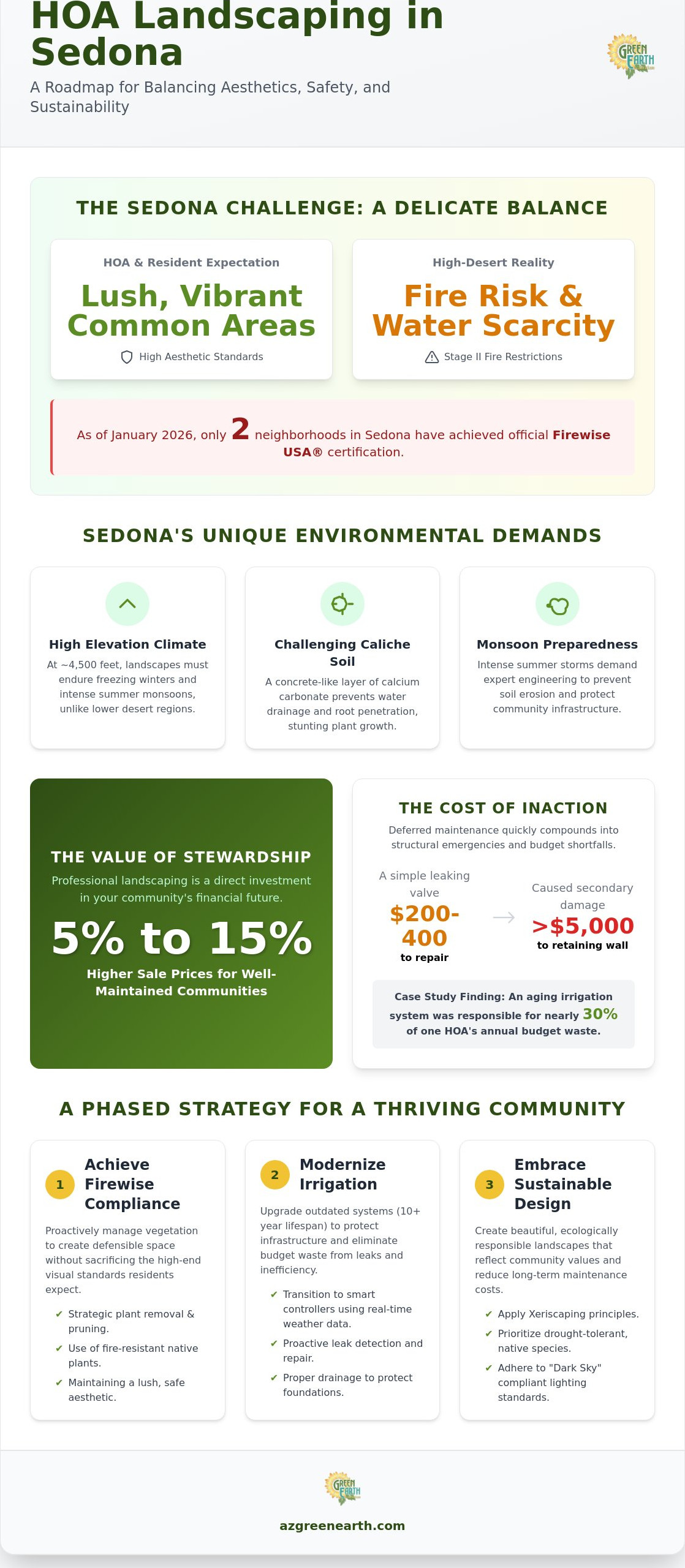
Did you know that as of January 2026, only two neighborhoods within Sedona city limits have achieved official Firewise certification? For many board members, the challenge of HOA landscaping Sedona feels like a constant tug-of-war between maintaining lush community standards and addressing the reality of Stage II Fire Restrictions. It’s common to feel overwhelmed by rising water costs from outdated irrigation or the concern that removing vegetation for safety might compromise the iconic Red Rock aesthetic your residents value.
We understand that your community landscape is more than just curb appeal; it’s a vital environmental asset that requires expert stewardship. This case study explores how professional management balances Sedona’s unique soil and climate needs with sustainable, water-wise innovation. You’ll learn how to navigate new 2026 regulations regarding backyard shade structures and pending drought legislation while effectively reducing long-term maintenance costs. We provide a clear roadmap for transforming your common areas into a vibrant, Firewise-compliant sanctuary that reflects the beauty and prestige of our local environment.
Key Takeaways
- Master the art of blending native flora with red rock formations while overcoming the technical challenges of nutrient-poor high-desert terrain.
- Discover a phased modernization strategy for HOA landscaping Sedona that upgrades community aesthetics without requiring immediate, large-scale financial assessments.
- Learn how to achieve full Firewise compliance across multi-family properties without sacrificing the high-end visual standards residents expect.
- Identify why proactive irrigation management and monsoon-ready engineering are the most effective ways to protect your community’s infrastructure and budget.
- Gain insight into how data-driven landscape maintenance and professional stewardship create enduring ecological health and increased property value.
The Unique Demands of HOA Landscaping in Sedona’s Red Rock Country
Managing a community in the Verde Valley requires a departure from standard desert maintenance routines. While Phoenix relies on heat-hardy succulents, HOA landscaping Sedona must account for a high-elevation climate that sits at roughly 4,500 feet. This elevation brings a unique set of challenges, including freezing winter nights and intense summer monsoons that can wash away poorly planned treatments. The terrain itself presents a significant hurdle; the soil often contains heavy layers of caliche, a concrete-like calcium carbonate deposit that prevents proper drainage and root penetration. Without professional intervention, plants struggle to establish, leading to wasted community funds and a patchy, uninviting appearance.
Standard Arizona landscaping tactics often fail here because they don’t respect the delicate balance of the high-desert ecosystem. Boards aren’t just managers; they’re the primary guardians of community property value. Since well-maintained communities can sell for 5% to 15% more than those with deferred care, the choice of a landscape partner is a direct investment in the neighborhood’s financial future. A disciplined approach ensures that common areas remain vibrant while respecting the natural limitations of our unique environment.
Preserving the Red Rock Aesthetic
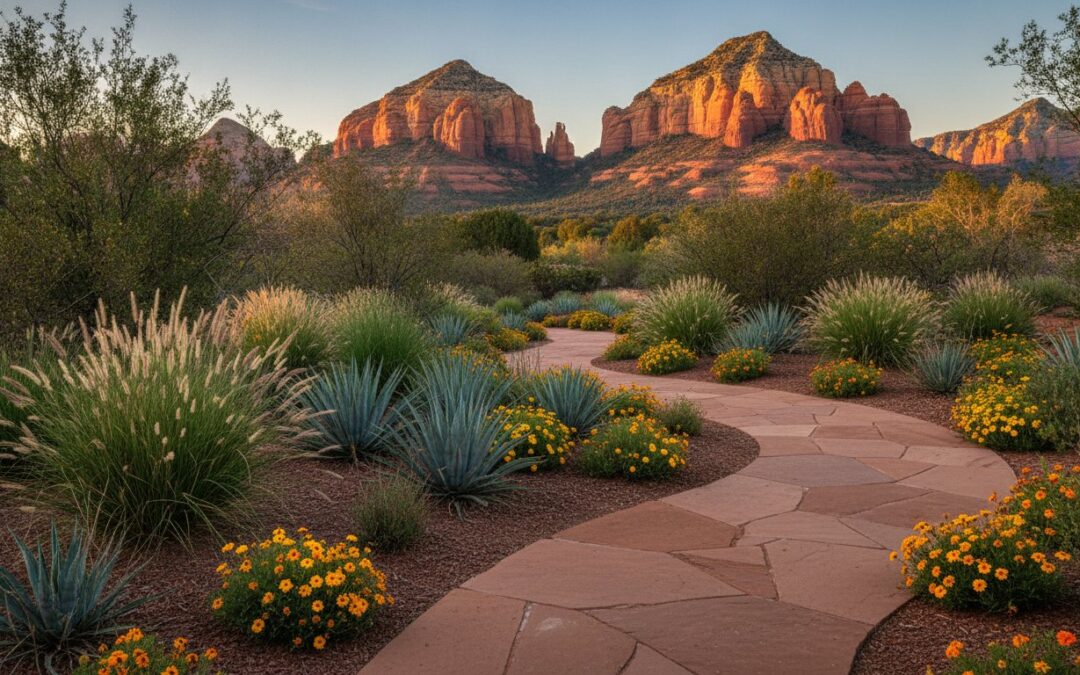
Maintaining the visual integrity of a Sedona community means working with the landscape rather than against it. We prioritize the use of native stone and local boulders to mirror the majestic geographic features that surround our neighborhoods. The goal is a seamless transition between manicured common areas and the raw beauty of the Coconino National Forest. This includes selecting a color palette where plant life complements the deep ochre and crimson of the red rocks. Additionally, we ensure all community features adhere to “dark sky” compliant outdoor lighting. This preserves our world-famous night views while providing necessary safety for residents and visitors alike.
The Environmental Stewardship Expectation
Sedona residents share a deep passion for the natural world and expect their HOAs to reflect those values. This means balancing the desire for lush, welcoming common areas with the practical necessity of water conservation. By integrating the principles of xeriscaping, we create landscapes that are both beautiful and ecologically responsible. Following “Keep Sedona Beautiful” standards isn’t just about aesthetics; it’s about sustainable land management. We focus on drought-tolerant native species that support local pollinators and require less supplemental irrigation. This forward-thinking strategy reduces long-term costs and ensures your community remains a responsible steward of our precious local resources.
Case Study: Modernizing a High-Traffic Sedona Community Landscape
Sedona communities often face a difficult choice between maintaining high aesthetic standards and managing escalating utility costs. In one recent modernization project, a local HOA discovered that their aging irrigation system was responsible for nearly 30% of their annual budget waste. Beyond the financial drain, overgrown vegetation had created a significant safety hazard, leaving the property vulnerable during the heightened wildfire risks of early 2026. A comprehensive assessment revealed that a leaking irrigation valve, which typically costs between $200 and $400 to repair, had already caused over $5,000 in secondary damage to a nearby retaining wall. This scenario is common in HOA landscaping Sedona, where deferred maintenance quickly compounds into structural emergencies.
To address these issues without imposing a massive one-time assessment on homeowners, we implemented a phased modernization strategy. This approach allows the board to prioritize critical safety and infrastructure repairs while spreading the aesthetic enhancements over several budget cycles. By focusing on high-impact areas first, the community saw immediate results in both safety compliance and curb appeal.
Phase 1: Irrigation Overhaul and Drainage Correction
The first priority involved stabilizing the community’s infrastructure. We diagnosed several underground leaks that were threatening building foundations, a common issue when drip systems exceed their ten-year lifespan. By transitioning the property to smart controllers that utilize real-time Sedona weather data, we ensured the landscape received precise hydration without waste. This is a core component of Arizona water-efficient landscaping, which is essential for communities navigating pending drought legislation. We also corrected drainage patterns near primary walkways to prevent the severe erosion typically seen during the July to September monsoon season.
Phase 2: Aesthetic and Firewise Revitalization
Once the water systems were secured, the focus shifted to safety and visual impact. With Sedona under Stage II Fire Restrictions as of June 2026, creating a defensible space was mandatory for insurance and safety purposes. We thinned dense brush and removed ladder fuels to meet Firewise standards, carefully maintaining the natural screening that provides resident privacy. To refresh the community’s appearance, we introduced drought-tolerant “color pops” at main entrances and upgraded worn paths with durable, local pavers hardscape. These improvements don’t just look better; they provide a functional, low-maintenance framework for the neighborhood.
The results of this strategic transition were measurable and immediate. By modernizing the infrastructure and aligning with sustainable practices, the HOA reduced its monthly water expenditures significantly while achieving full Firewise compliance. Most importantly, the community saw a renewed sense of pride among residents, protecting the 5% to 15% property value premium associated with well-managed Sedona landscapes.
Balancing Aesthetic Standards with Firewise Defensible Space
The primary conflict facing board members today is the perceived trade-off between lush curb appeal and the rigorous requirements of wildfire safety. While residents often advocate for dense, privacy-focused vegetation, the reality of our arid climate requires a more disciplined approach. Effective HOA landscaping Sedona doesn’t mean stripping the land bare. Instead, it involves strategic design that minimizes fuel loads while enhancing the natural beauty of the community. With the Sedona Fire District enforcing Stage II Fire Restrictions as of June 2026, the urgency for this balance has never been higher.
Integrating safety into the initial design phase allows for a landscape that looks intentional rather than reactive. This balance is the hallmark of professional HOA landscaping Sedona, where safety and aesthetics coexist. We focus on creating a defensible space that protects structures without making the property look like a construction site. This requires educating homeowners on the science of fire behavior. When residents understand that a single overgrown tree can act as a bridge for flames to reach their roof, they are much more supportive of necessary removals and pruning schedules.
Firewise Principles for Sedona Communities
Achieving a safe environment starts with managing the immediate surroundings of HOA structures. The 0 to 5 foot ignition-free zone is the most critical area; it should be clear of all combustible materials, including dead leaves, wooden fences, and certain types of mulch. Moving further out, we focus on the vertical and horizontal spacing of trees. This prevents ladder fuels from allowing a ground fire to climb into the canopy and become a crown fire. Proper Firewise landscaping Sedona requires specialized knowledge of local fuel loads and the specific ways fire moves through our unique canyons and slopes.
Selecting Fire-Resistant Native Species
One of the most effective ways to modernize an older community is by replacing highly flammable species with fire-resistant alternatives. Many older Sedona developments are heavy with junipers, which are essentially gasoline on a stick due to their high oil content and dry inner branches. We recommend replacing these with fire-resistant deciduous trees or low-growing succulents that maintain a high moisture content in their foliage. Using decorative rock mulch in place of wood chips creates natural fire breaks while providing the clean, sophisticated look that high-end HOAs demand. Maintaining plant health through professional irrigation management is also essential; a well-hydrated plant is naturally more fire-resistant than one struggling with drought stress.
Strategic Irrigation Management and Monsoon Preparedness
Treating a community’s irrigation system as a “set it and forget it” utility is one of the most expensive mistakes an HOA board can make. In our high-desert environment, weather patterns shift rapidly, and a static watering schedule often results in thousands of gallons of wasted water. This waste doesn’t just show up on the utility bill; it actively damages the landscape by leaching nutrients from the soil and encouraging shallow root growth. Proactive management involves constant calibration based on local Sedona weather data, ensuring plants receive exactly what they need to thrive during the hot, dry months preceding the summer rains.
The arrival of the monsoon season in late June brings much-needed moisture but also introduces the risk of significant erosion. In Sedona, where many properties are built on sloped terrain, unmanaged runoff can quickly turn into a destructive force. This water often pools against foundations or washes out the subgrade beneath community roads and walkways. Integrating strategic drainage solutions into your HOA landscaping Sedona plan is essential for protecting these high-value assets. By addressing water movement before the first storm hits, communities avoid the high costs associated with emergency structural repairs.
Transitioning to Smart Drip Irrigation
Modernizing an aging system is about more than just replacing old pipes. We utilize pressure-compensating emitters, which are vital for sloped Sedona properties where gravity often causes uneven water distribution. These emitters ensure that a plant at the top of a hill receives the same amount of hydration as one at the bottom. Additionally, real-time leak detection technology provides an immediate alert when a line breaks, preventing the kind of catastrophic water loss that can compromise a hillside. Investing in professional drip system repair Northern Arizona typically pays for itself through immediate water savings and the prevention of plant loss.
Drainage Grading for Structural Protection
Effective water management requires a blend of horticulture and engineering. We use a combination of French drains and strategically placed swales to redirect heavy monsoon rains away from buildings and toward areas where the water can safely percolate into the ground. This prevents standing water, which is a primary cause of root rot and mosquito breeding in common areas. We also conduct thorough evaluations of community retaining walls to ensure they have functional weep holes. Without proper drainage, the hydrostatic pressure built up during a storm can cause even the most robust wall to fail, leading to massive reconstruction costs.
Partnering with Green Earth for Long-Term Community Value
Selecting a landscape partner is one of the most consequential decisions an HOA board makes. With 47 years of experience specific to Northern Arizona, we understand that HOA landscaping Sedona requires more than just a mowing schedule; it demands a deep knowledge of the local ecology and a commitment to long-term asset protection. We operate as “Authoritative Environmentalists,” ensuring that every design choice is backed by horticultural science. This approach transforms common areas from a recurring expense into a thriving community investment that sustains resident satisfaction and protects property values over several decades.
Our role extends beyond day-to-day maintenance to include strategic capital improvement planning. Arizona HOA boards often manage annual commercial maintenance budgets ranging from $45,000 to $60,000, and we help you allocate those funds with precision. By identifying infrastructure lifecycles for irrigation systems and retaining walls early, we help you avoid the “emergency repair” cycle that drains reserve funds. For communities seeking a deeper understanding of how professional oversight elevates shared spaces, our approach to commercial landscaping Sedona AZ demonstrates how sustainable design and ecological resilience can be built into every phase of property management. We work as your visionary partner, taking community goals and turning them into a phased, financially responsible reality that respects the unique character of Red Rock country.
Custom Maintenance Planning for Sedona Boards
Every community has a different rhythm and financial structure. We tailor our service schedules to align with your specific budget cycles, ensuring that critical work is performed when it’s most effective. Transparency is a cornerstone of our partnership; we provide detailed reporting for board meetings that clearly outlines completed tasks and upcoming needs. This data-driven approach allows for complete homeowner transparency, making it easier to justify landscape investments. By prioritizing high-impact areas like community entrances and clubhouses, we maximize the immediate curb appeal that defines the neighborhood’s prestige. Business owners in neighboring communities can find similar guidance in our commercial landscape design Prescott AZ guide, which outlines how water-smart strategies and fire code compliance apply across the region’s high-desert properties.
The Green Earth Difference: Beyond Maintenance
Our commitment to excellence has earned us recognition as a “Sustainable Landscape Designer” runner-up, a status that reflects our dedication to ecological integrity. We don’t just maintain plants; we build lifestyles. Residents often want to extend their living space outdoors, and we provide the specialized construction expertise to make that happen. From installing custom outdoor kitchens and fire features to building durable pavers hardscape paths, we enhance the functional beauty of your common areas. Request a consultation today to see how our 47 years of local expertise can transform your Sedona HOA into a model of sustainable, high-desert beauty.
Securing the Future of Your Sedona Community
Modernizing your community landscape is a strategic investment in safety, sustainability, and financial stability. By balancing the iconic Red Rock aesthetic with rigorous Firewise principles, boards can protect residents while enhancing the neighborhood’s natural prestige. Implementing smart irrigation and monsoon-ready engineering ensures that your infrastructure remains resilient against the unique challenges of the high-desert climate. These proactive measures don’t just reduce immediate utility waste; they secure property values for decades to come.
Elevating your HOA landscaping Sedona requires a partner with deep local roots and technical expertise. With over 47 years of Northern Arizona experience, Green Earth provides the professional stewardship your board needs to navigate complex environmental demands. Our team is proud to be a statewide runner-up for Best Sustainable Landscape Designer and a dedicated specialist in Firewise Defensible Space. We invite you to Partner with Sedona’s HOA Landscaping Experts at Green Earth to begin a transformation backed by science and local passion. Let’s work together to build a community landscape that is as safe and sustainable as it is beautiful.
Frequently Asked Questions
Does Firewise landscaping mean we have to remove all our trees?
No, Firewise principles focus on selective thinning and strategic placement rather than clear-cutting. We manage the ignition-free zone and ensure proper vertical and horizontal spacing between tree crowns to prevent fire spread. This approach maintains the community’s natural beauty while significantly reducing fuel loads. Our goal is to create a defensible space that satisfies insurance requirements without sacrificing the privacy or shade that residents value.
How much can a Sedona HOA save by switching to smart irrigation?
Communities can see a significant reduction in water expenditures by transitioning to smart controllers and pressure-compensating emitters. Traditional “set it and forget it” systems often result in nearly 30% water waste due to leaks or overwatering during monsoon months. By utilizing real-time weather data, HOA landscaping Sedona becomes a precision operation. This modernization pays for itself by preventing plant loss and protecting expensive infrastructure from water-related damage.
Can our HOA be fined by the city for poor landscape maintenance?
Yes, the City of Sedona and the Sedona Fire District enforce strict codes regarding property maintenance and wildfire safety. Properties that fail to maintain Firewise standards or violate aesthetic guidelines can face citations, especially during Stage II Fire Restrictions. Beyond municipal fines, poor maintenance can lead to increased insurance premiums or even policy cancellations. We ensure your community remains compliant with all local regulations through disciplined, professional stewardship.
What are the best drought-tolerant plants for Sedona common areas?
Native species such as Agave, Desert Spoon, and various Penstemons are ideal for our high-desert environment. These plants are naturally adapted to Sedona’s nutrient-poor soil and require minimal supplemental irrigation once established. We select a plant palette that provides vibrant color pops while remaining resilient against frost and heat. This strategy ensures common areas look lush and intentional without the high maintenance costs associated with non-native vegetation.
How often should an HOA landscape be inspected for drainage issues?
We recommend a formal drainage and grading inspection at least twice a year, specifically before and after the summer monsoon season. Heavy rains from July to September can quickly overwhelm swales or clog weep holes in retaining walls. Early detection of erosion or standing water prevents foundation issues and protects community asphalt. A proactive inspection schedule allows the board to address minor grading adjustments before they become costly structural emergencies.
What is the process for an HOA to switch to Green Earth for maintenance?
Transitioning to our care begins with a comprehensive site assessment and a review of your current budget cycles. We identify immediate safety concerns, such as fire hazards or irrigation leaks, and develop a phased modernization plan. This methodical process ensures a seamless handover from your previous contractor without disrupting community services. Our team provides detailed reporting and transparent communication to help the board manage homeowner expectations throughout the transition.
Does Green Earth handle both residential and commercial areas within an HOA?
Yes, we provide comprehensive services for both large-scale commercial common areas and individual residential properties within the community. Our expertise in HOA landscaping Sedona allows us to maintain a consistent aesthetic and safety standard across the entire property. Whether we are managing a clubhouse entrance or installing a private backyard fire feature, we apply the same high standards of craftsmanship and environmental integrity to every project we undertake.
Recent Comments