
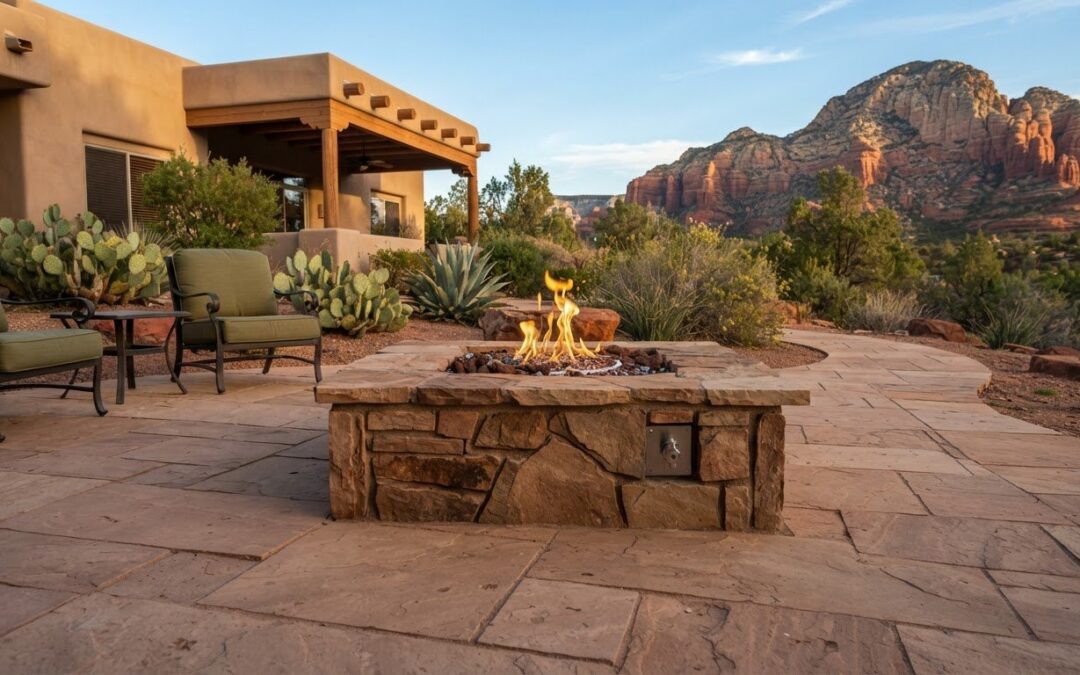
A fire pit’s best location is one that suits Sedona’s burn restrictions and leaves room for safe clearances, shifting winds, drainage, and everyday access. During Stage 1 and Stage 2 fire restrictions, wood-burning fire pits are prohibited; gas and propane models are typically permitted year-round when they have an instant shut-off control and are used responsibly. Planning outdoor fire pit installation in Sedona starts with choosing a site that works in changing conditions, not just one that looks right from the patio.
It’s easy to focus on the view or the distance to the seating. But nearby structures, vegetation, overhead features, and the path smoke and sparks may travel also affect whether a location is practical. Windy, dry days require particular care, while a low spot that collects water can complicate the hardscape and access.
This guide explains how restrictions, clearances, wind, drainage, service access, and circulation affect placement. You’ll learn what to consider when planning a fire feature that fits your landscape and supports responsible use and maintenance.
Key Takeaways
- Assess nearby structures, plants, furniture, and overhead features to identify a location with safer separation around the flame.
- Learn how fire type and spark control influence placement, especially when choosing a wood-burning feature.
- Plan for wind exposure, water runoff, maintenance access, and clear circulation so the fire feature fits the landscape in daily use.
- Firewise Defensible Space can help address vegetation and landscape considerations when planning a safer outdoor setting.
1. Burn bans and seasonal restrictions
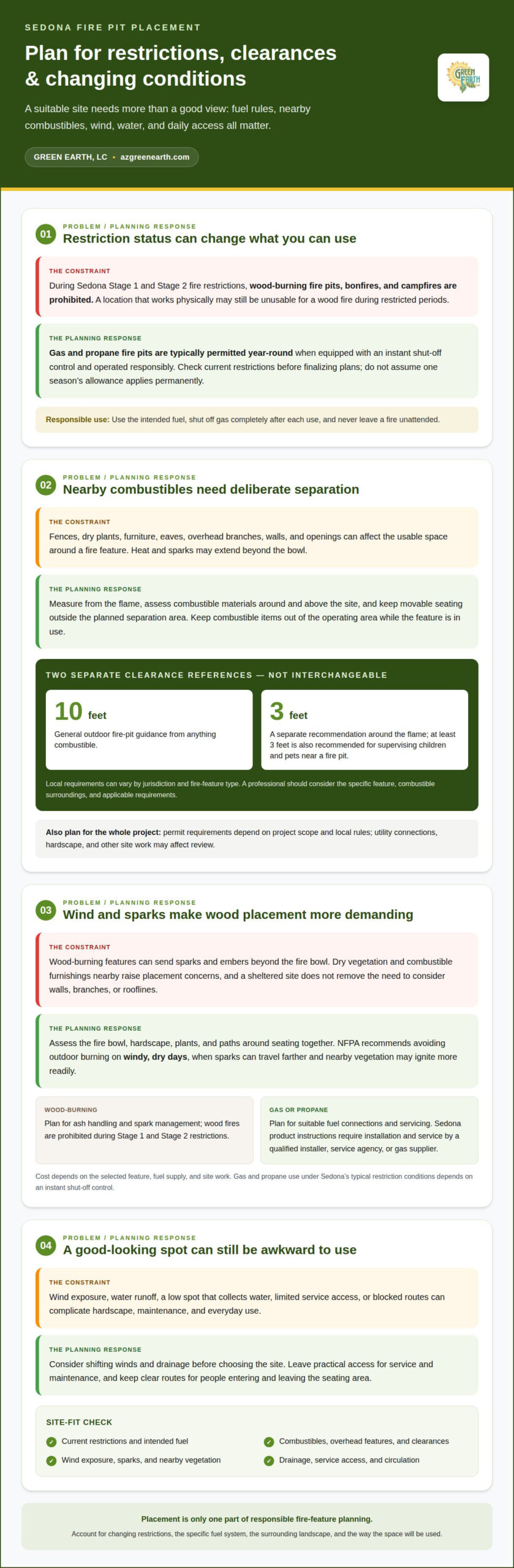
Sedona’s restrictions determine whether a fire feature can be used, not simply where it sits. During Stage 1 and Stage 2 fire restrictions, open flames are prohibited in Sedona. That includes wood-burning fire pits, bonfires, and campfires. Gas and propane fire pits are typically permitted year-round when equipped with an instant shut-off control and operated responsibly. Fuel choice therefore affects how often the feature can be used under changing restrictions.
No single material or design suits every Sedona property. Choose a finish and form suited to the fuel system, site exposure, and surrounding landscape. A professional can assess these factors alongside current rules, helping the design meet your needs without assuming wood burning will always be allowed.
Before installation plans are finalized, professionals check the current fire-restriction status for Sedona and assess how it affects the proposed fuel. They distinguish open-flame wood burning from a gas or propane feature, then consider whether the selected design includes the required instant shut-off control. Because restrictions may change, a plan should not treat one season’s permitted use as permanent approval for every later use. For example, a wood-burning feature may be unusable during Stage 1 or Stage 2 restrictions, even if its location is otherwise suitable.
This review helps determine the location and operating plan. A site intended for a wood fire calls for different expectations than one designed for gas or propane. Restrictions affect use, so placement alone cannot make a prohibited open flame permissible. Responsible operation still matters when gas or propane is allowed: use the intended fuel source and shut off the gas completely after each use. Never leave a fire unattended. These decisions help align the installation with Sedona’s changing conditions and set realistic expectations for using the feature.
2. Clearance from structures, vegetation, furniture, and overhead features
Begin by measuring from the flame and identifying combustible materials nearby. General outdoor fire-pit guidance gives 10 feet from anything combustible, while another recommendation calls for at least 3 feet around the flame. These are separate references, not interchangeable measurements. Fences, dry plants, furniture, eaves, and overhead branches can all affect the usable space around a proposed location.
Local clearance rules can vary by jurisdiction and fire-feature type. A portable outdoor fireplace and a defined recreational fire may be treated differently under local codes. NFPA 1 enforcement can also affect required separation. These differences mean a single general guideline shouldn’t be treated as a universal local code. A professional considers the specific feature, combustible surroundings, and applicable requirements when laying out the site.
Permit requirements depend on the project scope and applicable local rules. Utility connections, hardscape, and other site work may affect the review required, so plan for the entire project rather than just the fire bowl.
Clearance shapes everyday operation, too. Keep movable seating outside the planned separation area, and leave usable routes for people entering and leaving the space. At least 3 feet is recommended for supervising children and pets near a fire pit. Overhead coverings and branches deserve attention because heat and sparks can extend beyond the bowl. Keep combustible items out of the operating area while the feature is in use.
Operate fire pits outdoors, not inside a home or enclosed patio, where combustion exhaust can accumulate. A site plan should also consider nearby walls, openings, and overhead features, not just ground-level distances. Coordinating these elements with the surrounding outdoor fire feature layout helps make clearances part of the overall design instead of an afterthought.
3. Wood-burning fire-pit placement and spark control
Wood-burning fire pits, bonfires, and campfires are all prohibited during Sedona Stage 1 and Stage 2 fire restrictions. That makes wood a less dependable choice if you expect to use the feature during restricted periods. A wood design also needs placement that accounts for sparks and embers beyond the fire bowl, especially near dry vegetation or combustible furnishings.
Start by assessing the site’s exposure. A sheltered area may reduce wind, but nearby walls, branches, and rooflines still matter. NFPA recommends avoiding outdoor burning on windy, dry days, when sparks can travel farther and nearby vegetation may ignite more readily. A wood-burning plan should account for these conditions rather than rely on location alone.
Spark control also depends on the fire feature and how it will be used. A professional can assess the fire bowl, surrounding hardscape, nearby plants, and paths around the seating area. A location beside dry planting beds, for example, presents different concerns from an open paved area. Keep combustible materials outside the planned operating area, and never assume sparks are contained simply because the fire is low.
Gas and wood have different installation and maintenance needs. Cost depends on the selected feature, fuel supply, and site work. Wood requires ash handling and spark management, while gas systems need suitable fuel connections and servicing. Gas and propane use also depends on an instant shut-off control under Sedona’s typical restriction conditions.
For gas fire pits, Sedona product instructions require installation and service by a qualified installer, service agency, or gas supplier. A professional can evaluate the intended fuel, placement, and surrounding landscape before finalizing a design suited to the site and its operating needs.
4. Wind, drainage, service access, and circulation
A fire pit can meet clearance guidance and still be poorly placed. Wind direction, surface runoff, maintenance access, and pedestrian routes all affect its function. NFPA recommends avoiding outdoor burning on windy, dry days. When planning outdoor fire pit installation in Sedona, consider prevailing exposure and nearby wind channels, such as gaps between walls, where gusts may carry smoke or sparks toward seating.
Drainage matters before hardscape goes in. A low point can collect runoff around the fire feature, while an uphill location may direct water across the seating area. The layout should follow existing slopes and direct water away from the fire pit and walking surfaces. Where grading needs adjustment, drainage grading can help shape a functional route for runoff instead of leaving water to pond around the installation.
Fuel choice also affects placement. Liquid propane is 1.5 times heavier than air, and decorative glass media may allow propane to pool underneath. That makes the fire pit’s base and surrounding design important parts of the site review. A professional considers how the chosen fuel system fits the intended location and avoids treating the fire bowl as a standalone object.
Keep service access practical after construction. Installers need a workable route to reach the feature during installation and future servicing, without moving fixed seating or crossing delicate planting beds. Circulation matters in everyday use, too. The path from the house to the seating area should not force people to pass close to the flame or cross the main service route.
The best location balances wind exposure, runoff direction, fuel-system needs, access, and movement around the feature. For outdoor fire pit installation, Sedona properties benefit from a coordinated landscape plan. Moving a proposed site away from a runoff channel, for example, may also create a clearer path from the patio. Plan the fire pit as part of the whole landscape, not as an isolated centerpiece.
Green Earth, LC: Firewise Defensible Space
Green Earth, LC can coordinate fire-pit planning with the surrounding landscape through Firewise Defensible Space and Outdoor Kitchens Fire Features. These services are useful when vegetation, site layout, drainage, or access needs attention alongside the proposed feature. Considering these elements together helps the design fit the property rather than treating the fire pit as an isolated addition.
At home, this may mean coordinating the fire feature with outdoor living areas and surrounding planting. HOA and commercial properties can also benefit from landscape planning that considers shared spaces and circulation. Discuss how the feature relates to your site’s needs and landscape goals.
Contact Green Earth, LC to discuss your outdoor fire feature and landscape plans.
Shape the next step around your property
The next step is to turn your site priorities into a coordinated landscape plan. Consider how the fire feature relates to existing outdoor spaces, planting, drainage, and pedestrian movement. A well-planned outdoor fire pit installation in Sedona should feel integrated with its setting, not like an isolated addition.
Green Earth, LC brings this broader perspective through Firewise Defensible Space, HOA Landscape Maintenance, and Commercial Landscape Maintenance. These services can support fire-feature planning that involves vegetation management or shared outdoor areas. The right approach depends on the property’s layout and how the space is used.
Share your goals and site considerations with Contact Green Earth, LC about your fire pit. A thoughtful plan can help create an outdoor setting that feels welcoming and grounded in the landscape.
Frequently Asked Questions
Are wood-burning fire pits allowed in Sedona, or must they be gas-fired?
Wood-burning fire pits aren’t permitted during Stage 1 or Stage 2 fire restrictions, but Sedona doesn’t require every fire pit to be gas-fired. Gas and propane models are typically permitted year-round when they have an instant shut-off control and are operated responsibly. For example, a homeowner choosing wood should expect periods when the installed feature cannot be used under those restrictions.
What are Sedona’s wildfire defensible-space requirements for outdoor fire pits?
Defensible-space planning addresses the landscape around a home, while fire-pit clearances and burn restrictions govern the feature’s placement and use. Consider how dry vegetation, combustible materials, and access routes relate to the proposed location. A landscaped buffer does not override restrictions on open flames, and a compliant fire-pit location does not replace broader vegetation management around the property.
How far should an outdoor fire pit be from a house, trees, and property lines in Sedona?
Use 10 feet from anything combustible as general outdoor fire-pit guidance from the U.S. Fire Administration and the National Fire Protection Association. Trees and dry vegetation can be combustible, but property-line separation is a separate consideration. Don’t assume one distance applies to every fire type or local rule; the feature, surrounding materials, and applicable jurisdiction all affect placement.
What does professional installation of a natural-gas or propane fire pit in Sedona involve?
Professional installation coordinates the fire feature’s design, fuel supply, utilities, and surrounding hardscape. For a built-in feature, the plan may integrate gas lines, electrical connections, seating, and paving with the rest of the outdoor space. Installation and service should be handled by a qualified installer, service agency, or gas supplier. Site requirements depend on the selected fuel system.
Does Sedona require HOA approval for an outdoor fire pit?
HOA approval depends on the community’s governing documents and architectural review process, not solely on Sedona’s burn restrictions. An HOA may review the proposed location, materials, appearance, and effect on shared spaces. For example, a built-in fire feature in a common courtyard may receive different scrutiny from one in a private backyard. Treat HOA review and fire-use rules as separate matters.
Recent Comments