
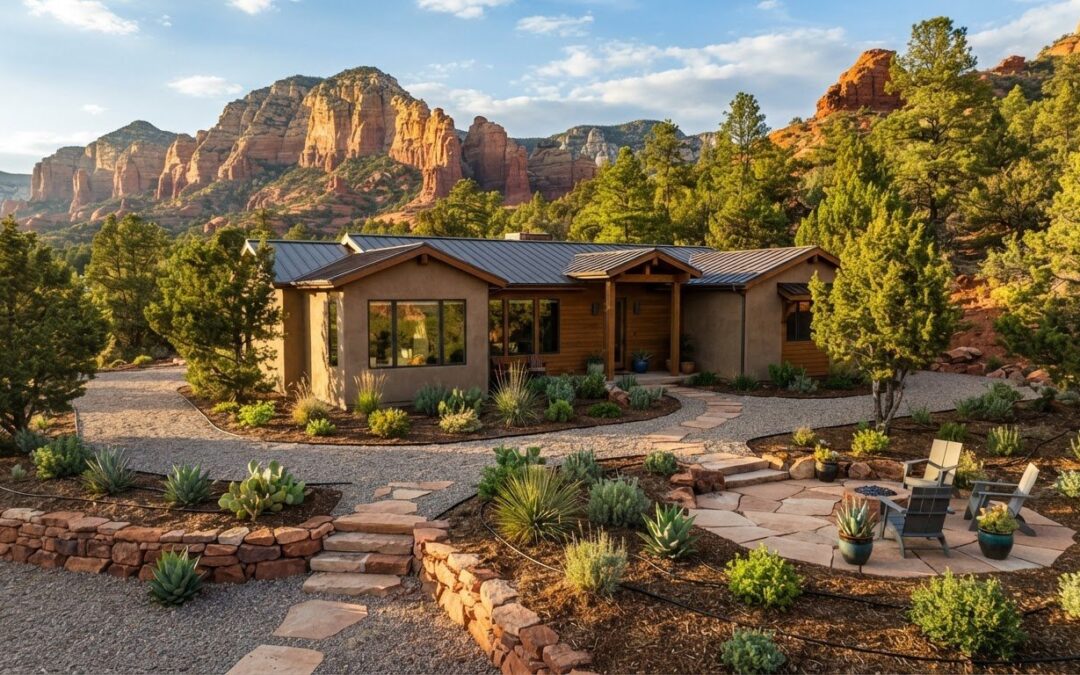
A fire-conscious yard doesn’t have to look stripped bare. Thoughtful wildfire mitigation landscaping can help manage the amount and arrangement of combustible material around a Northern Arizona home while preserving a healthy, attractive outdoor space.
If you’re unsure which plants or landscape materials may add to wildfire fuels, or what’s appropriate for a steep, dry, or wooded property, you’re not alone. Mitigation isn’t simply a matter of removing every plant or swapping in a few new ones. It’s an ongoing plan that considers how vegetation, structures, terrain, and routine maintenance work together.
This guide explains practical defensible-space principles and ways to manage fuels without losing the character of your landscape. You’ll learn what to check near the home, how plant choices and hardscape can support a thoughtful plan, and why regular cleanup matters. We’ll also cover how a site-specific assessment can help identify sensible next steps, whether that means adjusting planting, addressing drainage, or building a maintenance routine suited to conditions in Sedona, Camp Verde, Cottonwood, Flagstaff, Prescott, and the wider Northern Arizona region.
Key Takeaways
- Map structures, access routes, slopes, vegetation, dead material, and irrigation conditions to spot areas that may need attention.
- Look for connected groundcover, shrubs, and tree branches that can create continuous fuels, including pathways that carry fire upward.
- Use wildfire mitigation landscaping to manage fuel continuity while preserving a healthy, attractive yard, and plan for ongoing care.
- Follow a step-by-step walkthrough to prioritize manageable work instead of assuming every plant must be removed.
- Consider a site assessment when terrain, mature vegetation, drainage, or multiple structures make planning more complex.
What wildfire mitigation landscaping means for Northern Arizona properties
Wildfire is a real concern for properties near open land, woodlands, and dry vegetation across Northern Arizona. No landscape plan can eliminate that risk, but thoughtful choices can influence how fire may move through a property. Wildfire mitigation landscaping manages vegetation, combustible materials, and connected fuels to reduce a property’s exposure to wildfire, but it cannot guarantee protection.
The aim isn’t to remove every plant or create a bare yard. Instead, consider how vegetation and other combustible materials are arranged, where dead material collects, and how regular care can limit connected fuels. The right approach depends on the property, including its terrain, structures, and existing landscape.
How defensible space relates to landscape design
Defensible space is a maintained area around a structure where vegetation and other potential fuels are managed. Its condition can influence how fire reaches a building and can support safer working conditions for firefighters, but it isn’t a barrier that stops every fire. Landscape design helps shape this area through planting, spacing, hardscape, and maintenance decisions.
The wildland-urban interface, or WUI, describes places where homes and other development meet or intermingle with wildland vegetation. It helps explain why landscape choices matter, but it isn’t a property-specific risk diagnosis. Landscaping is also only one part of preparedness. It doesn’t replace firefighting, applicable building-code requirements, or household emergency planning.
Why local site conditions shape mitigation choices
Conditions can vary across the Verde Valley and Northern Arizona. A useful assessment considers slope and exposure, existing vegetation, structures, and access. The right way to manage vegetation beside a home may differ from what’s needed on a wooded slope or around several outbuildings. There isn’t one planting or clearance prescription that fits every property in Sedona, Camp Verde, Cottonwood, Flagstaff, or Prescott.
Dry conditions and seasonal weather can stress plants and affect how much maintenance they need. Irrigation performance, plant health, and dead material buildup all influence how a landscape functions over time. Make choices that respond to the site while supporting its health and appearance. For ideas on designing with regional conditions in mind, explore this Northern Arizona desert landscape design guide.
How vegetation, spacing, and landscape layers affect wildfire fuels
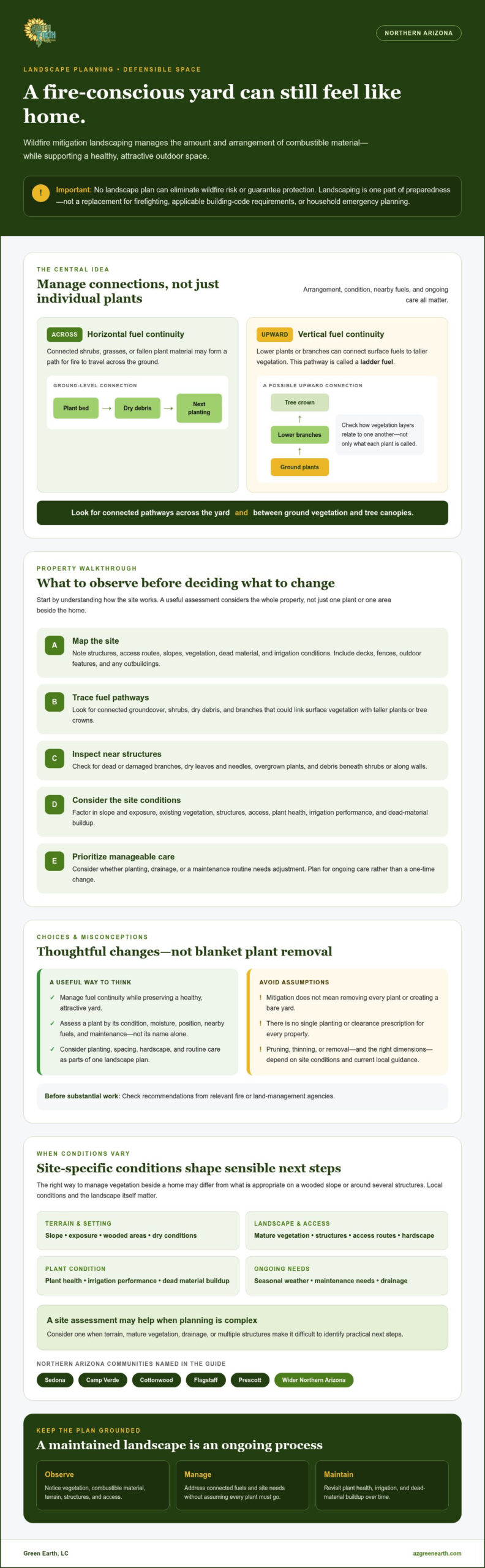
Fire can move through a landscape where vegetation and dry debris form connected paths. A continuous bed of shrubs, grasses, or fallen plant material may allow flames to travel across the ground. In other areas, plants and branches may create a route from surface vegetation into tree canopies.
This vertical connection is often called a ladder fuel: lower plants or branches can help fire climb toward taller vegetation. Arrangement matters as much as the individual plants. Horizontal fuel continuity can help fire move across a yard, while vertical continuity can connect ground-level fuels to tree crowns. A landscape plan should consider both.
Manage vegetation near structures without blanket plant-removal advice
Check the condition and placement of vegetation near buildings, decks, fences, and outdoor features. Look for dead or damaged branches, dry leaves and needles, overgrown plants, and debris caught beneath shrubs or along walls. A plant’s name alone doesn’t determine its risk. Its condition, moisture, position, nearby fuels, and maintenance all affect how it fits into the landscape.
Pruning, thinning, or removing vegetation may be appropriate in some places, but the right action and dimensions depend on site conditions and current local guidance. Check recommendations from relevant fire or land-management agencies before undertaking substantial work. Avoid applying a one-size-fits-all spacing rule to a property with varied slopes, vegetation, and structures.
Reduce connecting fuels while preserving a usable landscape
Look at how planting beds connect rather than focusing on a single shrub or tree. Breaking up a continuous bed or reconsidering shrubs beneath tree branches may interrupt fuel pathways while retaining useful shade, screening, and habitat. Keep plants maintained and regularly remove dead material that accumulates within or around them.
Mulch and other combustible materials also deserve a site-specific review, particularly near structures or where they connect with vegetation. Their suitability depends on placement and current local recommendations, so don’t assume one material is appropriate everywhere. Pavers or other hardscape can create functional spaces and interrupt planted areas, but hardscape isn’t a substitute for vegetation care.
Good wildfire mitigation landscaping balances fuel management with the way people use and care for their outdoor spaces. If you’re unsure how to adjust planting, maintenance, or hardscape for your site, a local landscape professional can help assess the options. Explore Green Earth’s landscape services as one resource for planning practical work.
Wildfire mitigation landscaping choices: useful changes and common misconceptions
Effective mitigation means making site-informed choices, not seeing how much vegetation you can remove. Keeping every plant isn’t always appropriate, but clearing a property without considering slope, soil, shade, erosion, and how the space is used can create other problems. The goal is to manage potential fuels while maintaining a landscape that functions and can be cared for.
No single plant label, mulch type, or hardscape material makes a property fire-resistant on its own. Placement, plant condition, nearby fuels, and maintenance all matter. Use the comparisons below to identify questions for your property, not as universal instructions.
| Landscape action | Intended benefit | Limitations and upkeep |
|---|---|---|
| Choose and place plants thoughtfully | Help avoid continuous beds and consider how shrubs relate to trees and structures. | Suitability depends on local conditions; plants still need care, and no plant choice removes wildfire risk. |
| Prune or manage vegetation | Address dead, damaged, or overgrown material that may connect fuels. | Work should reflect the plant, site, and current local guidance; excessive removal may harm the landscape or expose soil. |
| Clear accumulated debris | Reduce dry leaves, needles, and other dead material that can collect among plants or near structures. | Debris returns, so cleanup needs to be part of an ongoing routine. |
| Consider hardscape and irrigation condition | Hardscape can provide usable, less-vegetated areas; functioning irrigation supports plant health. | Hardscape doesn’t replace maintenance, and irrigation is not a promise of fire prevention. Material choice and placement still matter. |
Practical guidance, not guarantees
Be cautious of advice that ranks plants as universally safe or prescribes the same spacing and clearance for every yard. Local recommendations and requirements can vary, so check current guidance from the relevant fire authority or land-management agency before removing plants or setting dimensions. A professional familiar with the site can help weigh fuel concerns alongside drainage, erosion, and landscape use.
Green Earth offers Firewise Defensible Space, landscape maintenance, pavers and hardscape, irrigation drip system repair, and irrigation controller troubleshooting. These services can support specific parts of a broader plan, though they can’t guarantee protection. For related local context, see the Cottonwood defensible-space landscaping guide.
Wildfire mitigation landscaping can manage fuels and reduce some risks, but it can’t make a property fireproof. The most useful choices are matched to the site and maintained over time.
A practical wildfire mitigation landscaping walkthrough for your property
A useful plan starts with observation, not immediate removal. Walk the property when conditions are safe, take photos of areas that concern you, and note how the landscape connects from open ground to structures. This walkthrough helps organize questions and priorities. It isn’t a wildfire-risk assessment, code review, or certification.
Prioritise observations before choosing landscape work
Move through the site in a consistent order. Record what you see before deciding on major work:
- Structures and outdoor features: Note the home, sheds, decks, fences, and other features. Check for nearby plants and accumulated debris.
- Access: Check routes people use to reach buildings and move through the property. Flag places where vegetation or stored materials narrow access.
- Slope and drainage: Record steep areas, places where runoff collects, and signs of erosion. Grading decisions should account for how water moves across the site.
- Vegetation and dead material: Photograph dense or connected planting, overgrowth, damaged plants, and fallen leaves, needles, or branches.
- Irrigation condition: Look for visible signs that the system may not be working as intended, such as dry areas or leaks. Irrigation supports landscape health, but it doesn’t guarantee wildfire protection.
Keep notes specific: “dry branches touching the shed” is more useful than “yard needs cleanup.” Don’t climb, use power equipment, or attempt hazardous tree work to investigate. For work involving mature vegetation, steep ground, drainage changes, or uncertain clearances, seek qualified local help. Consult current agency guidance before deciding what to remove or alter.
Plan maintenance that keeps mitigation work effective
Turn your observations into a short priority list. Separate routine tasks, such as collecting fallen material, from design or construction decisions that need professional input. Set a recurring review around seasonal growth and weather changes. Recheck plant condition, debris accumulation, irrigation performance, access, and whether runoff is affecting slopes or structures. A property’s needs can shift as vegetation grows, weather patterns change, or outdoor spaces are modified.
For questions about grading and runoff, consult this Arizona drainage grading guide. Green Earth offers Firewise Defensible Space, landscape maintenance, irrigation services, and drainage grading that may support site-specific work. Discuss your landscape and mitigation priorities with Green Earth.
Use this walkthrough to identify observations, priorities, and questions for qualified professionals, not as a certification or guarantee of protection. A steady review routine helps keep wildfire mitigation landscaping responsive to the property over time.
When to work with a Northern Arizona wildfire mitigation landscaping professional
Some projects are straightforward to plan, while others call for a closer look at how vegetation, structures, access, and terrain interact. A site-specific landscape assessment can be useful if your property has steep or uneven ground, mature vegetation near buildings, drainage concerns, or several structures with different landscape conditions. It can help organize priorities and identify where current local guidance or another qualified professional is needed.
Consider bringing in a professional if you’re unsure which work to prioritize, how to preserve landscape function while managing fuels, or how grading and irrigation issues affect the plan. Landscaping can support risk reduction, but it doesn’t replace emergency planning, code advice, firefighting, or specialized forestry and tree-removal work. Green Earth does not offer large-scale tree removal.
What to ask before starting a mitigation landscape project
Ask how the proposed work accounts for your site’s slope, existing vegetation, structures, drainage, and intended use. Clarify what ongoing maintenance the plan will require and how it supports a healthy, functional outdoor space. Find out which recommendations are based on current local guidance and which questions should go to a fire authority, code official, arborist, or other qualified professional.
Request a clear scope of work. It should distinguish landscape services from emergency response, forestry work, and large-scale tree removal. This helps you understand what the project addresses, what remains outside its scope, and what follow-up may be appropriate.
How Green Earth can support landscape planning
Green Earth, LC is locally owned and based in Cornville, serving the Verde Valley and Northern Arizona, including Sedona, Camp Verde, Cottonwood, Flagstaff, and Prescott. Its landscape work includes Firewise Defensible Space and landscape maintenance, along with pavers, retaining walls, irrigation drip system repair, irrigation controller troubleshooting, and drainage grading. These services may support specific priorities in a broader wildfire mitigation landscaping plan, from maintaining the property to addressing hardscape, irrigation, or runoff concerns.
Green Earth has more than 47 years of experience and a sustainability focus. That experience can inform landscape decisions, but it doesn’t guarantee a particular wildfire outcome. The right scope depends on the property and should be discussed in that context.
If you’re ready to discuss a site-specific project, discuss your Northern Arizona landscape project with Green Earth.
Take the Next Step Toward a More Resilient Landscape
Wildfire mitigation landscaping is an ongoing process of managing vegetation and other fuels, not a one-time cleanup or a guarantee against fire. Start by observing how plants, structures, terrain, and access relate on your property, then prioritize practical work and regular maintenance. Thoughtful choices can reduce some risks while keeping your outdoor space healthy and useful.
For complex terrain, mature vegetation, drainage concerns, or multiple structures, a site-specific perspective can help clarify what to address and when to seek additional guidance. Green Earth is locally owned and based in Cornville, serving the Verde Valley and Northern Arizona. Its Firewise Defensible Space offering, landscape maintenance, construction, irrigation, and drainage services can support different parts of a broader property plan.
Discuss your Northern Arizona landscape project with Green Earth and explore next steps suited to your site. Thoughtful planning and steady care can help you make progress while preserving the character of your landscape.
Frequently Asked Questions
What is wildfire mitigation landscaping?
Wildfire mitigation landscaping is the ongoing management of vegetation, combustible materials, and connected fuels around a property to reduce some wildfire risks. It can include maintaining plants, managing dead material, and considering how landscaping relates to structures, access, and terrain. The right work depends on the site, so a plan for a wooded property near Flagstaff may differ from one for a home in Sedona, Camp Verde, or Cottonwood.
Can landscaping prevent a wildfire from reaching my home?
No. Landscaping can’t stop every wildfire or guarantee that a home will be protected. Managing dry vegetation, debris, and connected fuels may reduce some risks, but fire behavior and property conditions vary. Pair landscape maintenance with current guidance from local fire authorities and a household emergency plan. Treat landscape work as one part of preparedness, not a substitute for emergency response or building-code requirements.
What is defensible space in wildfire landscaping?
Defensible space is a maintained area around a structure where vegetation and other potential fuels are managed. Its condition can influence how fire reaches a building and may support safer working conditions for firefighters, but it isn’t a fireproof barrier. The appropriate approach depends on the property’s vegetation, slope, structures, and local guidance. Check with the relevant fire authority for recommendations that apply to your location.
Which plants are best for wildfire mitigation in Northern Arizona?
There isn’t one plant list that suits every Northern Arizona property. Plant condition, placement, spacing, water needs, and ongoing care all matter, and local recommendations may vary between Sedona, Prescott, Flagstaff, and lower-elevation areas such as parts of the Verde Valley. Before choosing or removing plants, consult current guidance from local fire or land-management agencies. A landscape professional can help consider suitable planting alongside the property’s terrain, irrigation, and maintenance needs.
Should I remove all trees and shrubs around my house?
No. Removing every tree and shrub isn’t necessary or appropriate for every property, and extensive clearing may affect shade, soil, drainage, and landscape function. Instead, assess how vegetation is arranged, whether dead or damaged material has accumulated, and whether plants connect fuels near structures. For mature trees, steep sites, or uncertain clearance decisions, seek qualified local advice and follow current agency recommendations rather than attempting hazardous work yourself.
How often should wildfire mitigation landscaping be maintained?
There’s no single maintenance schedule for every property. Review the landscape regularly, especially as seasonal growth, weather, and site conditions change. Check for fallen branches, dry leaves or needles, overgrown vegetation, and irrigation issues. After strong winds or other weather that leaves debris, reassess areas near structures and access routes. A recurring maintenance plan helps keep work effective, but timing should reflect your property and local guidance.
Can drip irrigation reduce wildfire risk?
Drip irrigation can support plant health when the system is working properly, but it doesn’t prevent wildfire or guarantee that plants won’t burn. Water needs vary by plant, season, and site conditions. Check for leaks, dry areas, and controller issues, and address repairs as needed. Irrigation is one consideration in a broader landscape plan, alongside plant placement, debris management, and ongoing maintenance.
Does Green Earth, LC provide large-scale tree removal?
No. Green Earth, LC doesn’t offer large-scale tree removal. The locally owned company is based in Cornville and serves the Verde Valley and Northern Arizona, including Sedona, Camp Verde, Cottonwood, Flagstaff, and Prescott. Its relevant offerings include Firewise Defensible Space, landscape maintenance, hardscape, irrigation services, and drainage grading. For large-scale tree work, contact a qualified provider and clarify the scope of service before arranging the work.
Recent Comments