
Did you know that 12.6% of properties in Yavapai County now face higher insurance premiums or policy cancellations specifically due to wildfire risk? For homeowners living among the Red Rocks, defensible space clearing sedona is no longer just a seasonal chore; it’s a critical financial and safety necessity. With the 2026 wildfire season already seeing over 1,300 fires across Arizona, the protection of your property has never been more urgent.
We understand the stress of trying to balance rigorous fire safety with the natural beauty of your landscape. It’s difficult to navigate the physical demands of clearing steep slopes while worrying if your efforts will clash with HOA regulations or strip away the character of your land. You shouldn’t have to choose between a safe home and a stunning view. You deserve a property that serves as both a sanctuary and a fortress against the elements.
This guide will teach you how to protect your Sedona property through strategic clearing that prioritizes ecological health and aesthetic appeal. We’ll preview the updated 2026 Sedona Fire District codes, explain the “Lean, Clean, and Green” three-zone strategy, and show you how to reveal the hidden beauty of your landscape while keeping your family safe.
Key Takeaways
- Learn how to implement defensible space clearing sedona using the 2026 three-zone strategy to create a safer, resilient buffer for your home.
- Discover the “Lean, Clean, and Green” principles that satisfy both local Firewise standards and strict HOA aesthetic requirements.
- Master the logistics of clearing on Sedona’s steep slopes while preventing soil erosion and maintaining regional drainage patterns.
- Understand when to transition from DIY brush removal to professional mastication and chipping for large-scale fuel reduction.
- Integrate fire safety with sustainable landscape design to ensure your property remains a beautiful, environmentally responsible sanctuary.
Why Defensible Space Clearing is Vital for Sedona Properties in 2026
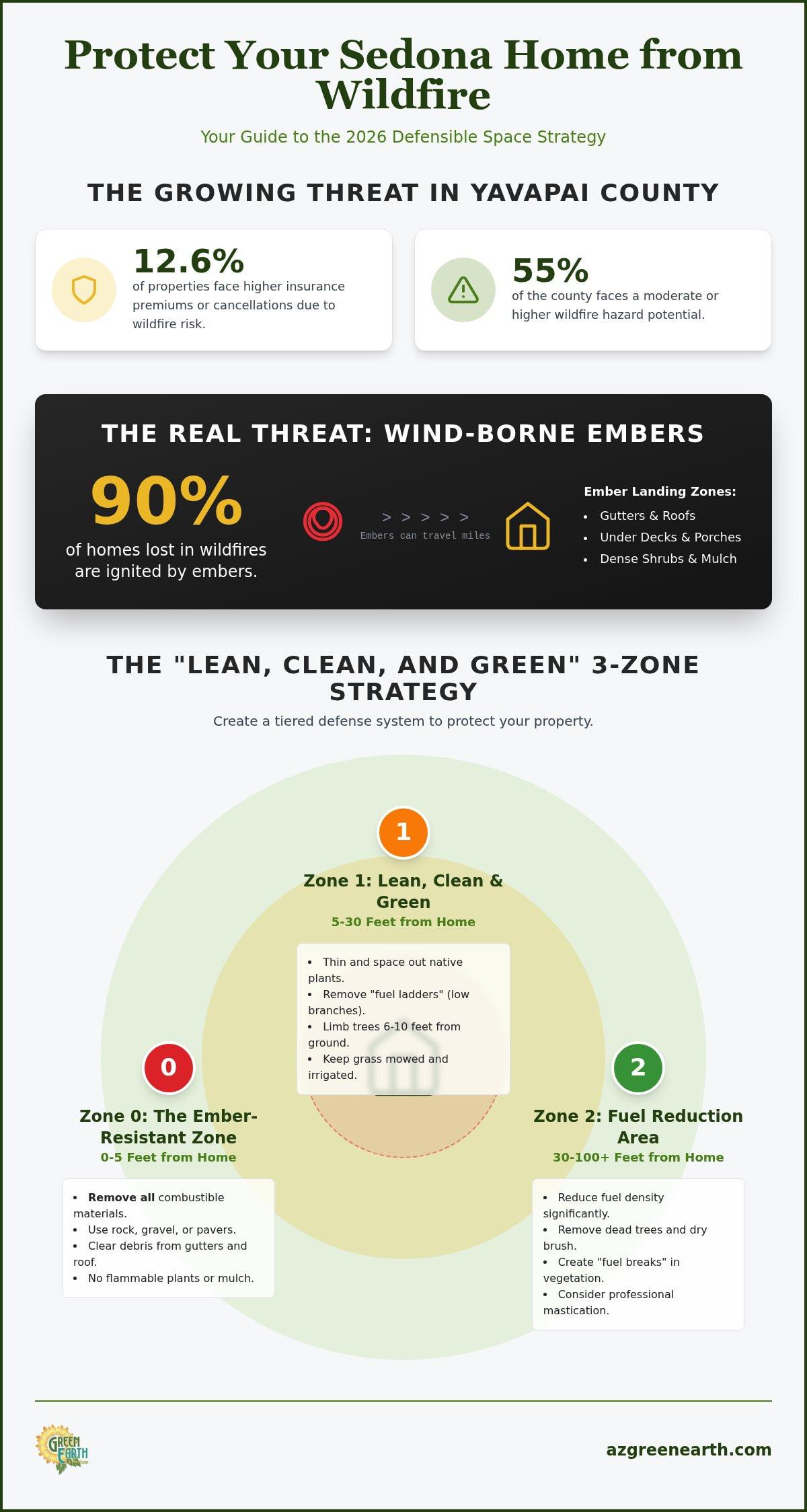
Understanding what is defensible space begins with recognizing it as a managed buffer between your home and the surrounding wilderness. In our high-desert environment, this zone acts as a critical break to slow or stop the spread of fire. The 2026 risk profile for Yavapai County is particularly stark. Statistics show that 55% of the county now faces a moderate or higher wildfire hazard potential. The recent Pocket Fire, which burned 27,393 acres just north of Sedona in July 2026, serves as a sobering reminder of why proactive defensible space clearing sedona is essential for every property owner.
Beyond physical safety, the economic landscape of Northern Arizona is shifting. Insurance providers are increasingly requiring proof of fuel reduction before renewing policies. Since 12.6% of Yavapai County properties are currently at risk of significant premium hikes or cancellations, maintaining a Firewise landscape is a financial imperative. Properties that meet these standards often see better market stability and preserved value. To support this, the 2026 “Fire Safe Sedona” program offers specific incentives and resources for owners who take early action to harden their homes and clear surrounding brush.
The Science of Ember Attacks
Most people imagine a wall of flames consuming a home, but the reality is different. Approximately 90% of homes lost in wildfires are actually ignited by wind-borne embers. These glowing coals can travel miles ahead of the main fire front, landing in gutters, under decks, or in dense shrubs. Effective clearing specifically targets these “ember landing zones” by removing the fine fuels that catch fire easily. Sedona’s unique canyon wind patterns often funnel heat and embers directly toward structures. This makes strategic vegetation management your first line of defense against long-range spotting.
Sedona’s 2026 Fire Ordinances
As of May 1, 2026, the Sedona Fire District has adopted the 2024 International Fire Code with specific local amendments. These ordinances mandate fuel reduction in high-risk Wildland-Urban Interface (WUI) areas. Navigating these rules can be tricky when they intersect with strict HOA aesthetic requirements. However, the city now offers expedited project approvals for owners who utilize certified Firewise clearing methods. Professional defensible space clearing sedona ensures your property meets these new standards without sacrificing the iconic Red Rock beauty that defines our community. By focusing on thinning and limbing rather than total removal, we help you stay compliant with both the fire marshal and your neighbors.
The 3-Zone Clearing Strategy: A Step-by-Step Blueprint
The “Lean, Clean, and Green” philosophy is the cornerstone of modern fire resilience. This approach proves that effective defensible space clearing sedona doesn’t require clear-cutting your entire acreage or stripping the land of its character. Instead, it involves strategic thinning that reveals the natural architecture of our local flora while removing “fuel ladders” that allow fire to climb. By prioritizing management based on proximity to your home, you create a tiered defense system that significantly increases your property’s chances of survival during a wildfire event.
Zone 0: The Non-Combustible Buffer (0–5 Feet)
The immediate five feet surrounding your home is the most critical area for preventing ignition from wind-borne embers. In this zone, the goal is to eliminate all combustible materials. This means removing dead leaves, pine needles, and traditional wood mulch that can easily catch fire. We recommend replacing organic ground cover with decorative stone or gravel to create a clean, non-combustible break. You should also ensure that gutters and roof valleys are clear of debris, as these are common “fuel beds” where embers settle. Following Arizona’s defensible space guidelines ensures that this high-risk perimeter is properly hardened against heat transfer.
Zone 1: The Lean and Green Space (5–30 Feet)
Moving further out, the 5 to 30-foot zone focuses on breaking the continuity of vegetation. Strategic spacing is vital here; trees and shrubs should be separated to prevent fire from jumping between them. You should limb up low-hanging branches to a height of 6 to 10 feet from the ground to eliminate the path fire takes from the forest floor to the canopy. While we focus on removing “volunteer” seedlings and invasive brush, we take care to preserve healthy native species like Manzanita. These plants are part of the Red Rock aesthetic, but they must be thinned and maintained to prevent them from becoming a hazard. Our team can help you design a Firewise Defensible Space plan that balances these safety zones with Sedona’s unique landscape beauty.
Zone 2: The Reduced Fuel Zone (30–100+ Feet)
The outermost zone is designed to slow an approaching fire by reducing the overall fuel load. In this area, we thin dense stands of vegetation to create both horizontal and vertical separation between fuel clusters. This doesn’t mean removing all trees; it means ensuring that the canopies don’t touch and that shrubs aren’t clustered directly under tree branches. We also manage dead-and-downed wood by removing heavy accumulations while leaving enough organic matter to protect soil health and prevent erosion. This methodical thinning reduces fire intensity, making it easier for firefighters to defend your property safely. Proper defensible space clearing sedona in this zone acts as the final buffer that protects your home from the surrounding wildland.
Sedona-Specific Challenges: Slopes, Flora, and Drainage
Sedona’s iconic topography presents unique obstacles for fire mitigation that generic guides often overlook. Unlike flat terrain, our steep hillsides create a chimney effect where heat rises and pre-heats uphill fuels, causing fire to move significantly faster. This geographical reality means that defensible space clearing sedona requires a specialized approach to plant spacing and soil retention. If you simply strip a hillside of its native brush without a plan, you risk catastrophic soil loss during the next monsoon cycle. Balancing safety with stability is the hallmark of a seasoned land manager.
Effective land management must account for the delicate link between fuel reduction and water flow. Removing ground-stabilizing vegetation can lead to severe erosion, making professional drainage grading Arizona a necessary companion to fire clearing. By integrating proper grading with your clearing efforts, you ensure that rainwater is directed away from your home’s foundation and that your topsoil remains intact even after the protective brush is thinned. This dual-focus approach protects your home from both the fire season and the heavy summer rains.
Managing Fuel on Steep Slopes
On a significant slope, the horizontal distance between shrubs must often be double or triple the standard requirements used on level ground. We utilize selective thinning techniques that keep the strongest root systems in place to hold the soil while removing the volatile “ladder fuels” that bridge the gap between the ground and the canopy. In many cases, installing retaining walls serves a dual purpose. These structures act as physical fire breaks and structural anchors that prevent slope failure after vegetation is thinned. They provide a clean, aesthetic solution to the physical challenges of our vertical landscape.
Fire-Resistant Sedona Native Plants
Selecting the right species is a core part of sustainable desert landscape design Northern Arizona. While native oaks and junipers are beloved features of our landscape, they require specific maintenance to remain fire-safe. We focus on “limbing up” these trees to create vertical clearance and removing dead wood from their interiors to reduce the fuel load. Low-fuel natives like agave, yucca, and prickly pear provide excellent ground cover that resists ignition. By strategically placing these fire-resistant species, you can maintain your property’s privacy and lush appearance while meeting the highest safety standards for defensible space clearing sedona.
Professional Clearing vs. DIY: Logistics and Safety
Managing a multi-acre Sedona property with dense juniper, scrub oak, and manzanita is a massive undertaking. The physical toll of defensible space clearing sedona on our steep, rocky terrain shouldn’t be underestimated. Homeowners often find that standard consumer tools are insufficient for the scale of fuel reduction required by current fire codes. While a professional team uses industrial masticators to shred thick brush in a fraction of the time, a DIY approach often leads to physical exhaustion and incomplete results. The sheer volume of material to be moved is usually the biggest surprise for property owners who attempt the work themselves.
Safety is the primary concern when operating machinery in the high desert. During Stage II Fire Restrictions, the risk of a metal blade striking a rock and sparking a fire is a genuine danger. Professionals utilize spark-aware protocols and carry specialized suppression equipment to ensure the clearing process remains safe. This level of preparation is difficult for a homeowner to replicate, especially when working on the challenging slopes common in the Verde Valley. Choosing professional intervention means you don’t have to risk your health or your property to achieve safety goals.
The Cost of Compliance vs. The Cost of Loss
Insurance companies in 2026 are increasingly strict, with 12.6% of Yavapai County properties facing higher costs or policy cancellations due to wildfire risk. A professional certificate of completion provides the necessary paper trail for these insurance audits, proving that your home meets local safety standards. Navigating HOA landscape maintenance Arizona guidelines is also much simpler with a partner who understands the fine line between fire safety and community aesthetics. Investing in a comprehensive clearing project offers a significant long-term ROI by securing your insurance eligibility and transforming a high-risk area into a manageable, beautiful landscape.
Tools and Techniques for High-Efficiency Clearing
Proper disposal is the final, often overlooked step in the fuel reduction process. Leaving piles of cut brush on the property creates “dead fuel” that is significantly more volatile than the living plants were. We prioritize hauling away debris or using high-capacity chippers to create mulch that can be safely integrated back into the soil for moisture retention. This methodical approach ensures that every pound of fuel removed is one less hazard near your home. By utilizing specialized equipment like chippers and masticators, we handle the biomass responsibly without creating new fire risks on your land.
Ready to harden your property against the 2026 fire season? Schedule a professional Firewise Defensible Space assessment to secure your home and protect the natural beauty of your landscape.
Partnering with Green Earth, LC for Firewise Excellence
Green Earth, LC brings over 47 years of experience to every project in the Verde Valley. We’ve spent decades understanding how fire moves through our unique canyons and high-desert plateaus. Our approach is that of an “Authoritative Environmentalist.” We believe that rigorous safety doesn’t have to come at the expense of ecological health or visual appeal. By choosing our team for defensible space clearing sedona, you’re partnering with a visionary leader that treats your property as a living ecosystem rather than a checklist of hazards.
We specialize in fire mitigation landscaping Sedona AZ, a service that goes beyond simple brush removal. We look at the big picture: how your plants, soil, and structures interact to create a resilient whole. As the statewide runner-up for Best Sustainable Landscape Designer, we take pride in our ability to transform high-risk areas into lush, fire-resistant sanctuaries that respect the local environment.
Our Sedona Firewise Process
Our methodical process begins with a comprehensive site evaluation. We identify specific fuel loads and determine the best thinning strategies to protect your home’s unique footprint. This isn’t just about cutting; it’s about aesthetic refinement. We coordinate directly with local fire marshals to ensure your property meets the requirements for Firewise certification. This professional verification is often the key to satisfying insurance auditors and HOA boards alike. To ensure your safety lasts, we offer ongoing maintenance plans. These scheduled visits keep your defensible space clearing sedona efforts compliant throughout the year, preventing new growth from becoming a future hazard.
Creating a Sustainable Sanctuary
True protection often requires a combination of vegetation management and structural upgrades. We frequently integrate clearing with hardscape construction Cottonwood AZ. Features like stone retaining walls and gravel pathways serve as permanent fire breaks that require zero maintenance and provide significant erosion control. Our expertise in drainage grading also ensures that your land remains stable after clearing, protecting you from the intense monsoon season. We’re dedicated to high standards of craftsmanship and environmental integrity in every project we touch.
Protecting your home is a long-term commitment. Let us help you navigate the complexities of 2026 fire regulations with confidence and style. Contact Green Earth, LC today for a Sedona defensible space consultation and take the first step toward a safer, more resilient property.
Securing Your Red Rock Legacy for the Future
Protecting your home in 2026 requires a proactive, methodical approach to land management. By implementing the tiered three-zone strategy and focusing on ember-resistant buffers, you can significantly reduce the risk of ignition. We’ve explored how strategic thinning and the “Lean, Clean, and Green” philosophy satisfy both fire marshals and HOA boards, ensuring your landscape remains both safe and stunning. Professional defensible space clearing sedona turns a daunting physical task into a sustainable investment in your property’s longevity.
As a Statewide Sustainable Landscape Design Award Winner with 47+ years of local expertise, Green Earth, LC understands the delicate balance of the Verde Valley ecosystem. We’re HOA and commercial compliance specialists dedicated to protecting your investment through expert execution. Secure your Sedona sanctuary with a professional defensible space assessment from Green Earth, LC.
You have the power to create a resilient landscape that stands strong against the elements. Take the first step today toward a safer, more beautiful future among the Red Rocks.
Frequently Asked Questions
How much clearing is required for a Firewise home in Sedona?
Firewise standards generally require a 100-foot radius of managed vegetation around your primary structure. This area is divided into three distinct zones. Zone 0 is a five-foot non-combustible buffer directly against the home. Zone 1 extends to 30 feet and focuses on wide plant spacing. Zone 2 reaches the 100-foot mark where thinning dense brush is the priority. These requirements help ensure your home meets the Sedona Fire District’s 2024 International Fire Code amendments.
Do I have to remove all the trees on my property to be fire-safe?
No, you don’t need to clear-cut your land to be safe. Firewise principles focus on “limbing up” existing trees and creating horizontal separation between canopies. You should remove low-hanging branches six to ten feet from the ground to prevent fire from climbing. Healthy, well-spaced native trees like oaks and junipers can remain, provided they don’t form a continuous path for flames to reach your roof or siding.
Can defensible space clearing help lower my Arizona home insurance?
Yes, defensible space clearing sedona is often a requirement for maintaining coverage or securing lower premiums in high-risk areas. With 12.6% of Yavapai County properties facing insurance instability in 2026, many providers now require proof of compliance before renewing policies. Professional clearing provides the documentation needed for insurance audits. By reducing the wildfire hazard potential on your land, you demonstrate to insurers that your property is a manageable and responsible risk.
What are the best fire-resistant plants for the Sedona climate?
The best fire-resistant plants for our region are high-moisture succulents and low-growing native species. Agave, yucca, and prickly pear cactus are excellent choices because they don’t easily ignite. You can also use deciduous shrubs that lack volatile oils. Avoid planting highly flammable species like Italian Cypress or dense rosemary near your foundation. Instead, prioritize rock-hardscaping and drought-tolerant perennials that stay green with minimal irrigation throughout the peak summer months.
Is there financial assistance for fire clearing in Yavapai County?
Yes, programs like “Fire Safe Sedona” and the “Firewise USA” initiative often provide resources and support for local homeowners. In 2026, the City of Sedona is prioritizing the expansion of these programs to help residents manage rising mitigation costs. You should contact the Sedona Fire District’s Community Risk Reduction Division at 928-204-8926 to check for current matching fund percentages or available grants that support proactive fuel reduction and clearing projects.
How often should I maintain my defensible space zones?
You should perform a thorough maintenance check at least once a year, preferably before the summer fire season begins in May. This includes removing dead leaves from gutters, thinning new seedlings, and clearing any dried weeds. Since Sedona’s vegetation can grow quickly after a wet winter, biannual inspections are even better. Regular upkeep is much more cost-effective than waiting until fuel loads become dangerous and require large-scale professional clearing again.
Does clearing brush cause erosion on Sedona’s red rock slopes?
Improper clearing can lead to soil loss, but professional defensible space clearing sedona utilizes selective thinning to prevent this. We keep deep-rooted native plants in place to anchor the soil while removing only the volatile surface fuels. On steep slopes, we often integrate retaining walls or drainage grading to manage water runoff. This ensures that your property remains structurally sound and protected from monsoon-driven erosion even after the dense brush is removed.
What is the difference between fire mitigation and defensible space clearing?
Fire mitigation is a comprehensive strategy that includes home hardening, ember-resistant vents, and community-wide planning. Defensible space clearing is a specific, critical component of that strategy focused on managing the vegetation surrounding your home. While mitigation looks at the entire structure and its environment, clearing creates the physical buffer zone that slows an approaching fire. Both are necessary to maximize your home’s chances of surviving a wildfire event in Northern Arizona.
Recent Comments