
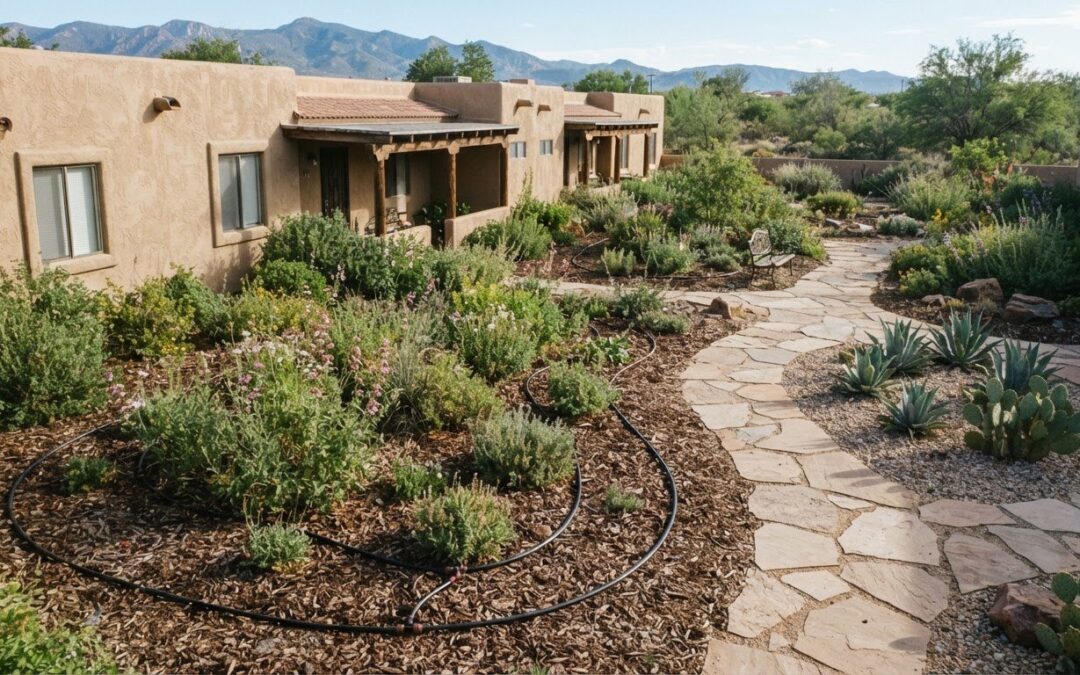
A drought-tolerant garden isn’t defined by how much gravel it contains. Effective low water garden design groups plants with similar water needs, chooses species suited to local conditions, and uses efficient irrigation and ground cover to limit waste. Native plants, mulch, permeable surfaces, and carefully placed succulents can all contribute to a landscape that needs less supplemental watering.
It’s understandable to want a garden that stays attractive without relying on frequent watering. The key is to plan the whole landscape around its plants, soil, sun exposure, and irrigation, rather than treating each choice separately. This guide explains what makes a garden drought-tolerant and how drip irrigation, watering timing, mulch, gravel, succulents, and fire-resistant hardscape can support lower water use while preserving a considered, welcoming outdoor space.
Key Takeaways
- Choose plants suited to regional conditions and group varieties with similar water needs to make irrigation more targeted.
- Learn how drip lines, soaker hoses, and cooler watering times can help deliver water where plants need it.
- Explore how mulch and living groundcovers shade soil, limit weeds, and help conserve moisture.
- See how gravel, succulents, and fire-resistant hardscape can support a lower-water landscape while shaping its look and function.
1. What is a drought-tolerant garden?
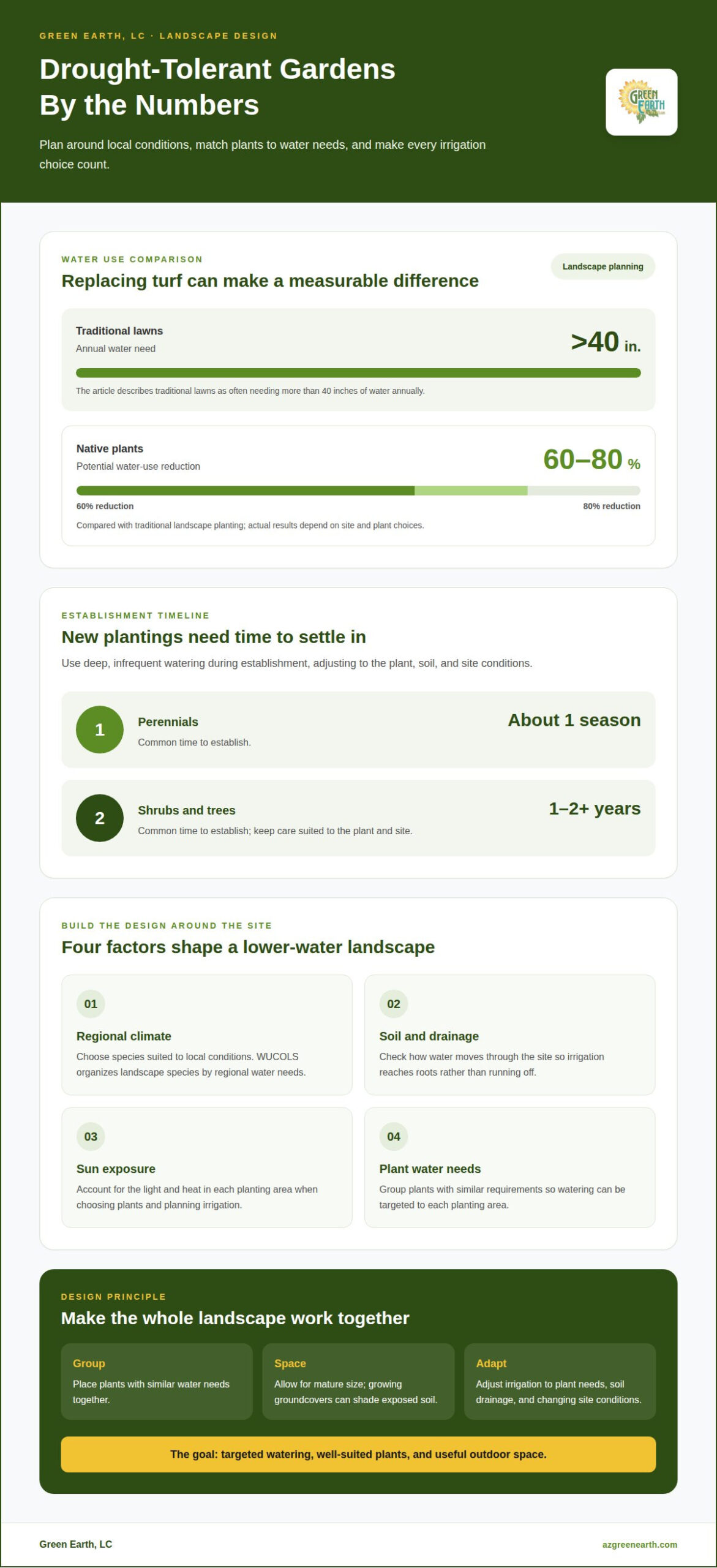
A drought-tolerant garden uses plants suited to the regional climate, soil, and sun exposure, with irrigation planned around their needs. A landscape professional assesses site conditions and groups plants with similar water requirements. That makes a low water garden design more responsive to each planting area instead of treating the entire landscape alike.
To select plants, professionals can consult the Water Use Classification of Landscape Species (WUCOLS) database, which organizes species by regional water needs. They also consider native plants adapted to local growing conditions. Another low water garden design consideration is mature plant size: spacing should allow room to grow while groundcovers gradually shade exposed soil.
Establishment takes planning. Perennials commonly need about one season to establish, while shrubs and trees often need 1-2+ years. Professionals use deep, infrequent watering during establishment, adjusting irrigation to the plant and site. Drip lines can deliver water near roots, while the schedule accounts for soil drainage and changing conditions.
Replacing turf involves assessing the irrigation system, soil, sun, and plant choices before installation. Professionals identify needed irrigation modifications, prepare the site, and install suitable plants and groundcovers. Traditional lawns often need more than 40 inches of water annually; native plants can reduce water use by 60-80% compared with traditional landscape planting. A third low water garden design decision is how much lawn to replace while retaining useful outdoor space.
Local restrictions, rebates, or landscaping rules can affect watering schedules, project requirements, and incentives. Details depend on local government, utility, and property. Installation costs vary with site preparation, planting quantities, mulch, lawn removal, and irrigation changes.
Common mistakes include overlooking drainage, combining plants with different watering needs, and neglecting establishment care. Matching plant choices and irrigation to site conditions helps prevent these problems.
2. Drip irrigation, soaker hoses, and watering timing
A low water garden design starts with irrigation that delivers moisture where plants can use it. Drip lines and soaker hoses apply water near roots, while overhead sprinklers wet foliage and surrounding surfaces. Drip irrigation is more than 90% efficient, compared with approximately 50-70% efficiency for sprinklers. The best layout depends on bed shape, plant spacing, soil, and slope, since runoff can carry water away from roots.
In low water garden design, watering schedules should reflect the plants and the site, not a single setting for every bed. Garden plants are generally best watered early, from 5 a.m. to 9 a.m., when cooler conditions can reduce evaporation. A professional considers soil moisture, drainage, and exposure when setting run times. A narrow shrub border, for example, may need a different schedule from a broad bed of groundcovers.
Before changing an existing system, a professional assesses the controller, irrigation zones, emitters, and coverage. A clogged outlet or leak can leave some plants dry while wasting water elsewhere. Slopes and drainage matter too: water may run downhill before reaching the root zone. These observations help determine whether the system needs repair, adjustment, or a revised schedule suited to the planting.
A controller can manage separate schedules for different zones, while drip lines can be positioned to serve plants as they grow. Regular troubleshooting helps identify programming issues and uneven delivery. If a system has faulty drip lines or inconsistent coverage, Irrigation Drip System Repair can address those problems. A well-planned low water garden design brings irrigation layout, controller settings, and planting needs together, making efficient watering part of the landscape rather than an afterthought.
3. Mulching to reduce evaporation and weeds
Mulch covers exposed soil, slowing evaporation and making it harder for weeds to take hold. Around tolerant plants, a professional selects material and depth based on the bed, nearby foliage, and soil conditions. Organic mulch, such as bark or wood chips, breaks down over time and adds organic matter. A common application depth is 3 to 4 inches, with space left around plant stems.
That separation matters. Mulch piled against stems or shrub trunks can keep the crown persistently damp and complicate routine inspection. In flower beds, a professional works the layer around established plants without burying low foliage. A 2-4 in. layer can shade soil, reduce evaporation and weeds, and moderate soil temperature. Mulch 3-5 in. thick has been tested to reduce soil evaporation by up to about 70%.
Inorganic mulch, including gravel or stone, lasts longer without decomposing and can suit beds where a mineral finish complements the planting. It generally needs a shallower layer, with 2 to 3 inches recommended. Rocks and organic mulch serve different purposes: gravel creates a durable surface, while organic material gradually contributes to soil structure. A landscape professional weighs appearance, plant needs, maintenance, and the site’s heat exposure before choosing.
To reduce water use, beds can combine groundcovers and grouped plants that shade more soil as they mature. Low-growing groundcovers act as living mulch, reducing evaporation and filling open spaces between shrubs and flowers. Closer planting can also shade soil, but spacing must allow for mature size and airflow. The result is a cohesive bed, not isolated plants surrounded by bare ground.
Seasonal upkeep keeps the mulch working. As organic material settles or decomposes, a professional checks coverage and replenishes thin areas without continually building excess depth. In a bed with native plants, the chosen mulch should complement the planting and preserve clear access to stems and irrigation outlets. Well-planned coverage helps conserve moisture while keeping the garden’s structure visible.
4. Gravel, succulents, and fire-resistant hardscape
Gravel gardens pair drought-tolerant plants with a clean, textured surface. Mediterranean plants often thrive in gravel settings, while cacti and succulents generally need less water than petunias or lobelia. When arranging gravel beds, consider sun, drainage, and mature plant size so foliage and flowers have room to grow without crowding paths.
Hen and chicks offer a compact example. Their rosettes grow 2 to 4 inches tall, and flower spikes can reach 12 inches. Used among stones or beside low-growing perennials, they add structure without filling the bed with thirsty plants. Ornamental grasses can provide movement and seasonal contrast, while boulders create visual anchors that connect planting areas to patios and pathways.
Hardscape materials also affect how rain moves across a garden. Permeable options such as gravel, stepping stones, and pavers allow water to percolate into the soil rather than run off. These surfaces can form walkways, patios, and transitions between planted beds. Plan the layout to guide movement through the garden while preserving space for plants suited to the site.
For a fire-smart backyard, hardscape can replace some combustible vegetation near outdoor living areas and create a clear break between planting zones. Stone, gravel, and pavers provide durable surfaces, but the overall layout matters too. When integrating hardscape with defensible-space planning, consider nearby plants, structures, and access routes. Material choices should support the landscape’s appearance as well as its intended function.
A cohesive design balances beautiful surfaces with living cover. For example, a gravel path can connect a paver patio to beds of succulents, grasses, and flowering perennials. In summer, well-positioned stones and paths provide structure while climate-adapted plants bring color. Explore paver hardscape options for a tailored outdoor layout.
Green Earth, LC
Green Earth, LC helps maintain water-conscious landscapes and address irrigation and defensible-space needs. Turn to the team when established planting beds need ongoing care, a drip system isn’t delivering water properly, or outdoor areas need Firewise Defensible Space. These services support the principles covered here by keeping landscape conditions and water delivery in view over time.
For properties managed by associations or businesses, HOA Landscape Maintenance and Commercial Landscape Maintenance help keep shared grounds cared for. Irrigation Drip System Repair and Irrigation Controller Troubleshooting address common system concerns, while Firewise Defensible Space supports fire-conscious landscape planning. The right next step depends on your property’s needs, whether that means routine care or attention to an existing system.
Contact Green Earth, LC to discuss your landscape needs.
Shape a landscape that fits your priorities
Start by defining how you want your outdoor space to work. Consider where you gather, which paths need clear access, and what views or features you want to preserve. These priorities help shape a low water garden design that feels intentional, rather than like a collection of separate water-saving choices.
Share your goals with a landscape professional, including any areas that are difficult to maintain or irrigate. The layout can then respond to how you use the property and the character you want it to have. For shared grounds, maintenance needs and fire-conscious planning can also inform the overall direction.
Green Earth, LC can help you consider the landscape as a connected whole and identify a practical next step for your property. Contact Green Earth, LC today to discuss your landscape. A thoughtful plan can make a more water-conscious garden a natural part of everyday life.
Frequently Asked Questions
What is a drought-tolerant garden?
A drought-tolerant garden uses plants that can withstand dry periods, while still receiving water during establishment and when conditions require it. It doesn’t mean a garden needs no water. The design considers how plants respond to local conditions, then places them where their needs can be met. In Northern Arizona, a professional also considers the differences between sunny, exposed areas and sheltered planting spots.
What is a low-water garden and how does xeriscaping work?
A low-water garden is planned to reduce supplemental irrigation without giving up useful outdoor spaces or visual variety. Xeriscaping applies that goal through coordinated choices: plant selection, layout, soil preparation, irrigation, and ongoing care. For example, a seating area can use hardscape alongside beds planted with species suited to their exposure. The result is a designed landscape, not simply a gravel-covered yard.
Which drought-tolerant plants are best for low-water gardens in the United States?
Suitable choices depend on local climate and planting conditions, but Russian sage, yarrow, and blue fescue offer different forms and textures. Plant hardiness varies by species and local conditions, so check whether a plant suits your garden before choosing it. These ranges help narrow options, but a plant’s sunlight, drainage, and mature size also affect where it performs well.
How can a landscape professional choose low-water plants for your USDA hardiness zone and local climate?
A professional considers the USDA hardiness zone alongside site conditions, since a zone alone doesn’t describe every planting bed. A sunny slope and a shaded area, for example, can create different growing conditions on the same property. Compare suitable species with regional water needs, then account for soil drainage and available space. This helps avoid choosing plants solely by their labels or appearance.
Which irrigation system is most efficient for a low-water garden, and what should a professional consider when installing drip irrigation, soaker hoses, or sprinklers?
Drip irrigation is generally the most efficient choice for planted beds because it delivers water near roots. Soaker hoses can suit continuous rows, while sprinklers may serve broader areas. A professional considers bed shape, plant spacing, soil, slopes, and existing equipment before deciding how to divide irrigation zones. For example, a narrow shrub border and a broad groundcover bed may need different layouts and schedules.
How do professionals prepare soil and use mulch to conserve water in a drought-tolerant garden?
Assess soil texture and drainage before planting. Compost or other organic matter may help improve soil and drainage. Choose mulch to suit the bed: organic material adds matter as it breaks down, while gravel provides a longer-lasting mineral surface. Around flowering plants and shrubs, cover exposed soil while keeping plant crowns and stems clear.
Recent Comments