
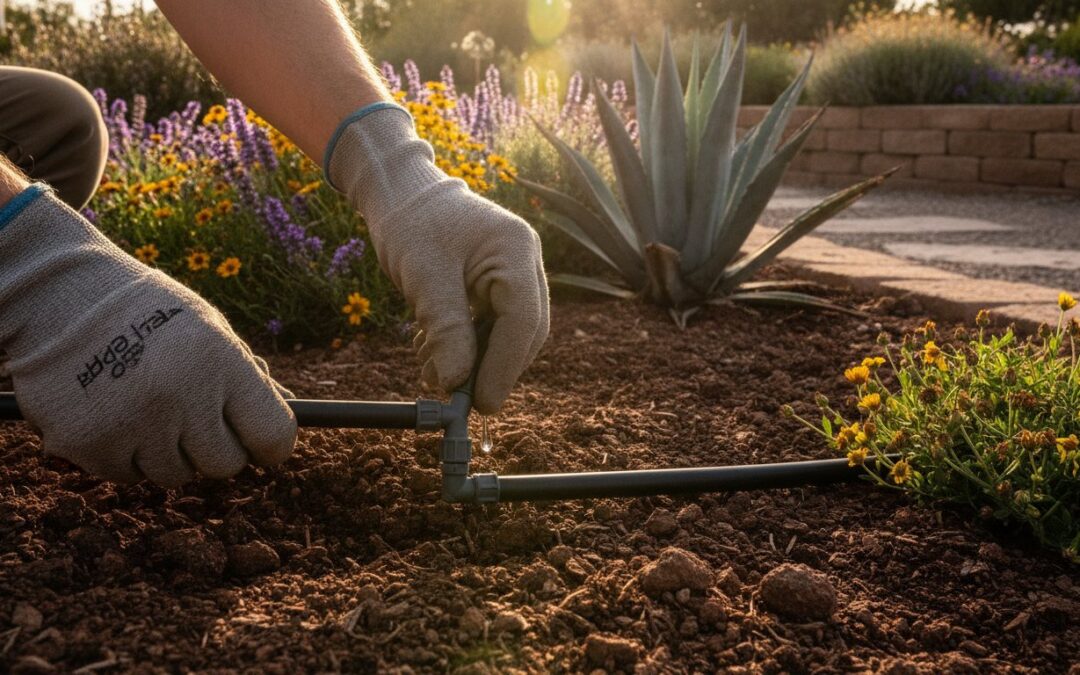
Imagine walking out to your garden only to discover a favorite agave wilting while your water bill reaches an unexpected high. In Northern Arizona, a single hidden leak or a line punctured by thirsty javelinas can waste thousands of gallons before you even notice a damp spot in the soil. Mastering drip irrigation repair Arizona isn’t just about fixing a broken pipe; it’s about acting as a responsible steward of our precious desert resources while ensuring your outdoor sanctuary remains vibrant.
You likely already know that Arizona’s hard water and extreme temperature swings are relentless on irrigation components. It’s frustrating to watch your investment struggle against clogged emitters and brittle lines. This guide provides the essential knowledge you need to diagnose common issues, from mineral scaling to pressure imbalances, so you can protect your landscape’s health. We will walk through the technical steps of repairing poly lines and cleaning filters, ensuring your system operates with the precision required to sustain thriving flora. By the end, you’ll have the confidence to maintain a leak-free system that balances mechanical excellence with environmental integrity.
Key Takeaways
- Identify “silent” leaks by monitoring your water meter and recognizing unusual vegetation growth before water waste escalates.
- Master the essential tools and safety steps required for effective drip irrigation repair Arizona to ensure a durable, leak-free system.
- Protect your landscape from Northern Arizona’s extreme climate shifts through proactive winterization and seasonal “Summer Survival” audits.
- Gain technical insights into high-efficiency water delivery that supports healthy desert flora while minimizing environmental impact.
- Learn how professional irrigation troubleshooting and sustainable design can enhance your property’s resilience and aesthetic beauty.
Understanding the Anatomy of Arizona Drip Irrigation
At its core, drip irrigation is a low-pressure, high-efficiency delivery system designed to provide water directly to the root zones of plants. Unlike traditional methods that broadcast water over large areas, this system uses a network of valves, pipes, and emitters to release water slowly and precisely. In our arid Northern Arizona environment, this technology is the gold standard for landscape management. It allows homeowners to maintain lush, healthy gardens without the excessive waste associated with surface flooding or high-impact sprays.
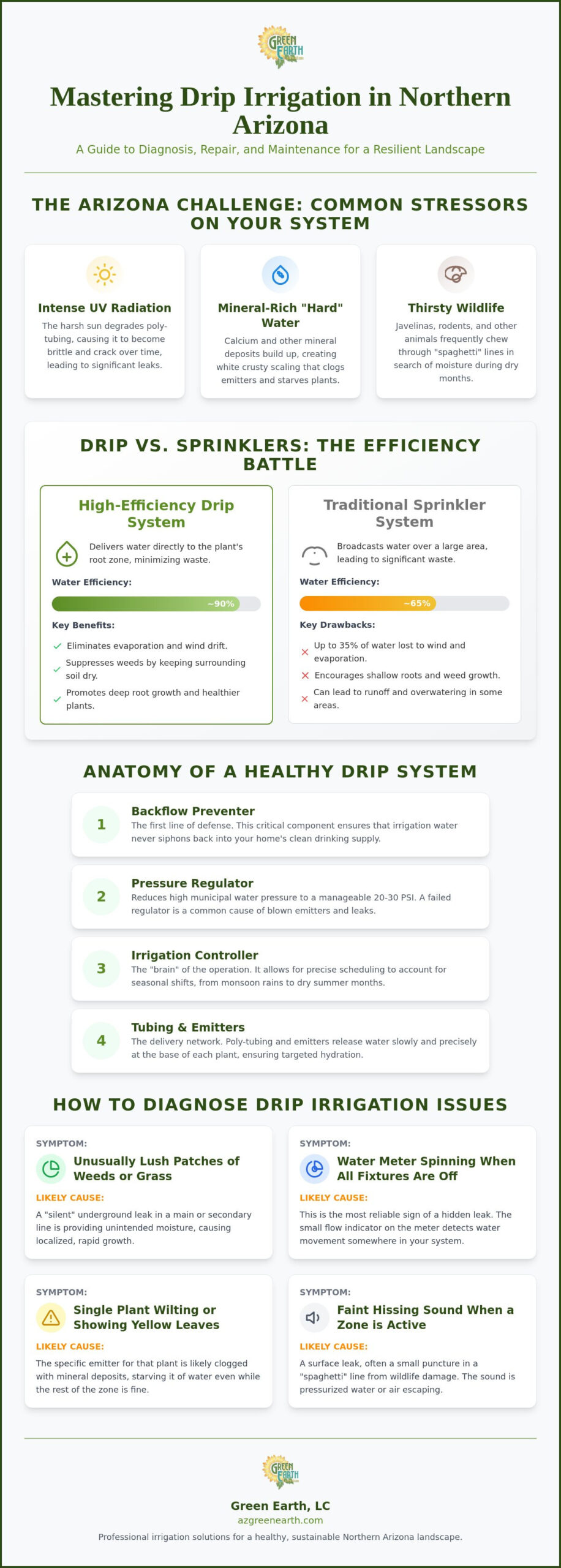
A functional system relies on several critical components working in harmony. The backflow preventer ensures that irrigation water never siphons back into your home’s clean drinking supply. Following this, the pressure regulator reduces the high pressure from municipal lines to a manageable level, usually between 20 and 30 PSI. Without this regulation, the delicate emitters at the end of the line would simply pop off or burst. Finally, the irrigation controller acts as the brain of the operation, allowing for precise scheduling that accounts for the dramatic seasonal shifts between the monsoon rains and the dry summer months.
The Benefits of Drip vs. Traditional Sprinklers
In the intense Sedona heat, traditional sprinklers often lose a significant portion of their output to wind drift and evaporation before a single drop reaches the soil. Drip systems eliminate this waste by applying water under a layer of mulch or directly at the base of the plant. This localized watering also serves as a natural form of weed suppression. By keeping the surrounding soil dry, you deny invasive species the moisture they need to germinate. For residents in the Verde Valley, this precision is essential for meeting long-term water conservation goals while preserving the aesthetic beauty of their desert flora.
Common Components That Fail in Desert Climates
The Arizona sun is notoriously harsh on outdoor materials. Over time, intense UV radiation causes standard poly-tubing to become brittle and crack, leading to significant leaks. When homeowners seek drip irrigation repair Arizona, the issue is frequently a failed pressure regulator. A malfunction here allows high-pressure surges to compromise the entire line, often blowing out emitters or causing “silent” underground leaks. Additionally, the mineral-heavy “hard” water common in Northern Arizona leads to calcium buildup. These deposits eventually clog emitters, starving your plants of hydration even when the system appears to be running. Regular troubleshooting is the only way to catch these mechanical failures before they impact the health of your landscape.
How to Diagnose Drip Irrigation Issues in Northern AZ
Effective drip irrigation repair Arizona begins with a systematic diagnostic phase. In our high-desert climate, water doesn’t always pool on the surface during a leak; it often drains through porous soil or remains trapped beneath a layer of decorative rock. To find these hidden issues, start by looking for “unusually lush” patches of weeds or grass. If one area of your landscape is significantly greener than the rest, it’s likely receiving unintended moisture from a compromised line.
Monitoring your water meter is the most reliable method for detecting silent leaks. Ensure all indoor appliances and faucets are off, then locate your meter box. Most modern meters have a small leak indicator, often a red or blue star or triangle, that spins even with a minute flow. If that dial is moving, you have a breach. For those managing more complex systems, irrigation controller troubleshooting Arizona homeowners can perform can reveal if the issue is mechanical or electronic.
Don’t ignore what your plants are telling you. Yellowing leaves or stunted growth on a single shrub often points to a clogged emitter. In Northern Arizona, our water is rich in minerals that create white, crusty calcification. This “hard water” buildup eventually chokes off the flow entirely. Walk your zones while the system is running manually to ensure every plant receives its designated share.
Identifying Leak Locations
Leaks generally fall into two categories: surface damage and underground breaks. Surface leaks are often the result of local wildlife. Javelinas and rodents frequently chew through “spaghetti” lines in search of moisture during the dry months. If you hear a faint “hissing” sound while a zone is active, follow the noise to find pressurized air or water escaping from a puncture. Underground main-line breaks are more deceptive and may require probing the soil for soft spots or checking for a drop in overall system pressure. Understanding the full scope of desert irrigation system repair — from UV-degraded tubing to shifting desert soils — is essential for accurately diagnosing these hidden failures before they escalate into costly water waste.
Troubleshooting Controller and Valve Problems
If a specific zone refuses to turn on, the culprit is usually the valve or the controller wiring. Check the valve box for standing water or signs of corrosion on the wire nuts. A failing solenoid, the cylindrical component on top of the valve, often produces a clicking sound or feels hot to the touch. Additionally, review your controller’s programming. Arizona’s monsoon season brings heavy rains that should trigger a change in your watering frequency. If your system is still running a peak summer schedule during a wet July, you are overwatering and risking root rot. For a deeper dive into diagnosing timer failures and programming glitches, our comprehensive guide to irrigation controller troubleshooting in Arizona walks you through every step of restoring your system’s efficiency.
Step-by-Step Guide: Common Drip Irrigation Repairs
Maintaining a resilient landscape in Northern Arizona requires a proactive approach to system maintenance. When addressing drip irrigation repair Arizona, having a dedicated repair kit is essential. You’ll need a specialized punch tool, barbed couplers, and a variety of emitters. It is vital to use professional-grade, UV-resistant materials. Standard retail tubing often lacks the carbon black additives required to withstand the intense high-altitude sun, leading to premature failure and more frequent repairs.
Before beginning any work, prioritize safety by shutting off the main water supply at the backflow preventer or the dedicated irrigation shut-off valve. Open a manual bleed screw on one of the valves to release residual pressure. This prevents a sudden spray of water and ensures that your fittings seat correctly. Once the repair is complete, always test the system under full pressure for at least five minutes to confirm the integrity of the seals before reburying any lines or covering them with decorative rock.
Fixing a Punctured Poly-Tube
Punctures from garden tools or wildlife are common. To fix a clean break, use a pair of sharp tubing cutters to remove the damaged section. Insert a barbed coupler into both ends of the remaining tube, ensuring they are fully seated against the center ring of the fitting. A goof plug is a small, dual-ended plastic insert used to permanently seal holes in poly-tubing after an emitter has been removed or relocated. For larger blowouts, you may need to bridge the gap with a new segment of UV-rated tubing and two couplers to ensure a tension-free connection.
Replacing Clogged Emitters
Mineral deposits are the primary enemy of emitter performance. When a head stops dripping, don’t just yank it out; use your punch tool to widen the opening slightly if the tubing has hardened. Select a replacement emitter with the correct Gallons Per Hour (GPH) rating for the plant’s needs, typically 0.5 GPH for small perennials or 2.0 GPH for larger shrubs. A critical, often overlooked step is flushing the system. Open the end caps of your lateral lines and run the water for one minute to clear out any debris or calcium flakes before installing new heads.
When to Call a Professional in Sedona or Flagstaff
While minor leaks are manageable for most homeowners, certain scenarios require expert intervention. If you discover a main-line break beneath expensive pavers or within a complex retaining wall, professional equipment is necessary to minimize property damage. Additionally, Arizona law requires certified testing for backflow prevention devices to protect the municipal water supply. For homeowners dealing with aging infrastructure or high-altitude challenges, seeking irrigation repair Flagstaff ensures your system is optimized for extreme temperature swings and long-term sustainability.
Northern Arizona Maintenance: Winterization and Summer Survival
Managing a landscape in Northern Arizona requires a distinct strategy compared to the lower deserts. While Phoenix homeowners focus primarily on heat, residents in the Verde Valley and the high country must account for extreme temperature fluctuations. A robust schedule for drip irrigation repair Arizona ensures that your system survives both the sub-zero winters of Flagstaff and the scorching pre-monsoon dry spells of June. Aligning your maintenance with the local climate cycle is the most effective way to preserve water and protect your botanical investment.
The “Summer Survival” audit should take place every May. June brings our highest evaporation rates, which can put immense stress on native and non-native plants alike. During this time, even a small leak can lead to rapid plant failure as the soil dries out faster than the system can compensate. Once the monsoons arrive in July, shift your focus to smart controller management. Modern systems can integrate local weather data to skip cycles during heavy rainfall, preventing soil saturation and nutrient leaching. By understanding plant dormancy periods in late autumn, you can gradually reduce watering frequencies, allowing your desert flora to transition naturally into the colder months.
Winterizing Your System in Flagstaff and Prescott
In the high country, winterization is non-negotiable. Exposed backflow preventers are highly susceptible to freeze-cracks, which often lead to expensive emergency repairs in the spring. Wrap these units in insulated blankets and ensure the internal valves are turned to a 45-degree angle to allow for expansion. Draining your lateral lines is equally important to prevent ice from splitting the poly-tubing. The “blow-out” method involves using a high-volume air compressor to force all remaining moisture out of the lines, ensuring no water is left to freeze and expand in the underground pipes.
Hard Water Management for the Verde Valley
In communities like Camp Verde and Cottonwood, the high mineral content of the water presents a constant challenge. Calcium and magnesium deposits create a white crust that eventually seals emitters shut. For larger residential or commercial systems, periodic acid-flushing with a mild, landscape-safe solution can dissolve these blockages before they require full replacement. Installing a high-quality sediment filter at the main source can significantly extend the life of your components. Even with filtration, we recommend a regular emitter replacement cycle every 18 to 24 months in high-calcium areas to maintain uniform water distribution.
If you’ve noticed a drop in pressure or suspect your system isn’t ready for the upcoming season, our team is here to help. Contact us for professional irrigation drip system repair to ensure your landscape remains healthy and efficient year-round.
Sustainable Drip Solutions by Green Earth, LC
With a legacy spanning more than 47 years in Northern Arizona, Green Earth, LC has established itself as a leader in ecologically responsible land management. We believe that professional drip irrigation repair Arizona is more than a mechanical fix; it’s a vital component of a healthy, sustainable ecosystem. Our team approaches every project with the mindset of an authoritative environmentalist, ensuring that your water delivery system supports the long-term vitality of your soil and plant life. By combining technical precision with deep regional knowledge, we help homeowners and property managers reduce water waste while enhancing the natural beauty of the high desert.
Our expertise extends beyond simple repairs to comprehensive system design. We specialize in creating custom irrigation solutions that integrate seamlessly with other essential land services. For instance, we often design irrigation layouts that support firewise landscaping Cottonwood AZ, ensuring that defensible spaces remain hydrated and resilient against wildfire risks. Additionally, our deep roots in the community make us a preferred partner for HOA landscape maintenance Arizona. We understand the unique budgetary and aesthetic requirements of board members and residents in Northern Arizona, providing reliable troubleshooting that keeps common areas thriving through every season.
Smart Technology Integration
The future of water conservation lies in the marriage of traditional craftsmanship and modern innovation. We specialize in the installation of Wi-Fi enabled smart controllers that offer real-time leak detection and remote monitoring capabilities. These systems allow you to adjust your watering schedule from a smartphone, responding instantly to the unpredictable weather patterns of the Verde Valley. When paired with soil moisture sensors, your system stops operating based on a rigid timer and starts watering based on actual plant needs. This data-driven approach is backed by the Green Earth guarantee of professional craftsmanship, ensuring your investment pays for itself through lower utility costs and improved plant health.
Get Started with a Professional Irrigation Audit
If you’re unsure where your water is going, a professional irrigation troubleshooting session is the most effective first step. During an audit, our technicians perform a zone-by-zone analysis to identify hidden leaks, pressure imbalances, and clogged emitters that DIY checks might miss. We provide a clear, prioritized plan for repairs or upgrades tailored to your specific terrain and microclimate. Our service area includes the diverse landscapes of Sedona, Camp Verde, Cottonwood, Flagstaff, and Prescott, allowing us to bring specialized knowledge to every corner of the region.
Don’t let a failing system compromise the health of your desert sanctuary or inflate your monthly bills. Take control of your water management with a partner who cares about the environmental integrity of your property. Schedule your professional irrigation repair today.
Securing Your Northern Arizona Landscape’s Future
Mastering the mechanical and seasonal nuances of your watering system is a vital step toward long-term property health and environmental responsibility. From identifying silent leaks through meter monitoring to adapting your infrastructure for the freezing winters of Flagstaff, proactive care prevents costly waste. We’ve explored how technical precision and smart technology can transform a standard system into an efficient, eco-friendly asset that sustains your desert flora even during the harshest June dry spells. It’s about more than just maintenance; it’s about being a responsible guardian of our regional resources.
If you’re ready to optimize your water usage, professional expertise makes all the difference. With over 47 years of regional experience and a reputation for award-winning sustainable landscape design, Green Earth, LC is the trusted partner for residential, commercial, and HOA properties. We are expert HOA and commercial service specialists dedicated to high standards of craftsmanship. We specialize in complex drip irrigation repair Arizona and comprehensive system troubleshooting. Request a Professional Irrigation Audit from Green Earth, LC today to ensure your landscape thrives in our unique climate. Let’s work together to protect the natural beauty of our local communities for years to come.
Frequently Asked Questions
How much does drip irrigation repair cost in Arizona?
The total cost for repairs depends on the complexity of the issue and the labor required for diagnostics. While small DIY components like emitters are inexpensive; professional intervention covers the expert troubleshooting and specialized equipment needed to locate hidden leaks. Investing in a professional audit often pays for itself by preventing the water waste associated with undetected underground breaks.
How do I know if my drip irrigation line is clogged?
You can identify a clog by checking for dry soil around specific plants or observing emitters that fail to release water during an active cycle. In Northern Arizona, white and crusty mineral buildup on the emitter heads is a clear sign of hard water calcification. If multiple plants in a single zone are wilting, the blockage may be located further up the line in a filter or main valve.
Can I use a regular garden hose for drip irrigation repairs?
No, you shouldn’t use a standard garden hose because it isn’t compatible with drip system fittings or pressure requirements. Drip systems rely on specific UV-resistant poly-tubing and barbed connectors designed to maintain a watertight seal at low pressures. Using improper materials will lead to blowouts and inefficient water delivery that can harm your landscape’s health.
What is the best time of day to run drip irrigation in Arizona?
The most efficient time to water is in the early morning, ideally between 4:00 AM and 8:00 AM. This schedule allows water to soak deeply into the root zones before the sun’s intensity increases evaporation rates. Watering during these cooler hours also ensures that your plants are fully hydrated before they face the peak heat of a Northern Arizona afternoon.
How long do drip irrigation systems last in the Arizona sun?
A high-quality system typically lasts between 10 and 15 years when it’s maintained properly and protected from the elements. Professional-grade tubing with carbon black additives resists UV degradation better than standard retail products. However, the extreme temperature swings in high-altitude climates mean you may need to replace smaller components like emitters or spaghetti lines more frequently.
Do I need a pressure regulator for my drip system?
Yes, a pressure regulator is a non-negotiable component that protects your emitters from being blown off the tubing by high-pressure surges. Without this device, the force of municipal water can cause system-wide failures that necessitate an extensive drip irrigation repair Arizona session. Maintaining a steady pressure of 20 to 30 PSI ensures your system operates with the mechanical precision it was designed for.
Why is my drip system making a whistling sound?
A whistling or high-pitched noise usually signals air trapped in the lines or a vibration within a failing pressure regulator. It can also indicate a small puncture where air and water are being forced through a narrow opening under pressure. These sounds often point to damage caused by local wildlife, such as javelinas or rodents, who may have chewed through the lines in search of moisture.
How often should I check my irrigation system for leaks?
You should perform a thorough visual inspection at least once a month during the primary growing season. Walking your zones while they are active allows you to spot pooling water or dry patches that indicate a malfunction. Regular checks, combined with monitoring your water meter for “silent” flow, are the best ways to ensure your drip irrigation repair Arizona needs remain minor and manageable.
Recent Comments