
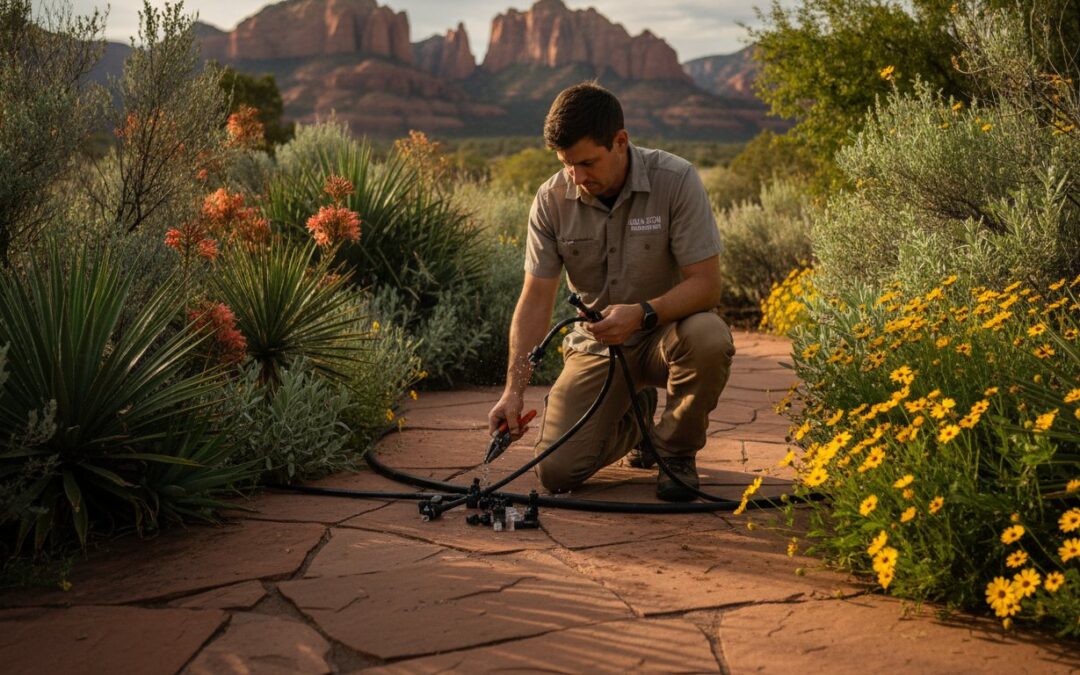
With Lake Mead sitting at a critical 1,046 feet and “Exceptional” drought conditions impacting every county in Arizona, can your property afford even a single undetected leak? You’ve likely noticed your water bills climbing alongside the summer temperatures, or perhaps you’ve felt the frustration of watching native plants struggle despite your system running daily. In our unique Northern Arizona environment, effective desert irrigation system repair is a matter of both financial wisdom and environmental stewardship. It’s a challenge that requires more than just basic plumbing; it demands a deep understanding of how intense UV rays and shifting desert soils impact our precious water resources.
We understand that maintaining a healthy, green landscape while adhering to strict local watering schedules can feel like a difficult balancing act. This guide provides the technical expertise you need to diagnose common failures, optimize your water delivery, and protect your investment against the harsh 2026 climate. We’ll walk through professional troubleshooting steps for controllers and drip lines, ensuring your system is durable enough to thrive through the monsoon season and beyond. This overview offers a clear roadmap to creating a more sustainable, resilient, and cost-effective outdoor sanctuary for your home or business.
Key Takeaways
- Understand how Northern Arizona’s unique environmental stressors, including caliche soil shifts and intense UV radiation, compromise the longevity of your irrigation components.
- Learn to identify “silent” leaks and subtle visual cues like salt crusting to prioritize your desert irrigation system repair before water waste escalates.
- Discover the technical advantages of drip irrigation for sustainable desert beauty and how to optimize sprinkler zones to meet modern HOA efficiency requirements.
- Master essential maintenance protocols, such as system flushing and seasonal controller adjustments, to ensure your landscape remains resilient through the 2026 monsoon season.
- Gain professional insights from 47 years of regional experience on balancing high-performance water delivery with long-term ecological stewardship.
Why Desert Irrigation Systems Fail: The Harsh Reality of Northern Arizona
Northern Arizona presents a beautiful but brutal environment for landscape infrastructure. While a standard drip irrigation system might last decades in more temperate climates, our local conditions accelerate wear and tear on even the highest quality components. Successful desert irrigation system repair requires understanding these unique environmental stressors before they compromise your property’s water efficiency and plant health.
UV Degradation and Component Fatigue
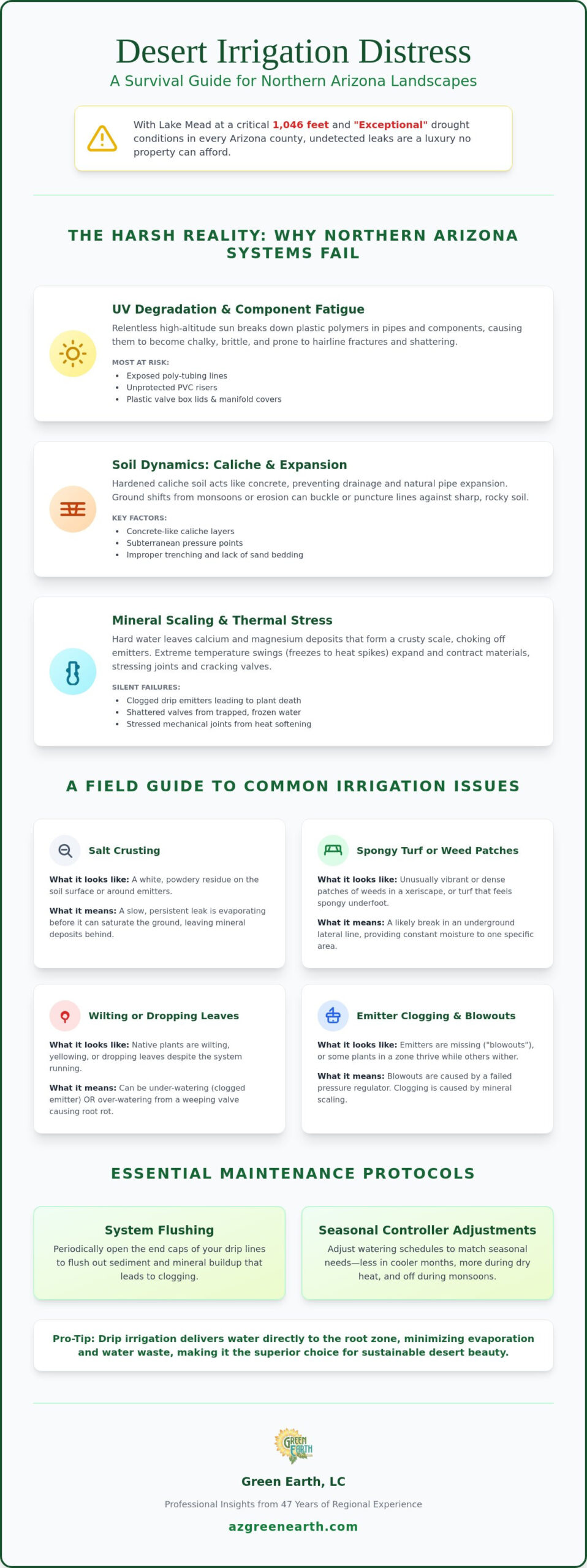
The high-altitude sun in Flagstaff and the intense solar gain in Sedona create a relentless assault on plastic components. Over time, UV radiation breaks down the polymer chains in PVC and poly-tubing, a process known as photo-degradation. This causes once-flexible materials to become chalky, brittle, and prone to hairline fractures. UV degradation in irrigation is the primary cause of surface-level leaks, often manifesting as shattered risers or cracked valve box lids that crumble at the touch.
Exposed components are most at risk in our climate:
- Poly-tubing lines that have worked their way to the surface due to soil erosion.
- Standard PVC risers that lack UV-resistant coatings or protective sleeves.
- Plastic manifold covers and exposed manual shut-off valves.
Soil Dynamics: Caliche and Expansion
Below the surface, the challenges are equally daunting. Much of Northern Arizona, particularly throughout the Verde Valley, is characterized by caliche. This is a hardened layer of calcium carbonate that acts more like concrete than soil. Caliche prevents proper drainage and creates a rigid environment that doesn’t allow for the natural expansion and contraction of pipes. When the ground shifts or when heavy summer rains arrive, these trapped lines often buckle or puncture against sharp, rocky inclusions. Proper trenching and bedding with sand are essential in desert repairs to provide a buffer against these subterranean pressures.
Mineral Scaling and Thermal Stress
Our regional water is notoriously hard; it carries a high concentration of dissolved minerals like calcium and magnesium. As water evaporates at the emitter, these minerals stay behind, forming a white, crusty scale that eventually chokes off the flow. This silent failure often goes unnoticed until a plant begins to wilt or die.
The extreme temperature swings of our region add another layer of complexity. A system in Flagstaff must survive deep winter freezes that can expand trapped water and shatter valves. Meanwhile, the same components in Sedona must withstand summer heat spikes that soften plastic and stress mechanical joints. Managing these transitions is a core part of effective desert irrigation system repair, ensuring your landscape survives regardless of the season’s extremes. Homeowners dealing with frozen lines or UV-cracked tubing can find targeted solutions in our drip system repair Northern Arizona troubleshooting guide, which covers both Verde Valley heat and high-country cold scenarios.
Identifying Common Desert Irrigation Issues
Effective desert irrigation system repair begins with keen observation. Because much of our regional infrastructure is buried beneath decorative river rock or thick layers of mulch, leaks rarely present as obvious puddles. Instead, the desert landscape provides subtle, often overlooked signals that water is being wasted or misdirected. Learning to read these signs is the first step toward restoring efficiency and protecting your property’s ecological health.
Visual cues often provide the most immediate evidence of a malfunction. Salt crusting on the soil surface, appearing as a white, powdery residue, often indicates a slow, persistent leak that evaporates before it can fully saturate the ground. Conversely, spongy turf or unusually vibrant patches of weeds in a xeriscaped area suggest a broken lateral line. For native plants, wilting or leaf drop doesn’t always mean a lack of water; it can also signal root rot from a weeping valve that never fully shuts off, constantly saturating the root zone.
Drip Emitter Clogging and Blowouts
Drip emitters are the precision instruments of a desertscape, but they are highly sensitive to pressure changes. If your pressure regulator fails, you may notice emitters popping off their lines entirely, a phenomenon known as a blowout. More commonly, emitters fail silently due to mineral scaling. If you notice specific plants struggling while the rest of the zone thrives, it is time to inspect for clogs. For a deeper look at managing these specific components, refer to our Drip Irrigation Repair Arizona guide.
The ‘Hidden’ Underground Leak
Detecting a leak under pavers or deep decorative rock requires a methodical approach. A simple but effective diagnostic tool is your water meter. Ensure all water is turned off inside the building, then observe the low-flow indicator on your meter. If it continues to spin, you have a leak. In high-altitude areas like Flagstaff, pressure checks are particularly vital; the thinner air and elevation changes can affect how pressure-compensated emitters perform compared to systems in the Verde Valley.
Beyond the pipes, controllers and valves frequently fall victim to the elements. Power surges from monsoon lightning can fry sensitive circuitry, while battery backups often fail unnoticed, resetting your schedule to factory defaults that may water during the heat of the day. For those maintaining turf alongside xeriscaping, following the EPA’s Sprinkler Spruce-Up guide can help catch these subtle flow issues early. If your system’s behavior remains erratic despite your best efforts, our specialists can provide professional irrigation controller troubleshooting Arizona homeowners rely on to restore your landscape’s balance. Precise desert irrigation system repair ensures that every drop serves a purpose, maintaining the beauty of your outdoor space without unnecessary waste.
Drip vs. Sprinkler: Choosing and Repairing for Efficiency
Choosing between drip and sprinkler systems isn’t just about aesthetics; it’s a strategic decision for water conservation in Northern Arizona. Drip irrigation remains the gold standard for sustainable desert beauty because it delivers water directly to the root zone, virtually eliminating the massive evaporation losses that plague overhead sprays in our arid climate. When performing a desert irrigation system repair, converting high-water-use zones to drip often provides the most significant return on investment through reduced utility costs and improved plant longevity. This transition is especially lucrative given that the City of Flagstaff offers a rebate of $1.00 per square foot for grass converted to low-water-use landscapes through June 2026.
However, many residential and commercial properties must maintain turf to comply with specific HOA standards. In these cases, repair efforts should focus on extreme precision. A common desert failure is “misting,” where high water pressure turns droplets into a fine fog that drifts away in the wind before hitting the ground. Installing pressure-regulating stems is a crucial step in any desert irrigation system repair project to keep water on the grass and off the sidewalk, ensuring every gallon serves its intended purpose.
Optimizing Sprinkler Coverage
Poorly aimed heads cause “overspray,” which does more than waste water; it can compromise structural elements. Constant moisture hitting hardscapes can lead to salt blooming, staining, and eventually erosion of the bedding material. If your landscape features high-end masonry or stone paths, reviewing our guide on Hardscape Construction Cottonwood AZ can help you understand how to protect these investments. Upgrading to multi-stream rotary nozzles is a simple repair that improves wind resistance and ensures uniform coverage across the entire zone.
Smart Technology: The 2026 Standard
By 2026, smart controllers have become the baseline for responsible land management in the Southwest. These devices utilize local weather stations to automatically skip cycles during rain or high-wind events. Modern systems also rely on Evapotranspiration, or ET, which is the combined process of water evaporating from the soil and transpiring from plants. Controllers use ET data to calculate exactly how much moisture the landscape actually needs based on current atmospheric conditions. Integrating flow sensors provides a final layer of protection, offering immediate smartphone notifications if a catastrophic pipe failure occurs, allowing for rapid intervention before thousands of gallons are lost.
Troubleshooting and Preventative Maintenance Guide
Maintaining a high-performance landscape in our region requires more than just reactive fixes. Proactive maintenance ensures your desert irrigation system repair lasts for years rather than months. One of the most overlooked steps after any line repair is flushing the system. When a pipe is cut, soil and small pebbles inevitably enter the line. If you don’t open the flush valves at the end of your drip runs, that debris will migrate directly into your emitters, causing immediate clogs and localized plant death.
As we transition from the dry spring growth phase into the 2026 summer monsoon season, your controller settings must evolve. While the humidity rises, the intense heat still drives high water demand. This is also the time to inspect your filtration system. Northern Arizona’s mineral-heavy water can quickly coat a mesh filter in scale, reducing pressure and starving your plants. A quick rinse of the filter screen every three months can prevent a complete system failure. Testing the backup battery in your controller is equally vital before the lightning-heavy storm season begins. A dead battery means a power flicker will wipe your custom watering schedule, potentially reverting to a default setting that ignores local watering restrictions. For a comprehensive walkthrough of diagnosing timer failures and error codes before they escalate, our irrigation controller troubleshooting Arizona homeowner’s guide covers exactly what to look for heading into peak season.
The 5-Minute Monthly System Audit
Consistency is your best defense against water waste. Walk your property once a month while the system is active. Look for “geysers” where a head has been sheared off by a mower or “donuts” where a clogged nozzle has left a ring of dying grass. Check your valve boxes for standing water or pests like black widows that favor these damp, dark spaces. Finally, listen to your equipment. A faint, repetitive hum from a solenoid that won’t engage often signals an electrical fault that needs professional attention before the heat of July arrives.
Winterizing in Northern Arizona
The geographical diversity of our region means maintenance isn’t one-size-fits-all. For homeowners in high-altitude areas, the priority is preventing catastrophic pipe bursts. This requires a full system blowout before the first hard freeze hits the peaks. In the slightly milder Verde Valley, you may only need to shut off the main supply and insulate exposed manifolds. Homeowners preparing for the cold season can also benefit from reviewing our drip system repair Northern Arizona guide for step-by-step strategies on protecting lines from alpine freezes. If you find yourself overwhelmed by the technical requirements of high-altitude systems, seeking Professional Irrigation Repair in Flagstaff ensures your infrastructure is protected against the most extreme winter conditions.
Don’t wait for a high water bill to tell you something is wrong. Our team offers expert irrigation drip system repair to keep your Northern Arizona landscape thriving and efficient.
Sustainable Irrigation Solutions with Green Earth, LC
Green Earth, LC brings over 47 years of regional experience to every project. We’ve spent decades refining our approach to desert irrigation system repair, ensuring that every solution respects the delicate balance of our local ecosystem. While a “band-aid” DIY fix might stop a leak temporarily, it often fails to address the underlying pressure imbalances or mineral scaling issues that lead to catastrophic failures later. Our team provides a professional diagnosis that identifies these root causes, saving you significant money and stress in the long run.
We specialize in customized repair and maintenance plans tailored for HOAs, commercial properties, and private residences. Managing a complex HOA system requires a level of precision that goes beyond basic plumbing. It involves balancing the high water demands of community spaces with the stringent conservation requirements of 2026. Our authoritative approach ensures that your infrastructure isn’t just functional, but a model of environmental efficiency.
Award-Winning Sustainable Design
Our commitment to the environment has earned us recognition as a statewide runner-up for Best Sustainable Landscape Designer. We don’t just fix pipes; we look at the entire landscape as a living system. By integrating Desert Landscape Design Northern Arizona with the latest water-saving technology, we create outdoor spaces that are as resilient as they are beautiful. As a visionary partner, we can take an aging, inefficient system and transform it into a model of modern water stewardship through a comprehensive overhaul.
Schedule Your Comprehensive System Audit
A Green Earth professional service call is a thorough investigation of your property’s water health. During an audit, we inspect every component, from the main valve and controller to the furthest drip emitter. We ensure your system is optimized for the specific challenges of your terrain, whether you’re dealing with caliche soil or high-altitude freeze cycles. Our service area extends across the region, providing expert desert irrigation system repair from the high-altitude forests of Flagstaff to the red rocks of Sedona and throughout the Verde Valley.
Protecting your property’s long-term health begins with a reliable, professional infrastructure. Trust the local experts who have been guardians of Northern Arizona’s landscapes for nearly half a century. We are ready to help you achieve a thriving, water-wise environment that stands the test of time. Contact us today to secure the health of your landscape for the seasons to come.
Securing Your Landscape’s Future in a Changing Climate
Achieving a resilient, water-efficient property in Northern Arizona requires a shift from reactive fixes to proactive stewardship. As we’ve explored, the combination of intense UV exposure and challenging soil dynamics makes high-quality desert irrigation system repair essential for any long-term conservation strategy. By prioritizing precision drip technology and conducting regular system audits, you don’t just lower your monthly utility costs; you actively protect the natural beauty of our local environment. Professional intervention ensures that your infrastructure remains durable enough to withstand the seasonal extremes found from Flagstaff to the Verde Valley.
With over 47 years of regional experience, Green Earth, LC remains committed to excellence and ecological responsibility. As a statewide runner-up for Best Sustainable Landscape Designer, we understand the technical nuances of our unique climate. We’re ready to help you transform your irrigation system into a high-performance asset that thrives in 2026 and beyond. Schedule your professional irrigation audit with Green Earth, LC today. Let’s work together to create a lush, sustainable sanctuary that you can be proud of for years to come.
Frequently Asked Questions
How often should I check my desert irrigation system for leaks?
Perform a visual audit at least once a month while the system is actively running. Northern Arizona’s extreme temperature swings and rocky soils can cause sudden failures in PVC and poly-tubing that aren’t immediately visible. Catching a leak early prevents the silent water loss that often occurs under decorative rock. Regular checks are your best defense against sky-high summer utility bills.
Why is my water bill so high when my plants look dry?
This paradox usually indicates a major underground leak or a weeping valve that never fully closes. Water is escaping before it reaches the emitters, or it’s flowing constantly at a low rate that doesn’t saturate the root zone. Professional desert irrigation system repair can identify if a line has been punctured by caliche or if mineral scaling has completely choked your emitters.
Can I repair a drip irrigation line myself?
Homeowners can certainly patch a surface-level poly-tube, but complex issues usually require expert diagnosis. DIY fixes often address the symptom rather than the root cause, such as a failed pressure regulator. A professional desert irrigation system repair ensures that the work includes proper trenching and bedding to protect the new lines from future caliche-related soil shifts.
What is the best time of day to water in Northern Arizona?
The optimal window is between midnight and 8 a.m. to minimize evaporation and wind drift. In Flagstaff, municipal rules strictly prohibit watering between 9 a.m. and 5 p.m. to conserve resources during peak heat. Watering at night or in the early morning allows moisture to soak deeper into the root zones before the high-altitude sun rises.
How do I know if my irrigation controller is broken?
Look for a blank display, erratic scheduling, or zones that simply won’t activate despite manual overrides. Monsoon season lightning often causes power surges that fry internal circuits. If your controller loses its memory after a brief power flicker, your backup battery has likely failed. This requires immediate replacement to ensure you stay compliant with local watering schedules.
What are the signs of a failing irrigation valve in the desert?
Signs include weeping, where water constantly seeps from a head even when the system is off, or a zone that fails to shut down. Desert mineral deposits often build up on the internal diaphragm, preventing a tight seal. This leads to spongy soil and significant water waste. If you notice a single zone staying wet, the valve needs professional attention.
Does a smart irrigation controller really save money in Arizona?
Yes, these devices utilize real-time evapotranspiration data to adjust watering based on actual plant needs and local weather. In 2026, with Lake Mead at record lows, these systems are critical for avoiding fines and maximizing efficiency. They can reduce outdoor water use significantly compared to traditional timers by automatically skipping cycles during rain or high-wind events.
Why do my sprinkler heads keep breaking every summer?
Intense UV radiation in the high desert turns standard plastic sprinkler heads brittle within just a few seasons. This fatigue, combined with soil expansion and contraction, makes them highly susceptible to cracking under pressure. Upgrading to UV-resistant components or pressure-regulating heads can significantly extend the lifespan of your system and prevent the geysers that lead to wasted water.
Recent Comments