
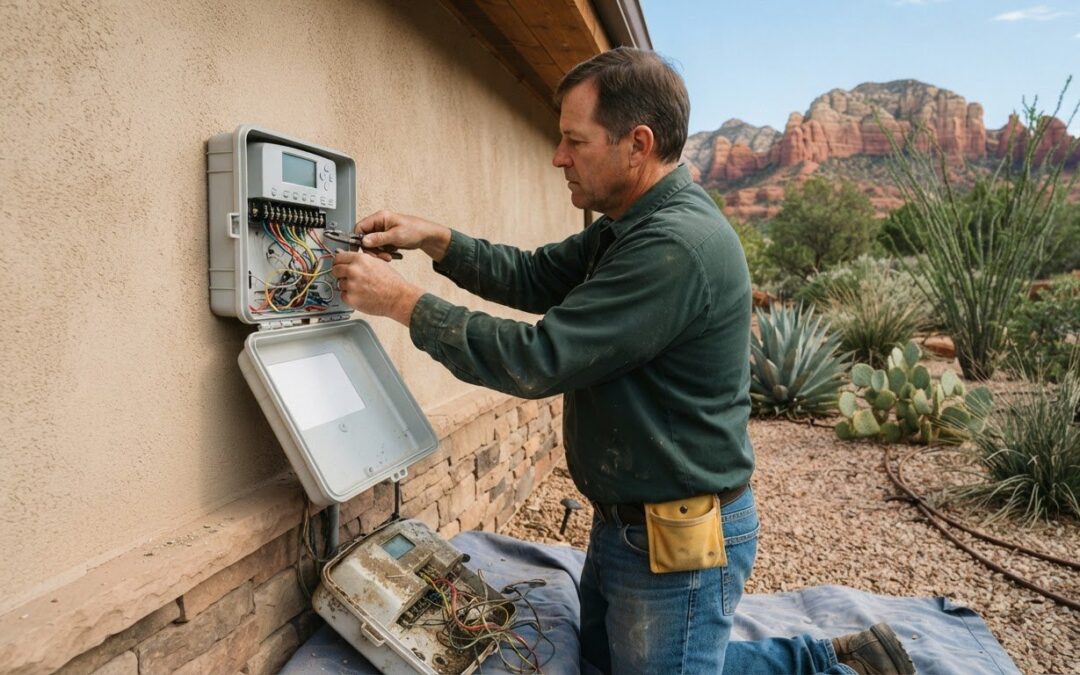
A sprinkler controller can last anywhere from five to twenty years, though its internal electronics may wear out sooner. Irrigation controller replacement cost depends on the controller selected and any work needed to reconnect it. Installation may also involve wiring or other irrigation-system repairs.
It’s reasonable to wonder whether an aging timer needs replacement or another repair. The controller’s age, recurring faults, and wiring condition can help guide that decision.
This article explains what affects irrigation controller replacement cost for Northern Arizona landscapes, including the hardware, wiring, and professional installation. You’ll also see why zone count and overall system condition matter when estimating the work, and how replacing a controller differs from fixing a wider irrigation problem.
Key Takeaways
- Use the controller’s age and pattern of repeat faults to help judge whether repair or replacement makes more sense.
- Match a replacement timer to the system’s zone count and features, since those choices shape hardware needs.
- WaterSense-labeled irrigation controllers can help an average home save up to 15,000 gallons of water annually, according to the U.S. Environmental Protection Agency (WaterSense).
- Wiring or broader system faults can affect installation work, so identifying the source of the problem is an important part of troubleshooting.
How long should a sprinkler controller really last?
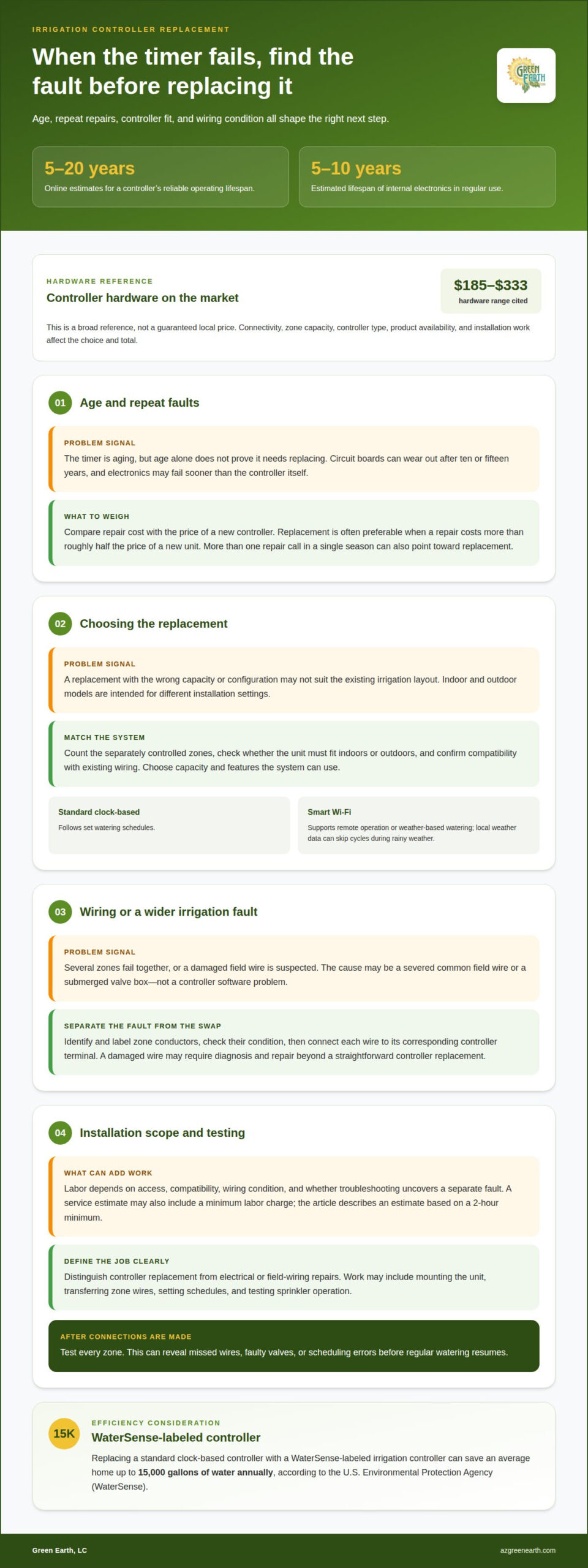
A sprinkler controller’s lifespan is the period it reliably operates irrigation zones. Online estimates range from five to twenty years, while internal electronics may last five to ten years in regular use. Circuit boards can wear out after ten or fifteen years, so age alone doesn’t determine whether replacement makes sense.
A smart Wi-Fi controller connects sprinkler scheduling with remote operation or weather-based watering. Irrigation controller hardware on the market typically costs between $185 and $333; connectivity, zone capacity, and controller type affect model selection. Smart models can use local weather data to skip watering cycles during rainy weather, while standard clock-based controllers follow set schedules. The feature difference can matter as much as the initial hardware choice.
Installation cost covers fitting the controller and connecting it to the irrigation system. Wiring condition and zone count affect the work involved. For example, a damaged field wire may need diagnosis and repair beyond a straightforward controller swap.
Replacement is often preferable when repair costs more than roughly half the price of a new controller. More than one repair call in a single season can also make replacement the better choice. If a controller fails after a decade, field solenoids, rain sensors, and underground connectors may also be nearing the end of their functional lifespans.
A controller warranty is the manufacturer’s stated coverage for that particular model. Warranty terms and ongoing expenses vary by product; future costs can depend on whether the system needs troubleshooting, wiring work, or sensor repairs. A replacement upgrade may also support more efficient scheduling. Replacing a standard clock-based controller with a WaterSense labeled irrigation controller can save an average home up to 15,000 gallons of water annually, according to the U.S. Environmental Protection Agency (WaterSense).
Basic controller hardware prices in Upstate New York
A basic irrigation controller is the timer that activates sprinkler zones on a schedule. That hardware range is only a broad reference: model capacity and configuration matter more than the timer’s label alone.
A station or zone is a separately controlled part of the irrigation system. These examples show that station count is not the only factor affecting a model’s listed price.
Indoor and outdoor models are designed for different installation settings. Choosing a controller suited to the existing mounting location can simplify replacement; a different configuration may change the installation requirements.
Yes, irrigation controller replacement cost can vary by location across the United States. Local product availability and the work required at the property affect the total, while hardware examples provide a comparison, not a guaranteed local price. In Northern Arizona, zone count, indoor or outdoor placement, and compatibility with existing wiring help determine the right controller.
Before selecting a model, identify how many zones the system operates and whether the replacement must fit an indoor or outdoor location. A compatible controller avoids paying for capacity or features the system won’t use. If the timer’s symptoms could stem from wiring rather than the controller itself, irrigation controller troubleshooting from Green Earth, LC can help distinguish the source of the fault.
Professional installation and wiring
Professional installation means fitting and setting up a replacement controller. The work can include mounting the unit, transferring zone wires, setting schedules, and testing sprinkler operation. Labor depends on access, controller compatibility, wiring condition, and whether troubleshooting uncovers a separate fault.
A minimum labor charge is the smallest billable time for a service visit. An estimate lists an unused minimum labor balance based on a 2-hour minimum labor charge. That detail matters when the physical swap takes less time than the minimum: the estimate may show labor time that remains unused rather than additional work completed.
Wiring carries controller signals to irrigation valves. A technician identifies and labels the existing zone conductors, checks their condition, then connects them to the corresponding controller terminals. If several zones fail together, a severed common field wire or submerged valve box may be the cause, rather than a controller software problem.
Whether permits or electrical-code requirements apply depends on the project scope and local rules. A controller replacement can involve powered equipment and low-voltage zone wiring, so the work involved determines which requirements apply.
A capable homeowner can replace a controller if the new unit matches the existing system and wiring. Record the original terminal labels, mark each zone wire, transfer the connections to matching terminals, then test each zone and schedule. Basic tools include a screwdriver and wire labels. Damaged conductors or unclear connections make the task more complex.
Professional labor can increase if wiring needs repair, the controller is difficult to access, or the system needs fault diagnosis. A simple transfer of labeled zone wires, for example, differs from tracing a common-wire failure across multiple valves. Zone capacity and compatibility also affect setup: the replacement must operate the existing irrigation layout correctly.
Before installation begins, define whether the work covers controller replacement alone or also electrical and field-wiring repairs. This clarifies what the labor includes and whether troubleshooting is part of the job. Testing every zone after connection can uncover missed wires, faulty valves, or scheduling errors before regular watering resumes.
Multi-zone electric controllers
A multi-zone electric controller activates separate irrigation zones through individual electrical connections. Each station operates a distinct area, such as a lawn section or planting bed. Start by matching the replacement controller’s capacity to the zones already in use.
For example, Hunter’s PRO-HC line includes 12-station and 24-station Wi-Fi controllers. The Hunter PCC600I Pro-C is a 6-station indoor controller, while the Hunter PCC1200 is a 12-station outdoor controller. These examples show how station capacity and installation setting differ across models. A replacement needs enough stations for the system’s active zones.
Modular controllers allow station capacity to expand with compatible modules. The Hunter Pro-C 3-station expansion module is one example. A retrofit kit, such as the Hunter ICC2 front panel retrofit kit, replaces a specific part of an existing controller rather than necessarily replacing the whole unit. The right option depends on the current controller and system configuration.
A 2-wire decoder system is an alternative controller arrangement that operates valves using decoder devices along a shared wire path. It differs from a multi-zone electric controller’s individual zone connections, so the system type affects which replacement equipment fits. Confirming the existing arrangement is an important first step before choosing hardware.
Smart controllers often support seven or eight watering zones. Features can include multiple programs, soak-and-cycle scheduling, weather-based watering, rain delay, sensor inputs, and remote operation. These capabilities can help manage different landscape needs, but available features depend on the model. More stations or specialized equipment can also affect hardware requirements.
For a sound replacement decision, identify the controller type, indoor or outdoor location, active station count, and any expansion modules. Then match those requirements to compatible equipment before installation. If multiple zones behave unexpectedly, schedule irrigation controller troubleshooting to help identify whether the controller or another system component needs attention.
Green Earth, LC: Irrigation Controller Troubleshooting
Green Earth, LC provides irrigation controller troubleshooting when schedules fail, zones stop responding, or repeated faults make replacement seem necessary. Diagnosing the system helps distinguish a controller problem from wiring, valve, sensor, or connector issues, so the next step addresses the actual fault.
When a controller fails across several zones, it may not be the only source of trouble. Troubleshooting can reveal whether the issue lies with the controller, field wiring, or another irrigation component. If replacement is appropriate, diagnosing the fault first clarifies the work involved and helps avoid replacing hardware that isn’t causing the problem.
Green Earth, LC can assess controller problems for residential systems, HOA properties, and commercial landscapes through its irrigation troubleshooting service. Contact Green Earth, LC to discuss your irrigation controller issue.
Plan the next step for your landscape
A controller decision is also an opportunity to align irrigation management with how the landscape is used today. As planting areas, property needs, or maintenance priorities change, clear schedules and appropriate system oversight can help keep watering intentional. Consider the property’s purpose, who is responsible for its care, and how irrigation fits into broader landscape planning before deciding what comes next.
Irrigation controller replacement cost is only one part of the decision. Green Earth, LC provides irrigation controller troubleshooting, as well as HOA Landscape Maintenance, Commercial Landscape Maintenance, and Firewise Defensible Space. These services meet different property needs, from ongoing landscape care to controller concerns.
If you’re ready to discuss an irrigation controller issue or related landscape priorities, contact Green Earth, LC. A thoughtful next step can help keep your landscape operating in harmony with its needs.
Frequently Asked Questions
Is Upgrading to a Smart Controller Worth It?
A smart controller may be worthwhile if you want flexible scheduling or remote operation. Weather-based watering, for example, can adjust schedules using local weather data, while multiple programs can support different landscape areas. If you prefer a simple fixed schedule and rarely change it, those added controls may offer less practical value. Base your decision on how you manage watering, not connectivity alone.
Should You Repair or Replace It?
Repair is worth considering when the fault is isolated and the controller otherwise operates reliably. Replacement becomes more practical when repairs cost more than roughly half the price of a new controller, or the unit needs more than one repair call in a single season. Diagnosis can also show whether the problem is the controller or a field component, helping you avoid replacing functioning hardware.
What if I don’t even know what kind of controller I have?
The controller’s label and wiring layout can help identify its type. A technician can note the manufacturer and model, whether it is installed indoors or outdoors, and how many zone terminals are connected. The system may use individual zone wires or a 2-wire decoder arrangement. A clear photo of the controller face and wiring terminals can make identification easier during troubleshooting.
How much does a replacement irrigation controller cost?
The irrigation controller replacement cost for hardware on the market typically ranges from $185 to $333, with a median of about $236. This is a market reference, not a quote for a particular property. The project total can also depend on installation needs, wiring condition, controller capacity, and whether diagnosis uncovers faults beyond the timer itself.
What is the typical labor cost to replace a sprinkler controller?
Labor rates for a professional installation typically vary based on regional service fees and project complexity. This is an installation estimate, not a labor-only rate. The work can vary with access, wire condition, and whether each zone needs testing. Estimates may also include a minimum labor charge, even when the physical controller swap takes less time.
What does it cost to replace a 4-zone, 8-zone, or 16-zone irrigation controller?
The irrigation controller replacement cost for a 4-zone, 8-zone, or 16-zone system depends on the capacity and type of equipment selected. A 4-zone system may use a different model than an 8-zone layout, while a 16-zone system may need higher capacity or modular equipment. Indoor or outdoor placement, Wi-Fi features, and existing wiring also shape the hardware and installation scope.
Recent Comments