
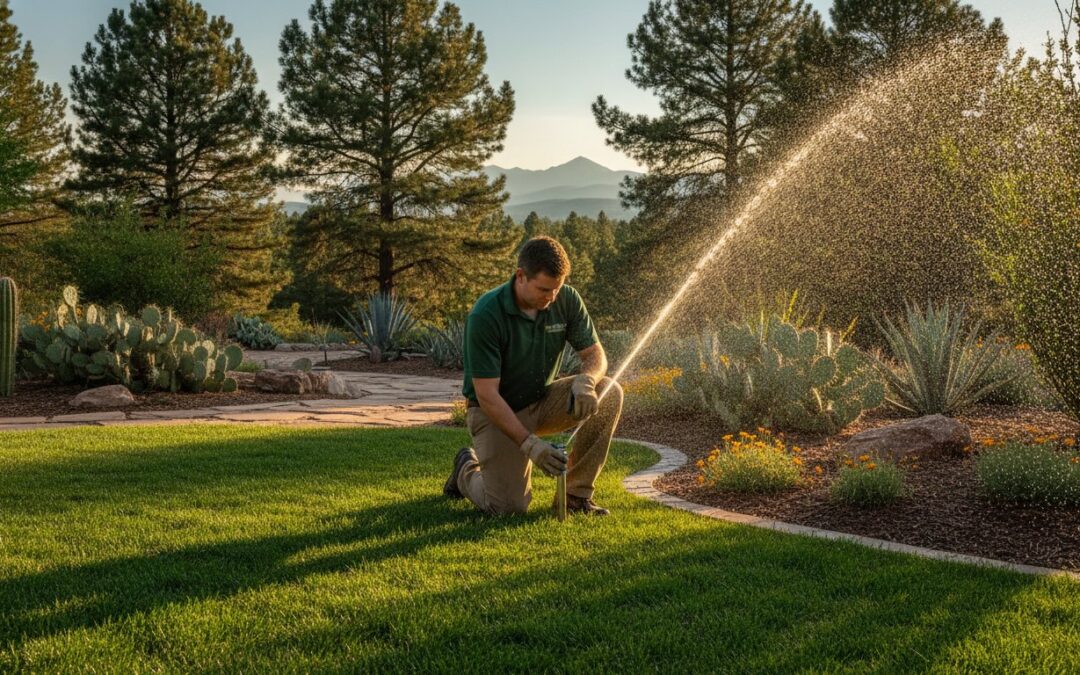
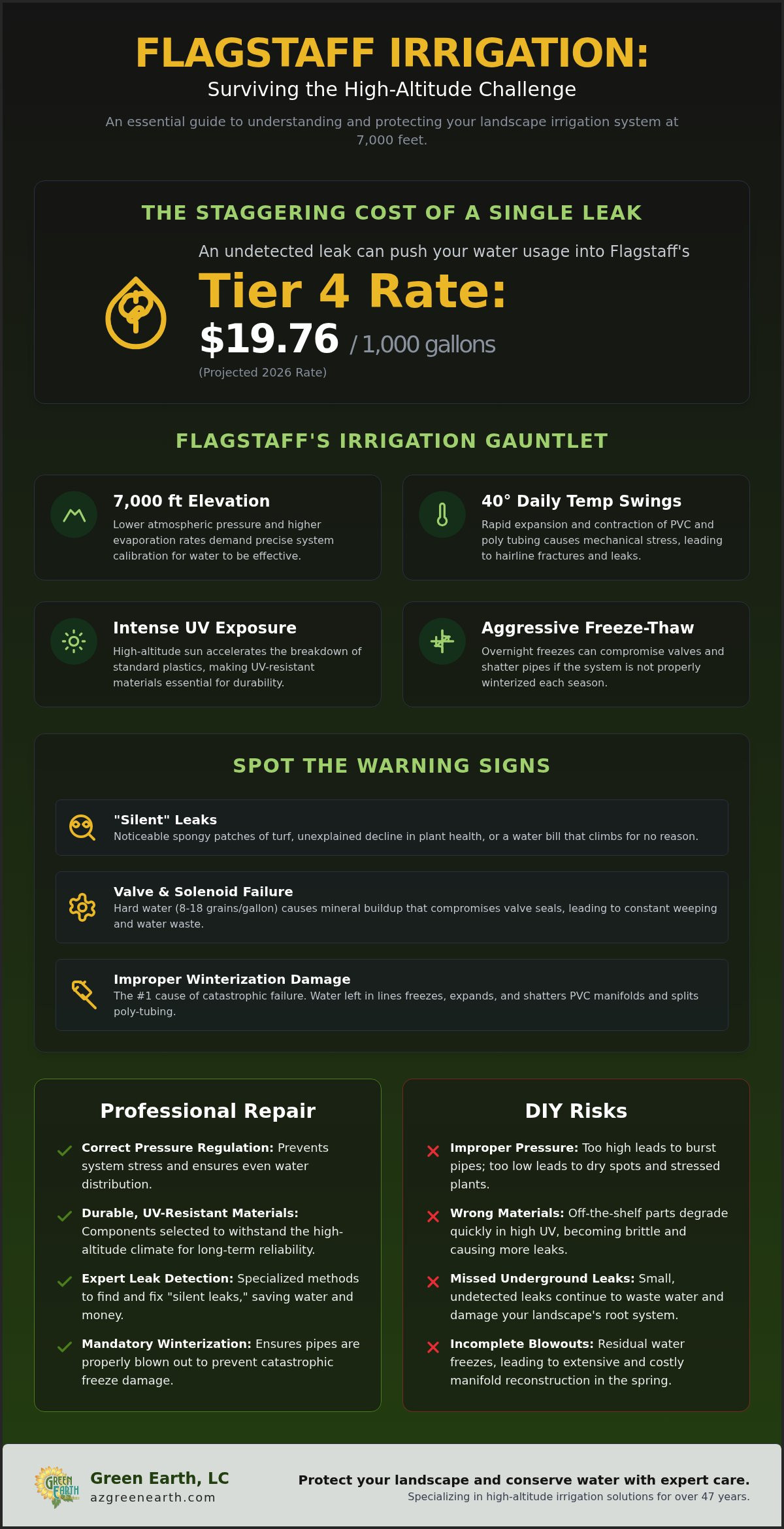
Did you know that a single undetected leak in your yard could push your monthly utility costs into Flagstaff’s Tier 4 water bracket, where 2026 rates hit a staggering $19.76 per 1,000 gallons? It’s a frustrating reality for many in Northern Arizona. You want a lush, healthy landscape, but rising costs and strict city watering schedules can make it feel like an uphill battle. We understand that managing an outdoor space at 7,000 feet requires more than just a basic sprinkler setup; it demands a system built for high-altitude resilience.
Whether you’re dealing with broken pipes from a harsh freeze or a confusing electronic controller, professional irrigation repair Flagstaff services are essential for protecting your investment. With over 47 years of local experience, we’ve seen how proper maintenance prevents the $25 fines associated with watering rule violations. In this article, you’ll discover how to achieve a leak-free, automated system that thrives during summer droughts and survives the winter freeze. We will walk you through expert troubleshooting, modern water-efficient upgrades, and the essential steps for seasonal winterization to ensure your landscape remains a beautiful, sustainable asset.
Key Takeaways
- Understand how Flagstaff’s 7,000-foot elevation and rapid temperature swings uniquely stress irrigation components like PVC and poly tubing.
- Learn to diagnose “silent leaks” and discover why specialized irrigation repair Flagstaff methods are required to maintain both drip and sprinkler zones efficiently.
- Avoid the risks of DIY repairs by understanding how professional pressure regulation prevents catastrophic bursts and long-term system failure.
- Follow a disciplined seasonal maintenance schedule, including mandatory winter blowouts, to protect your pipes from the region’s sub-zero winter temperatures.
- Gain insights into sustainable, climate-resilient landscape management that preserves water while maintaining the aesthetic beauty of your property.
Understanding Flagstaff’s Unique Irrigation Challenges
Flagstaff’s environment presents a set of variables that simply don’t exist in the lower deserts. At 7,000 feet, the air is thinner, the sun is stronger, and the soil is often a complex mix of volcanic rock and clay. These factors create a high-stakes environment for any water delivery system. When you seek irrigation repair Flagstaff homeowners often discover that standard off-the-shelf solutions aren’t enough to withstand the local climate. The physics of water delivery changes at this elevation; lower atmospheric pressure and higher evaporation rates mean your system must be calibrated with precision to be effective.
The volcanic soil common in Northern Arizona, often referred to as malpais, presents unique drainage hurdles. While some areas drain too quickly, others hold water in ways that can lead to root rot or system clogs if not managed through precise Sustainable Irrigation Management. Additionally, the extreme temperature swings, which can vary by 40 degrees in a single day, cause PVC and poly tubing to expand and contract rapidly. This mechanical stress leads to hairline fractures that eventually become major leaks. Several factors contribute to these challenges:
- Volcanic soil drainage patterns that complicate runoff management.
- Extreme daily temperature fluctuations that stress plastic components.
- Low atmospheric pressure impacts on flow and pressure regulation.
- Aggressive freeze-thaw cycles that can compromise valves overnight.
Elevation and UV Exposure
The intensity of the sun at high altitudes is a primary cause of system degradation. Standard irrigation parts, designed for more temperate climates, often fail prematurely in the Northern Arizona sun. High-altitude UV exposure accelerates the molecular breakdown of standard plastics, significantly shortening the lifespan of exposed irrigation components. To combat this, we prioritize UV-resistant materials for all drip systems. This ensures your lines don’t become brittle and shatter after just one or two seasons. Investing in high-quality components during an irrigation repair Flagstaff project is the only way to ensure long-term durability against the mountain sun.
The Firewise Connection
In our region, irrigation is a critical component of home safety. Maintaining a “lean, clean, and green” defensible space is a core tenet of protecting your property from wildfire. Proper hydration ensures that your plants remain resilient and less likely to ignite. By integrating your watering schedule with firewise landscaping Sedona principles, you create a moisture-rich buffer that helps prevent plants from becoming dangerous fuel sources. Expertly managed irrigation supports this goal by delivering the exact amount of water needed to keep vegetation healthy without wasting precious resources.
Troubleshooting Common System Failures in Northern Arizona
Identifying an issue often begins with the “silent leak.” While a geyser in the front yard is easy to spot, most system failures are much more subtle. You might notice a spongy patch of turf, a sudden decline in plant health, or a water bill that climbs without explanation. In our region, irrigation repair Flagstaff frequently involves hunting down these underground fractures. Because our water is classified as “very hard,” ranging from 8 to 18 grains per gallon, mineral buildup often compromises valve seals and solenoids. When a valve fails to close completely, water weeps through the system 24 hours a day, leading to significant waste and potential property damage.
The primary cause of catastrophic failure in Northern Arizona remains improper winterization. If water is left in the lines during a sub-zero freeze, the resulting expansion can shatter PVC manifolds and split poly-tubing. Following a disciplined schedule for seasonal irrigation system maintenance is the only way to protect these delicate components. We often find that systems which weren’t professionally blown out in the fall require extensive manifold reconstruction by the time spring arrives.
Drip Irrigation Repair and Maintenance
Drip systems are the backbone of sustainable gardening in our climate, but they require specific care. Clogged emitters are a frequent headache; those same mineral deposits that affect valves can completely block the small orifices of a drip head. Additionally, local wildlife like elk and deer often puncture poly-tubing while searching for water during dry months. Repairing these “puncture wounds” requires specialized couplings rather than simple tape. When we optimize these systems, we ensure they align with the principles of desert landscape design Northern Arizona, focusing on delivering water directly to the root zone where it’s needed most.
Smart Controller Troubleshooting
Your “automatic” timer might be your landscape’s worst enemy if it isn’t programmed for our specific seasons. Many homeowners lose up to 50% of their water to evaporation by watering during the forbidden 9 a.m. to 5 p.m. window or failing to account for the July monsoons. Modern WiFi-enabled smart controllers can automatically adjust for local weather patterns and rain events, ensuring you don’t water the pavement during a thunderstorm. If your current interface is confusing or unresponsive, professional irrigation controller troubleshooting can restore efficiency and provide peace of mind. Upgrading to a system with rain sensors is a proactive step toward environmental stewardship and lower utility costs.
The Real Cost of Water Waste: Professional Repair vs. DIY
While the temptation to handle a broken sprinkler head with a quick trip to the hardware store is strong, the hidden costs of amateur fixes often outweigh the savings. A professional diagnostic identifies the root cause of a problem, whereas DIY attempts frequently address only the symptoms. In Flagstaff, where water rates are tiered, a small leak that goes unnoticed for a season can result in hundreds of dollars in excess charges. Investing in professional irrigation repair Flagstaff ensures that your system operates at peak efficiency, protecting both your wallet and the local water supply.
Beyond the financial aspect, DIY repairs carry physical risks to the system’s infrastructure. Without proper tools to measure PSI, a homeowner might inadvertently create pressure imbalances. Excessive pressure doesn’t just waste water; it causes “misting,” where water evaporates before hitting the ground, and can lead to catastrophic pipe bursts. For commercial properties and HOAs, these risks are magnified. A single failed manifold on a large-scale system can waste thousands of gallons in a single night, creating significant liability and compromising the health of expensive shared green spaces.
Pressure Regulation and Backflow
Many neighborhoods in Flagstaff experience high static water pressure due to the city’s varying topography. Without a functioning pressure regulator, your valves and emitters are under constant stress, leading to premature failure and frequent leaks. Backflow preventer testing is another critical, non-negotiable safety step required by local codes. If a backflow device fails, there is a significant risk that contaminated irrigation water could be siphoned back into your home’s clean drinking water supply.
Long-Term Landscape Health
Precision repairs do more than just stop leaks; they ensure your plants receive the deep-root hydration necessary for survival in our arid climate. When a system is properly calibrated, it prevents the surface-level runoff that often leads to soil erosion. This is closely connected to effective drainage grading Arizona, as an over-saturated yard can eventually threaten the structural integrity of your home’s foundation. By maintaining a leak-free system, you ensure that moisture stays where it belongs, supporting healthy growth while keeping your property’s perimeter dry and secure. Professional intervention guarantees that your landscape remains an asset rather than a source of property damage.
Seasonal Maintenance: Protecting Your System from the Freeze
Flagstaff’s sub-zero winters are notoriously unforgiving to irrigation infrastructure. If you neglect to remove water from your lines before the first deep freeze, the expanding ice will inevitably shatter valves, manifolds, and backflow assemblies. This isn’t just a recommendation; it’s a mandatory part of property ownership at 7,000 feet. While some regions can get away with simple gravity draining, our frost line depth requires a professional blowout using high-volume compressed air to ensure every drop is purged from the system. Relying on luck during a Northern Arizona winter often leads to an expensive irrigation repair Flagstaff project come April.
Beyond irrigation systems, high-altitude winters also pose risks to your roof and gutters through the formation of ice dams. For homeowners looking to safeguard their entire property, specialized snow melt and heat cable systems from utheatcable.com offer a proactive solution to prevent structural damage caused by heavy snow accumulation.
Timing is everything when protecting your landscape investment. We recommend scheduling your fall service by mid-October, though early frosts can strike as early as late September. If an unexpected freeze warning is issued before your blowout appointment, you should wrap your backflow preventer in heavy blankets or dedicated insulation bags. This temporary measure can save you from a catastrophic burst until a professional can fully winterize the system. When spring arrives, the process is reversed with equal care. Re-pressurizing the system too quickly can cause a “water hammer” effect, which uses a surge of pressure to blow out fittings and damage internal valve diaphragms.
The Fall Winterization Checklist
A thorough winterization starts by shutting down the main water supply and draining the backflow assembly to prevent it from cracking. When using compressed air to clear the lines, we focus on air volume rather than high pressure. High PSI can actually generate enough friction to melt plastic piping from the inside out. For the 2026 winter season, ensure all exposed pipes and valves are wrapped in high-grade insulation. This extra layer of protection is vital for components that sit above the frost line, providing a final defense against the most extreme temperature drops.
Spring Start-Up and Inspection
Spring activation is the best time to identify any winter damage that occurred despite your best efforts. We look for frost-heaved heads that have been pushed out of the ground by the expanding soil and inspect manifolds for hairline fractures. This is also the time to adjust your controller for the dry, windy months of May and June. For those managing community properties, ensuring your system is optimized is a key part of HOA landscape maintenance Arizona standards. For professional assistance with your seasonal transitions, schedule your system blowout or spring activation with our expert team today.
Sustainable Irrigation Management with Green Earth, LC
Green Earth, LC stands as a cornerstone of the Northern Arizona community, bringing over 47 years of specialized local experience to every project. We’ve spent decades refining our techniques to meet the specific demands of Flagstaff’s intense freeze-thaw cycles and high-altitude conditions. As the statewide runner-up for Best Sustainable Landscape Designer, our philosophy centers on the idea that a beautiful yard shouldn’t come at the cost of our natural resources. When you choose us for irrigation repair Flagstaff, you’re partnering with an authoritative environmentalist dedicated to long-term property health and water conservation.
Our role as a visionary partner means we don’t just fix broken components; we transform your outdoor space into a functional and efficient reality. We pride ourselves on our disciplined craftsmanship and forward-thinking solutions that address the unique challenges of the 7,000-foot elevation. Whether you’re a residential homeowner or a commercial property manager, our goal is to provide a sense of trust and reassurance that your landscape is in expert hands. We treat every system as a vital part of the local ecosystem, ensuring that your irrigation supports a healthy, vibrant environment for years to come.
Commercial and HOA Expertise
Managing large-scale systems for commercial properties and HOAs requires a disciplined, methodical approach. We understand that property boards need more than just a technician; they need a partner who can provide detailed water-use analysis and transparent reporting. Our team excels at identifying inefficiencies in complex manifolds and large-zone configurations that others might overlook. By modernizing these systems, we help communities reduce their environmental footprint while simultaneously lowering their monthly utility expenditures. Our goal is to transform aging infrastructure into a functional, reliable asset that serves the community with excellence and precision.
Our Commitment to Sustainability
True sustainability requires looking at the entire outdoor environment as a single, connected system. We leverage advanced technology, such as soil moisture sensors and weather-based controllers, to ensure that water is only applied when absolutely necessary. This water-wise approach is often integrated with our expertise in hardscape construction Cottonwood AZ, where we use grading and structural elements to naturally direct moisture and prevent erosion. By combining professional design with expert execution, we create landscapes that are both aesthetically stunning and ecologically sound. We invite you to schedule a comprehensive 2026 irrigation audit with Green Earth, LC to discover how we can optimize your property’s water management for the future.
Secure Your Landscape for a Resilient Future
Managing a landscape at 7,000 feet requires a disciplined approach to water stewardship and infrastructure protection. By prioritizing seasonal winterization and addressing silent leaks before they escalate, you safeguard your property against the region’s extreme freeze-thaw cycles. Professional intervention doesn’t just lower your utility bills; it ensures your outdoor space remains a healthy, vibrant asset that can withstand the unique pressures of the Northern Arizona sun. Expert irrigation repair Flagstaff services bridge the gap between basic maintenance and long-term climate resilience.
As the statewide runner-up for Best Sustainable Landscape Designer with over 47 years of local experience, Green Earth, LC provides the technical precision your system needs. Our certified irrigation troubleshooting specialists are ready to help you transition into the 2026 season with confidence and peace of mind. We invite you to Schedule Your Flagstaff Irrigation Diagnostic with Green Earth, LC today. We look forward to helping you cultivate a beautiful, water-wise sanctuary that thrives for years to come.
Frequently Asked Questions
When should I winterize my irrigation system in Flagstaff?
You should schedule your winterization by mid-October to stay ahead of the first deep freeze. While the official growing season might last longer, early frosts often strike Northern Arizona in late September. A professional blowout is the only way to ensure water is completely removed from the lines before the ground freezes, which prevents the catastrophic pipe bursts common in our 7,000-foot elevation.
Why is my water bill so high even though I haven’t changed my watering schedule?
A sudden spike in your utility bill usually points to a “silent leak” or a valve that isn’t closing properly. With Flagstaff’s 2026 tiered water rates, exceeding 11,501 gallons can trigger a Tier 4 charge of $19.76 per 1,000 gallons. If you suspect a hidden leak, seeking professional irrigation repair Flagstaff is the most effective way to identify the source and stop the financial waste.
Can I use a standard air compressor to blow out my own irrigation lines?
Standard home air compressors typically lack the necessary volume, or CFM, to safely clear a full irrigation system. While they may provide enough pressure, they don’t move enough air to purge all the water from low spots in the lines. This often leaves water behind to freeze and crack the pipes. Additionally, small compressors can run too hot, potentially melting your plastic components from the inside.
What is the best time of day to water my landscape in Northern Arizona?
The best time to water is during the early morning hours, specifically before 9 a.m. City of Flagstaff regulations prohibit outdoor watering between 9 a.m. and 5 p.m. to minimize evaporation. You must also follow the assigned schedule: odd-numbered addresses water on Tuesdays, Thursdays, and Saturdays, while even-numbered addresses water on Wednesdays, Fridays, and Sundays. No watering is permitted on Mondays.
How often should I have my backflow preventer tested?
You must have your backflow preventer tested annually by a certified professional. This is a mandatory requirement in Coconino County to ensure that irrigation water, which can contain fertilizers or bacteria, doesn’t siphon back into your home’s clean drinking water supply. Regular testing protects your family’s health and keeps your property in compliance with local plumbing codes and environmental safety standards.
Do drip systems need more maintenance than traditional sprinklers?
Drip systems require a different type of maintenance rather than more frequent care. Because Flagstaff’s water is classified as “very hard,” ranging from 8 to 18 grains per gallon, mineral deposits often clog the small emitters. You also need to inspect poly-tubing regularly for punctures caused by local wildlife. These systems are highly efficient but need a disciplined eye to ensure they remain functional and water-wise.
What should I do if I notice a wet spot in my yard but the sprinklers are off?
Shut off the main water supply to your irrigation system immediately to prevent further property damage. A persistent wet spot when the system is inactive usually indicates a leak in the pressurized mainline or a weeping valve that has failed to seal. Leaving this unaddressed can lead to soil erosion and potentially threaten your home’s foundation, so it’s vital to investigate the cause right away.
Does Green Earth, LC offer emergency irrigation repair for HOAs?
We specialize in comprehensive HOA landscape maintenance and provide priority irrigation repair Flagstaff for our contract clients. While we don’t offer 24/7 emergency calls, we understand the high stakes of large-scale water waste on community properties. Our team focuses on rapid troubleshooting and sustainable repairs to keep your common areas healthy while maintaining strict adherence to your association’s water budget and local regulations.
Recent Comments