
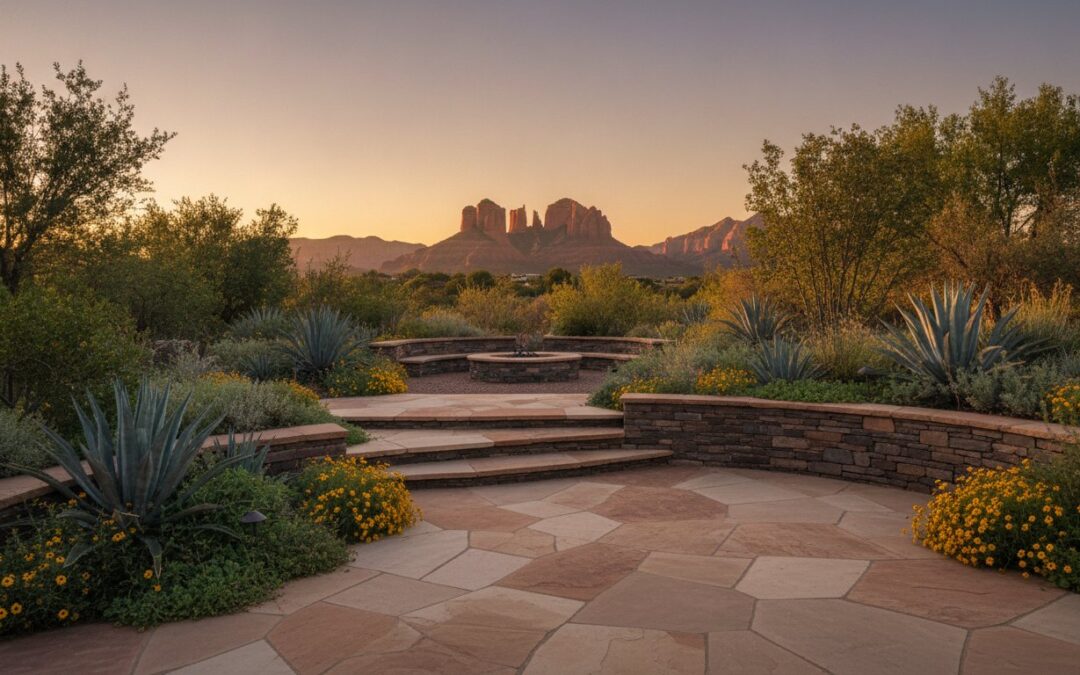
Did you know that 12.6% of property owners in Yavapai County are currently facing higher insurance premiums or policy cancellations due to wildfire risk? With over 1,300 wildfires already recorded in the state during the 2026 season, protecting your home has never been more critical. You likely want a beautiful outdoor space that reflects the natural majesty of Northern Arizona, but rising water rates and the high maintenance of traditional lawns can feel like a constant burden. A professional sustainable landscape renovation in Arizona offers a way to reclaim your time and peace of mind while significantly increasing your property value.
We believe that your yard should be a source of pride rather than a drain on your resources. This guide provides a clear roadmap to transforming your property into a water-wise, fire-safe, and ecologically resilient oasis. You’ll learn how to implement the latest Firewise defensible space standards, master monsoon-ready drainage, and utilize smart irrigation technology. We’ll preview the essential steps to creating a landscape that survives our unique climate with minimal effort, ensuring your home remains a safe and stunning sanctuary for years to come.
Key Takeaways
- Learn how a professional sustainable landscape renovation in Arizona balances water efficiency with modern aesthetics to lower your utility bills and increase property value.
- Discover the “Right Plant, Right Place” philosophy to select native species that naturally thrive in Northern Arizona’s unique soil and climate.
- Explore the advantages of smart irrigation controllers and precision drip systems that use real-time weather data to eliminate water waste.
- Understand how to integrate Firewise defensible space and hardscaping to create a beautiful, functional barrier against wildfire risks.
- Identify why professional drainage grading is essential for protecting your property from erosion and runoff during the intense monsoon season.
The Shift Toward Sustainable Landscape Renovation in Arizona
Sustainable renovation in Arizona has evolved into a necessity. It represents a fundamental shift from purely aesthetic improvements toward building long-term ecological resilience. A sustainable landscape renovation in Arizona isn’t just about replacing grass with gravel; it’s about creating a system that can withstand the intense pressures of our current environment. By integrating sustainable landscaping principles, we move beyond simple curb appeal to create outdoor spaces that function as living ecosystems.
Why is 2026 the year to transition? We’ve seen significant water rate hikes across the state and a record-breaking wildfire season with over 1,300 recorded fires already. These aren’t just environmental concerns; they’re financial ones. Homeowners in Yavapai County are already seeing the impact on insurance premiums. By choosing a sustainable renovation, you’re investing in a property that’s easier to insure and more valuable to future buyers who prioritize low utility costs and fire safety. In a typical home, 50-70% of residential water consumption is for outdoor landscaping, making efficiency the smartest investment you can make.
There is a distinct difference between a basic “desertscape” and a truly sustainable landscape design. While a desertscape might simply be a field of rocks, a sustainable design is a living, functional system. It manages drainage during the monsoon season, provides cooling shade through strategic plantings, and supports local biodiversity. It’s a forward-thinking approach that balances human comfort with environmental health, ensuring your property remains an asset rather than a liability.
High-Desert vs. Low-Desert Sustainability
Landscaping in Sedona or Flagstaff is vastly different from Phoenix. As of May 1, 2026, the Sedona Fire District adopted the 2024 International Fire Code, mandating fuel reduction in high-risk areas. Our high-desert environment faces extreme temperature swings and high-altitude UV exposure that can scorch plants that thrive in the lower valleys. The soil in the Verde Valley often requires specific management to ensure proper drainage during the monsoon season. We design for these local realities, ensuring your plants don’t just survive but thrive in our unique climate.
Environmental Stewardship as a Community Value
Your yard is part of a larger ecosystem. By choosing native plants, you provide critical habitat for local pollinators and wildlife. These choices also help reduce the heat island effect in our growing Northern Arizona towns. Every gallon of water saved through smart irrigation and proper plant selection contributes to regional conservation efforts. This commitment ensures our local communities remain vibrant and resilient for the next 47 years and beyond. It’s a way to be a responsible guardian of the local landscape while enjoying a beautiful, low-maintenance outdoor space.
Planning Your High-Desert Renovation: Native Plants and Local Ecology
Designing a sustainable landscape renovation in Arizona requires a deep understanding of altitude and microclimates. While many guides focus on the scorched basins of Phoenix, Northern Arizona homeowners must plan for freeze cycles and high-elevation sunlight. We follow the “Right Plant, Right Place” philosophy. This means choosing species that evolved to thrive in our specific soil without constant human intervention.
Transitioning from a thirsty lawn to a low-water garden doesn’t mean sacrificing greenery. By implementing hydrozones, we group plants with similar moisture requirements together. This strategy ensures that high-water accent plants don’t lead to overwatering your drought-tolerant shrubs. For a deeper dive into these methods, you can refer to the University of Arizona’s sustainable landscaping guide, which highlights the importance of native selection and organic mulching to preserve soil health.
Top Native Species for Sedona and Flagstaff
Your plant palette should reflect your specific elevation. Sedona’s red rock climate favors heat-tolerant perennials and shrubs, while Flagstaff requires species that can survive heavy snow and shorter growing seasons. Consider these local favorites for your project:
- Sedona and Verde Valley: Apache Plume, Desert Marigold, and Parry’s Agave provide vibrant color and structural interest with minimal water.
- Flagstaff and High Altitudes: Ponderosa Pine, Rocky Mountain Penstemon, and Fernbush thrive in cooler, thinner air and tolerate winter freezes.
It’s vital to avoid invasive species like Saltcedar or Cheatgrass. These plants threaten local biodiversity and significantly increase wildfire fuel loads, which is a major concern for our region. Selecting the right native species is the first step toward a landscape that is both beautiful and protective.
Sustainable Design Principles for Renovation
True sustainability integrates the natural lay of the land. By using desert landscape design Northern Arizona strategies, we can create year-round visual interest that works with your property’s topography. We balance softscape elements with functional hardscaping like permeable pavers or retaining walls. This balance prevents erosion during heavy monsoons while providing a structured, intentional look. If you’re ready to move away from high-maintenance turf, our team can help you identify the best native replacements for your neighborhood. You might start by exploring our custom landscape solutions to see how we’ve transformed similar properties in the Verde Valley over the last 47 years.
Smart Irrigation and Drainage: Maximizing Every Drop
Water conservation in the high desert is about more than just turning off the tap. It’s about precision. A comprehensive sustainable landscape renovation in Arizona integrates technology with natural landforms to ensure every drop serves a specific purpose. With water rates in Gilbert rising by 25% and Chandler by 15% as of early 2026, the financial incentive for efficiency has never been higher. Transitioning to a smarter system isn’t just an environmental choice; it’s a necessary step to control rising utility costs.
Smart irrigation controllers act as the brain of your yard. These devices connect to local weather stations and automatically adjust schedules based on humidity, temperature, and recent rainfall. This technology eliminates the “set it and forget it” mentality that often leads to water running down the street during a summer storm. By delivering water only when the soil actually needs it, you can significantly reduce the 50-70% of water typically lost to outdoor usage in Arizona homes.
Beyond technology, passive rainwater harvesting uses the natural contours of your land to water your plants. By creating basins and swales, we can capture high-volume monsoon rainfall and direct it toward your vegetation. This method allows water to soak deep into the root zones, naturally recharging the soil and reducing your reliance on the municipal water supply.
Modernizing Your Irrigation System
If you notice soggy spots in your yard or plants that are wilting despite regular watering, it’s likely time for irrigation repair Flagstaff homeowners can trust. High-altitude environments are particularly hard on irrigation components due to intense UV exposure and freeze-thaw cycles. Drip systems are vastly superior to traditional sprinklers because they deliver water directly to the roots, nearly eliminating evaporation. A professional audit during your renovation can identify clogged emitters or hidden line breaks that waste thousands of gallons annually.
Drainage Grading and Monsoon Management
Many homeowners overlook the role of drainage grading Arizona as a core sustainability tool. Proper grading doesn’t just protect your foundation; it prevents topsoil erosion during intense monsoon bursts. By sculpting the land into functional rain gardens, we transform a potential flood hazard into a valuable landscape resource. Using sustainable materials like local river rock for erosion control on sloped landscapes provides a permanent, low-maintenance solution that keeps your property’s soil and nutrients exactly where they belong.
Firewise Design and Sustainable Hardscaping: Safety Meets Aesthetics
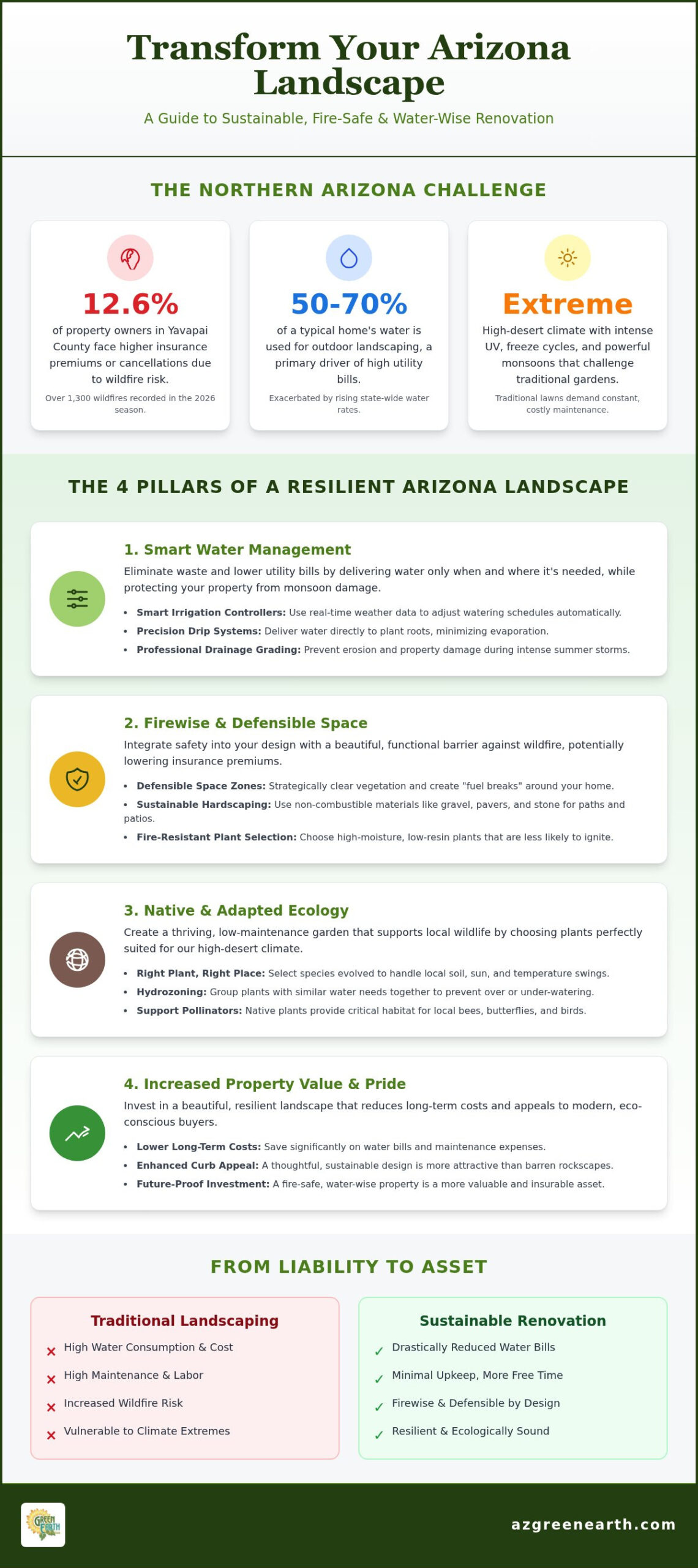
In Northern Arizona, environmental stewardship and home safety are inseparable. A sustainable landscape renovation in Arizona must account for the reality of our fire season, which has already seen over 1,300 wildfires in 2026. True sustainability means creating a landscape that protects your home while conserving precious resources. By strategically using hardscaping, we create permanent fire breaks that require zero water and provide high visual impact.
We focus on eliminating fuel ladders. These are paths of vegetation that allow fire to climb from the ground into the tree canopy. By spacing plants correctly and using non-combustible materials like stone and pavers near structures, we break these paths. This approach satisfies insurance requirements and provides peace of mind without turning your yard into a barren wasteland. It’s a disciplined way to balance the beauty of the high desert with the practical needs of land management.
Creating a Fire-Resilient Landscape
Effective defense relies on the three zones of firewise landscaping Cottonwood AZ. Zone 0, the five feet immediately surrounding your home, is the ember-resistant zone. We replace flammable wood mulch and juniper bushes with decorative gravel or pavers. Zone 1 extends to 30 feet, where we ensure tree crowns are at least 10 feet apart and lower branches are pruned. Finally, Zone 2 focuses on thinning dense brush to slow an approaching fire. Choosing fire-resistant native plants like succulents or deciduous trees with high moisture content allows you to maintain beauty while adhering to these safety standards.
Sustainable Hardscape Solutions
Investing in hardscape construction Cottonwood AZ is a long-term eco-investment. We prioritize permeable pavers and locally sourced stone to reduce the carbon footprint of your project. Permeable surfaces allow rainwater to filter into the ground rather than creating runoff, supporting the drainage goals we discussed earlier. Retaining walls are another essential tool, providing slope stabilization and preventing erosion on tiered properties. These structures can be softened with boulders and gravel to create dry riverbed aesthetics that look natural and require no irrigation. If you want to secure your property with a professional defensible space plan, contact our Firewise certified team to schedule a consultation.
Partnering with Green Earth, LC for Your Eco-Friendly Transformation
Green Earth, LC is more than a landscaping company; we’re a community fixture with a 47-year legacy in the Verde Valley. When you embark on a sustainable landscape renovation in Arizona, you need a partner who understands the deep nuances of our soil, climate, and local ecosystems. Our longevity is a testament to our reliability and our commitment to excellence in every project we undertake. We’ve spent nearly five decades refining a design-build process that takes your vision and grounds it in professional execution and environmental integrity.
Our approach is disciplined and forward-thinking. We serve residential homeowners looking for a personal sanctuary, but we also provide specialized, large-scale solutions for commercial properties and HOAs. Every project is handled with the same level of craftsmanship, ensuring that your landscape is not only beautiful today but resilient for decades to come. As the statewide runner-up for “Best Sustainable Landscape Designer” by Green Living Magazine, we take our role as environmental stewards seriously. We don’t just move dirt; we curate living spaces that respect our natural resources.
Expertise in Northern Arizona Communities
We’ve built our reputation by serving the distinct needs of Sedona, Flagstaff, and Prescott. Each of these areas presents unique challenges, from the red rock heat to high-altitude snow loads. Navigating local HOA landscape maintenance Arizona regulations can be complex. Our team has the experience to ensure your sustainable landscape renovation in Arizona meets all community standards while maximizing ecological benefits. We understand the specific plant palettes and structural requirements that define our region’s aesthetic and safety needs.
Start Your Sustainable Renovation Today
The journey toward a more resilient property begins with a professional landscape consultation. During this initial meeting, we evaluate your property’s topography, existing irrigation efficiency, and drainage needs. We don’t believe in a one-size-fits-all solution. Instead, we help you phase your renovation to manage costs and ensure each element, from Firewise defensible space to smart irrigation, is installed with precision.
Phasing a large-scale project allows you to prioritize the most critical safety and water-saving updates first. Whether you’re interested in hardscape construction or a complete native plant overhaul, our team provides a clear path forward. Contact Green Earth, LC today for a professional project evaluation and let us help you transform your Northern Arizona property into a functional, sustainable reality. Our expertise ensures your investment adds lasting value to your home and the local environment.
Secure Your Northern Arizona Legacy
Transitioning to a resilient outdoor space is a vital step for any homeowner in our region. By integrating native plants that thrive in high-elevation climates and installing smart irrigation systems, you can effectively combat rising utility costs. Prioritizing Firewise defensible space further ensures your property is protected against the wildfire risks we’ve documented throughout 2026. A professional sustainable landscape renovation in Arizona represents a permanent investment in your home’s safety, value, and ecological health.
Green Earth, LC brings over 47 years of local expertise to every project. As the statewide runner-up for “Best Sustainable Landscape Designer” by Green Living Magazine, we are specialists in high-desert irrigation and Firewise safety. We take pride in being the local guardian of the Verde Valley landscape. Our team is ready to transform your vague ideas into a functional, beautiful reality that respects our natural resources. Take the first step toward a worry-free yard today. Schedule Your Sustainable Landscape Consultation with Green Earth, LC. Your vision for a water-wise, fire-safe sanctuary is within reach. Let’s build a landscape that honors the natural majesty of Northern Arizona together.
Frequently Asked Questions
What is the most sustainable landscape for Arizona?
The most sustainable option is a xeric design that utilizes native vegetation and permeable surfaces. This approach minimizes water waste and supports local biodiversity while requiring fewer chemical inputs. A successful sustainable landscape renovation in Arizona prioritizes the “Right Plant, Right Place” philosophy. By incorporating natural land contours for passive water harvesting and using smart controllers, you create a system that thrives with minimal human intervention and respects our local high-desert environment.
How much does a sustainable landscape renovation cost in Northern AZ?
Costs for a sustainable landscape renovation in Arizona depend entirely on the complexity of the design and the specific materials selected. Factors such as the total square footage of hardscape, the type of permeable pavers used, and the extent of drainage grading required will influence the final investment. While project totals vary, homeowners often find that the long-term savings on utility bills and reduced maintenance provide a significant return on their initial expenditure.
Can I have a green yard in Arizona while being sustainable?
You can certainly maintain a lush, green aesthetic without relying on traditional thirsty lawns. Many native Northern Arizona plants, such as the Ponderosa Pine or various evergreen shrubs, provide year-round color and texture. By grouping these plants into hydrozones and using organic mulch to retain moisture, you can achieve a vibrant yard that remains ecologically responsible. This strategy allows you to enjoy a green sanctuary that doesn’t drain regional water supplies or require constant mowing.
Do sustainable landscapes require less maintenance?
Sustainable landscapes typically require far less maintenance than traditional yards once they are fully established. Native species are naturally adapted to our soil and climate, meaning they don’t need the constant fertilization or heavy pruning that exotic plants demand. Additionally, smart irrigation technology automates water management, and hardscape fire breaks reduce the need for constant brush clearing. This allows you to spend more time enjoying your outdoor space and less time working on it.
What are the best drought-tolerant plants for Flagstaff vs. Sedona?
Plant selection varies greatly by elevation and microclimate. For high-altitude areas like Flagstaff, we recommend hardy species such as:
- Fernbush
- Rocky Mountain Penstemon
- Native bunchgrasses
In the warmer red rock climate of Sedona, heat-tolerant plants like Parry’s Agave, Desert Marigold, and Apache Plume thrive. Choosing species specific to your elevation ensures your renovation remains resilient against the extreme temperature swings common in Northern Arizona.
How does Firewise landscaping impact my property insurance?
Implementing Firewise principles has become a financial necessity for many homeowners. As of 2026, major insurers are increasingly requiring proof of defensible space inspections before renewing policies in wooded areas. By creating a fire-resilient landscape with proper plant spacing and non-combustible hardscape zones, you reduce the risk of property loss. This proactive approach helps protect your home from policy cancellations and can lead to more favorable insurance terms in high-risk regions like Yavapai County.
What is drainage grading and why is it important for sustainable yards?
Drainage grading is the process of sculpting your land to manage water runoff effectively. It is a critical component of a sustainable yard because it prevents topsoil erosion and protects your home’s foundation during intense monsoon bursts. By directing rainfall into swales or basins, we can recharge the soil and provide deep hydration for your plants. This permanent construction solution transforms potential flood hazards into a valuable resource for your local high-desert ecosystem.
How often should I have my drip irrigation system inspected?
We recommend having your drip irrigation system professionally inspected at least twice a year, typically in the spring and fall. The high-altitude UV exposure and intense freeze-thaw cycles in Northern Arizona can cause lines to crack or emitters to clog over time. Regular audits identify hidden leaks that waste water and ensure your plants receive precise hydration. Keeping your system in top condition is essential for maintaining the health and efficiency of your sustainable renovation.
Recent Comments