
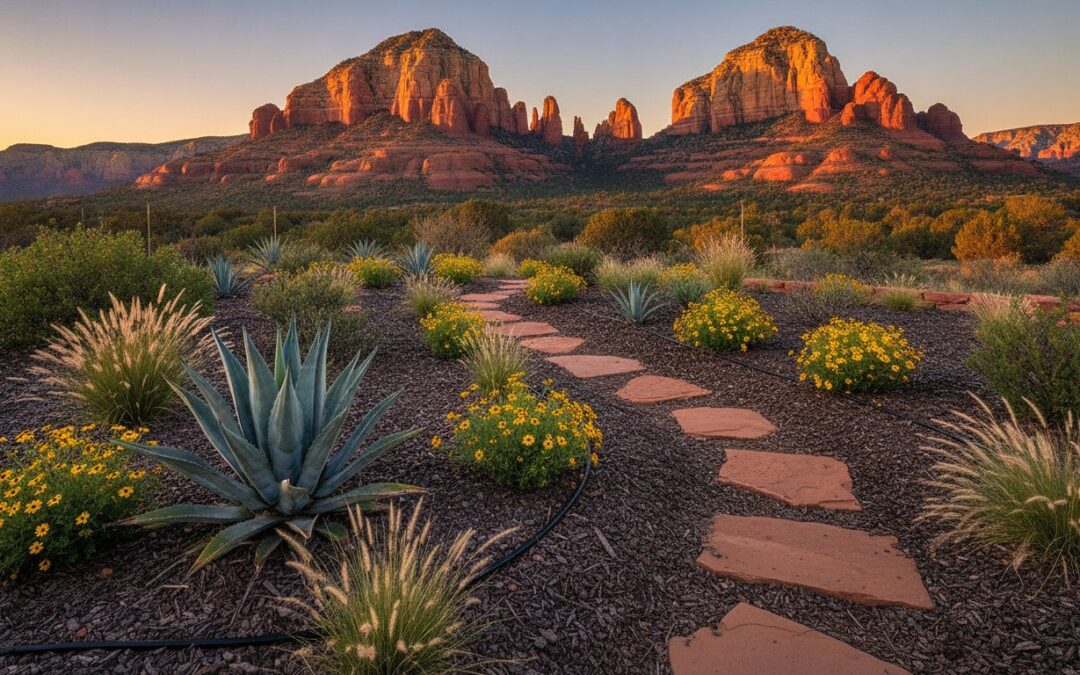
Did you know that outdoor irrigation accounts for up to 60 percent of the total water demand for households in our Arizona communities? You’ve likely felt the sting of rising utility bills or watched a favorite shrub wither during a July heatwave, all while wondering if your property can actually handle the next heavy monsoon. It’s a common frustration for homeowners and commercial property managers throughout our region. Implementing professional water wise landscaping Verde Valley residents can rely on is no longer just an aesthetic choice; it’s a necessity for property resilience in 2026.
We understand that you want a beautiful, professional-looking yard without the constant stress of high maintenance or plant loss. This guide will show you how to transform your Northern Arizona property into a thriving, low-water sanctuary that survives both extreme drought and seasonal runoff. We will explore high-efficiency irrigation techniques, drainage grading strategies to prevent erosion, and the best local plant selections to ensure your landscape remains lush while your utility costs and maintenance requirements drop.
Key Takeaways
- Learn how to implement water wise landscaping Verde Valley properties need to thrive despite our region’s unique elevation and climate challenges.
- Discover the power of hydrozoning to group plants by their specific moisture requirements, ensuring every drop of water is used efficiently.
- Understand the “Mulch Rule” and soil preparation techniques that lock in moisture and protect your landscape from intense summer heat.
- Explore how high-efficiency drip systems and smart controllers can significantly lower your utility bills by adapting to real-time weather conditions.
- See why professional design and drainage grading are essential for managing monsoon runoff and increasing your property’s long-term value.
The Essentials of Water Wise Landscaping in the Verde Valley
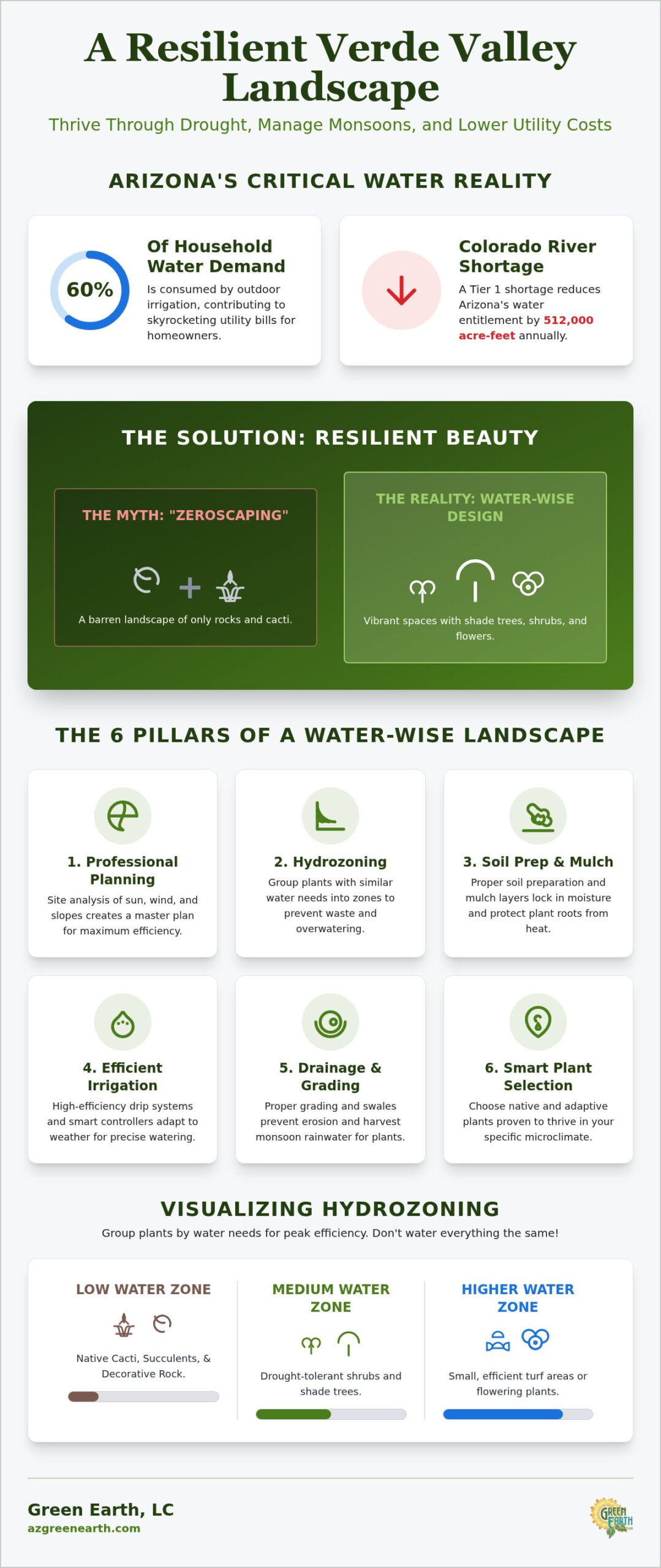
Achieving a sustainable yard in Northern Arizona requires more than just swapping grass for gravel. As we navigate 2026, the Colorado River is operating under a Tier 1 shortage condition. This reduces Arizona’s annual entitlement by 512,000 acre-feet, making water conservation a critical economic and environmental priority for Yavapai County residents. Implementing professional water wise landscaping Verde Valley homeowners can trust is no longer a luxury; it’s a strategic investment in property longevity.
We approach every project through the lens of “Resilient Beauty.” This philosophy centers on creating outdoor spaces that look established and lush but possess the structural integrity to survive with minimal human intervention. A resilient landscape isn’t just about surviving a drought. It’s about thriving during the 110-degree summer days and managing the heavy runoff from intense monsoon storms without losing topsoil or damaging your home’s foundation.
Water-Wise vs. Xeriscaping: What is the Difference?
Many homeowners hesitate to adopt conservation-focused designs because they fear a yard filled with nothing but brown rock and a few lonely cacti. While the term The Essentials of Water Wise Landscaping or xeriscaping often carries this “zeroscaping” stigma, true water-wise design is far more vibrant. It’s a holistic approach that uses seven core principles, including specialized soil preparation, efficient irrigation, and the use of mulches to lock in moisture.
By following a professional desert landscape design Northern Arizona residents can enjoy functional, green spaces that include shade trees, flowering shrubs, and even small, high-efficiency turf areas if desired. The goal is to maximize the visual impact of your property while minimizing the gallons required to keep it healthy.
Why Regional Expertise Matters in 2026
The Verde Valley sits in a unique transition zone, with elevations ranging from 3,000 to 4,500 feet. This “middle ground” elevation creates specific challenges that neither low-desert nor high-mountain strategies can solve alone. Our 47 years of experience in the region has shown us that local microclimates vary wildly. A plant that flourishes in the red clay of Sedona might struggle in the rocky, alkaline soil of Cottonwood or the sandy loams near Camp Verde.
Precipitation patterns are also shifting. While the City of Cottonwood relies on groundwater from 24 well sites, the regional drought affects the entire water table. We design systems that account for these realities, ensuring your irrigation is technically proficient and your plant palette is perfectly matched to your specific neighborhood. This localized knowledge prevents the costly mistake of planting species that can’t handle a surprise Sedona freeze or a blistering Cottonwood heatwave.
Planning and Design: The Foundation of Conservation
Successful water wise landscaping Verde Valley projects begin long before the first shovel hits the dirt. A comprehensive site analysis serves as your blueprint for efficiency. We map sun exposure patterns, prevailing winds, and existing slopes to understand how your specific lot interacts with the elements. For instance, west-facing walls create heat islands that require different plant selections than shaded northern alcoves. This data-driven approach is why sustainable landscaping in Arizona starts with a professional master plan.
One of the most effective strategies we employ is hydrozoning. This involves grouping plants with similar water, soil, and sun requirements into specific irrigation zones. By separating high-water ornamental features from drought-tolerant native species, you eliminate the common mistake of over-irrigating the entire property just to keep one plant alive. To select the right species for these zones, we recommend consulting official resources like The Verde Valley Palette: Soil, Mulch, and Plants provided by the state. Integrating these zones correctly ensures your yard stays vibrant without wasting a single drop.
The Role of Drainage and Grading
In the Verde Valley, we must design for two extremes: prolonged drought and sudden, violent monsoons. Proper drainage grading in Arizona is essential to prevent erosion and protect your home’s foundation when the clouds finally break. Instead of merely shedding water off the property, we utilize “Passive Rainwater Harvesting.” This technique involves subtle land contouring, such as swales or basins, that direct rain toward deep-rooted trees. It turns a potential flood hazard into a free irrigation event while keeping your soil intact. If you’re noticing pooling or erosion after storms, it’s often a sign that your property’s drainage grading needs professional adjustment.
Functional Hardscaping and Patios
Integrating high-quality hardscaping is a primary method for reducing a property’s “thirsty” square footage. By expanding outdoor living areas with hardscape construction in Cottonwood, AZ, you replace high-maintenance vegetation with functional, water-free spaces. We recommend using permeable pavers for patios and walkways. Unlike solid concrete, these allow rainwater to seep back into the soil, recharging the local aquifer rather than contributing to street flooding. Adding structural elements like native boulders and retaining walls provides aesthetic depth and visual weight to the landscape, ensuring it looks finished and intentional even with fewer plants.
The Verde Valley Palette: Soil, Mulch, and Plants
Selection of the right biological and structural elements is the soul of any property transformation. We approach soil preparation as the biological foundation of success. Arizona’s high-desert soil is notoriously mineral-heavy, alkaline, and often compacted. Simply digging a hole and dropping in a plant is a recipe for failure. We recommend amending your planting areas with organic matter to improve water retention and provide the nutrients necessary for healthy root development. This preparation ensures that projects involving water wise landscaping Verde Valley property owners request can actually thrive during our intense summer heat cycles.
Safety is just as vital as sustainability in our region. Balancing your water conservation goals with firewise landscaping in Cottonwood, AZ requirements is a non-negotiable part of our professional design process. We create defensible space by strategically spacing plants and selecting species with high moisture content. This dual-focus approach protects your home from wildfire threats while maintaining a lush, inviting aesthetic that doesn’t rely on excessive irrigation.
Native Plants for Resilient Landscapes
Choosing vegetation that is naturally adapted to Yavapai County’s unique climate is the most effective way to reduce water use. High-performance drought tolerant landscaping in Arizona must also be frost-hardy to survive our winter nights, which can see temperatures drop significantly at our 3,000 to 4,500-foot elevation. Top performers include the graceful Desert Willow, structural Agaves, and vibrant Salvia species. These plants don’t just survive; they create active pollinator gardens that support local bees and butterflies. For a comprehensive list of approved species, you can consult the Arizona Department of Water Resources landscaping guide, which offers specific recommendations for our valley’s climate zones.
Mulching Strategies for the High Desert
Mulch serves as your landscape’s protective blanket. We follow the “Mulch Rule,” which requires a layer of at least two to three inches to effectively suppress weed growth and lock in soil moisture. In the Verde Valley, we often utilize inorganic mulches like decomposed granite or river rock for their longevity and wind resistance. These materials provide a clean, professional finish that complements our red rock vistas. However, organic wood chips are excellent for deep-root hydration in specific zones. We always caution clients to avoid flammable organic mulches directly against the home’s siding to maintain fire safety standards. As a local authority on water wise landscaping Verde Valley residents trust, we ensure every material choice serves both an aesthetic and a functional purpose.
Efficient Irrigation: Managing Every Drop
Precision delivery is the engine of water wise landscaping Verde Valley properties require to stay healthy without waste. While early desert landscapes relied on overhead sprinklers, modern high-efficiency systems have pivoted toward drip irrigation. This shift is vital because overhead sprays lose a significant percentage of water to evaporation and wind drift before it ever reaches the soil. In our arid climate, where humidity is often in the single digits, water from a standard sprinkler can vanish mid-air. Drip systems deliver moisture directly to the base of the plant, ensuring every gallon serves its intended purpose.
Maintaining these systems is just as important as the initial design. Leaks or clogged emitters can quickly undermine your conservation goals and lead to plant loss. Investing in professional irrigation repair in Flagstaff and the Verde Valley ensures that your system accounts for regional challenges like mineral buildup from hard water or pressure fluctuations caused by our varied terrain. If your system isn’t functioning at peak performance, you aren’t just losing water; you’re risking the health of your entire landscape investment.
Drip Irrigation vs. Spray Systems
The primary benefit of a drip system is the ability to facilitate “Deep Watering.” Unlike frequent, shallow sprays that encourage weak surface roots, slow-release emitters allow moisture to penetrate deep into the earth. This encourages trees and shrubs to develop resilient root structures that can better withstand the stress of a June heatwave. We also prioritize pressure regulation in our designs. Northern Arizona’s slopes can cause uneven water distribution, but regulated emitters ensure that plants at the top of a hill receive the same volume as those at the bottom, regardless of elevation changes.
Smart Technology and Controllers
The “set it and forget it” mentality is the enemy of water conservation. Your irrigation schedule must change at least four times a year to reflect seasonal shifts in temperature and plant dormancy. Modern Wi-Fi enabled controllers take this a step further by using real-time weather data and evapotranspiration rates to adjust daily. These systems are particularly effective at managing the “Monsoon Factor.” When the forecast predicts a heavy summer storm, smart controllers automatically skip scheduled cycles, preventing over-saturation and saving up to 50 percent of water compared to traditional timers.
If you are ready to modernize your outdoor space and reduce utility costs, our team provides expert Irrigation Controller Troubleshooting to ensure your technology is working at its highest efficiency.
Professional Implementation and Maintenance
The transition from a visionary master plan to a living, breathing environment requires technical precision. While DIY projects are common, professional installation of water wise landscaping Verde Valley properties often saves thousands of dollars in long-term repair and utility costs. Our 47 years of regional experience has shown that minor errors during the initial phase, such as improper emitter placement or incorrect grading, lead to localized flooding and plant failure. Entrusting your project to a seasoned partner ensures that every structural element, from retaining walls to high-efficiency drip lines, is installed with the integrity required to last for decades.
Ongoing care is the second half of the sustainability equation. Specialized landscaping in Prescott, AZ and the Verde Valley requires a year-round commitment to seasonal pruning. This isn’t just about aesthetics; it’s a critical safety measure. Regular thinning of shrubs and the removal of dead wood reduces fuel loads, maintaining the Firewise Defensible Space standards discussed earlier. Professional maintenance ensures that your plants grow into their intended forms without becoming a hazard to your home.
Long-Term Landscape Health
Every new project enters what we call the “Establishment Period,” typically lasting one to three years. During this time, even the most drought-tolerant native species require consistent monitoring to ensure their root systems take hold in our mineral-heavy soil. We also recommend periodic soil health assessments. While native plants are adapted to local conditions, the occasional application of specialized organic fertilizers can boost resilience against pests and extreme temperature swings. After our intense summer monsoons, it’s vital to perform a thorough check of all irrigation components. High-velocity runoff can shift mulch or expose buried lines, leading to hidden leaks that compromise your water-saving goals.
The Green Earth, LC Advantage
Choosing Green Earth, LC means partnering with a firm that views itself as a guardian of the Northern Arizona landscape. As the statewide runner-up for “Best Sustainable Landscape Designer” in Green Living Magazine, we pride ourselves on being a visionary partner for both residential homeowners and HOA property managers. We offer a seamless design-build-maintain experience, meaning the experts who design your water-wise system are the same ones who ensure its long-term health. We invite you to explore our project galleries to see how we transform vague ideas into functional, beautiful realities. Our commitment to environmental stewardship and disciplined craftsmanship ensures your property remains a thriving, low-water sanctuary for years to come.
Cultivating Your Resilient High-Desert Oasis
Creating a landscape that balances aesthetic appeal with ecological responsibility is a journey that begins with a professional master plan. By prioritizing hydrozoning, precision drainage grading, and high-efficiency drip technology, you ensure your property is prepared for both the dry heat and the intense monsoon seasons. These strategies don’t just conserve our local groundwater; they build a foundation for long-term property value and reduced utility costs. With 47 years of Northern Arizona experience, we’ve seen how the right design can turn a struggling yard into a thriving sanctuary that survives our region’s unique challenges.
As specialists in sustainable high-desert design and a Green Living Magazine award winner, we’re dedicated to helping you achieve a landscape that reflects the natural beauty of our region. Implementing water wise landscaping Verde Valley homeowners can be proud of is a rewarding investment in your home’s future. Ready to transform your Verde Valley property? Contact Green Earth, LC today for a sustainable landscape consultation. We look forward to partnering with you to create an outdoor space that is as functional, resilient, and beautiful as the valley itself.
Frequently Asked Questions
Is water-wise landscaping the same as xeriscaping?
Water-wise landscaping is the modern evolution of xeriscaping, focusing on a holistic approach that emphasizes both aesthetics and environmental health. While xeriscaping is often wrongly associated with barren rock yards, water-wise design utilizes a vibrant palette of native plants and smart technology. It integrates soil preparation, efficient irrigation, and strategic design to create a lush environment that requires minimal water. This approach ensures your outdoor space remains a beautiful, functional extension of your home without the high maintenance costs.
Can I still have a lawn in a water-wise Verde Valley landscape?
You can certainly include a lawn, provided it is designed as a functional “oasis” rather than a purely ornamental feature. We recommend limiting turf to small, high-use areas and utilizing high-efficiency irrigation systems to manage demand. In a professional water wise landscaping Verde Valley design, large lawns are often replaced with native bunchgrasses or permeable hardscaping. This strategy allows you to enjoy the benefits of green space while significantly cutting your monthly utility expenses and water consumption.
Which plants are best for low-water use in Sedona and Cottonwood?
The best plants for our region are those that can handle both intense summer heat and freezing winter nights. Species like the Desert Willow, various Agaves, and Apache Plume are top performers in the red clay of Sedona and the rocky soils of Cottonwood. These plants are naturally adapted to our 3,000 to 4,500-foot elevation, requiring very little supplemental water once established. Selecting native species also supports local pollinators, creating a yard that is as ecologically responsible as it is beautiful.
How much water can I actually save with a drip irrigation system?
Transitioning to a high-efficiency drip irrigation system can reduce your outdoor water usage by 30 percent to 50 percent. Unlike traditional spray heads that lose water to wind and evaporation, drip emitters deliver moisture directly to the root zone. This precision ensures that your plants receive deep hydration without wasting water on sidewalks or encouraging weed growth. When combined with smart controllers, these systems maximize every drop, making them a crucial component of any water wise landscaping Verde Valley project.
Are there local rebates for converting to a water-wise yard in 2026?
As of July 2026, the City of Cottonwood and the Town of Camp Verde are not offering direct monetary rebates for turf removal. Instead, local municipalities have shifted their focus toward educational workshops and promoting rainwater harvesting techniques. While financial incentives are currently unavailable, the long-term savings on your water bill and reduced maintenance costs provide a significant return on investment. We recommend checking with Yavapai County for any updated conservation programs that may be announced throughout the year.
How do I manage monsoon runoff in a drought-tolerant yard?
Managing monsoon runoff requires professional drainage grading to prevent erosion and protect your home’s foundation. We utilize passive rainwater harvesting, such as swales and collection basins, to capture heavy rainfall and direct it toward your trees and shrubs. This technique turns seasonal storms into a free irrigation source while keeping your soil intact. Proper land contouring ensures that even the most intense monsoons benefit your landscape rather than causing property damage or contributing to street flooding.
Does water-wise landscaping increase my property value?
A professionally designed water-wise landscape can significantly increase your property value by enhancing curb appeal and reducing operational costs. Potential buyers in Northern Arizona increasingly look for homes with low-maintenance yards and manageable utility bills. A beautiful, resilient landscape signals that the property is well-maintained and environmentally conscious. By investing in sustainable design, you are enhancing both the current enjoyment of your outdoor space and its future marketability in a water-conscious real estate market.
How often should I adjust my irrigation controller in Northern Arizona?
You should adjust your irrigation schedule at least four times a year to account for seasonal changes in temperature and plant needs. Northern Arizona’s climate fluctuates wildly between the dry spring, the humid monsoon season, and cold winter months. Smart Wi-Fi controllers are the most effective solution, as they use real-time weather data to make daily adjustments automatically. For manual systems, troubleshooting your controller every quarter ensures your plants aren’t over-watered during the dormant season or neglected during a heatwave.
Recent Comments