
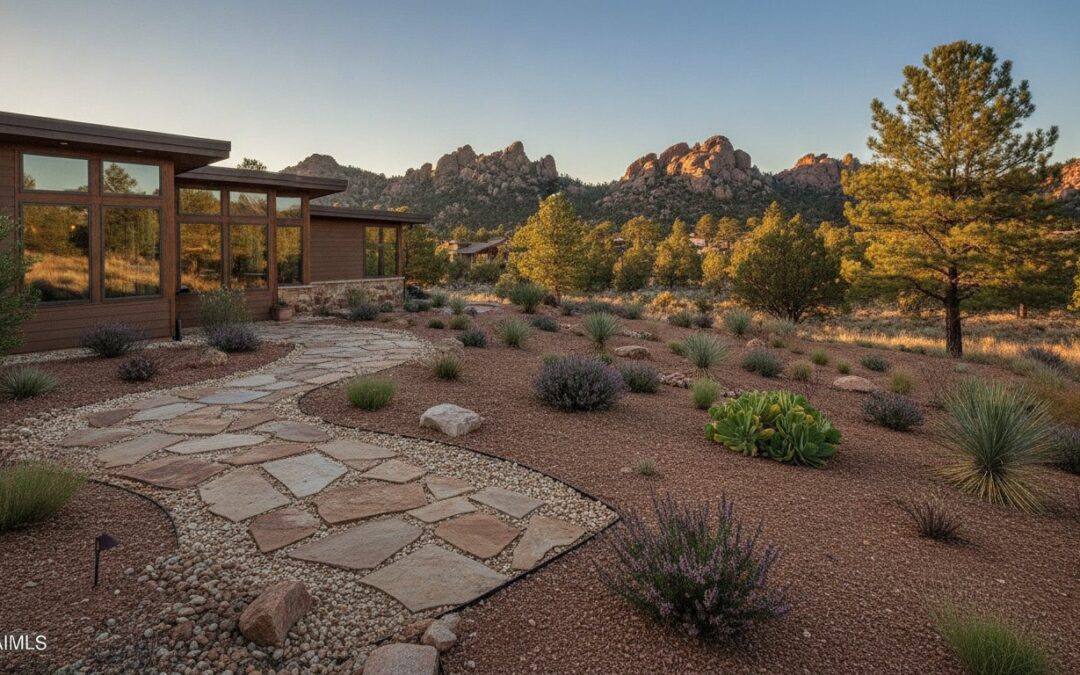
What if the most effective way to protect your home from wildfire isn’t clearing every tree, but strategically designing the firewise landscaping prescott properties need to stay safe? As stewards of the Northern Arizona environment since 1979, we understand the local anxiety that builds when the summer heat arrives and fire restrictions begin. You want to safeguard your property, but you shouldn’t have to sacrifice the lush, natural beauty that defines our community for a barren field of rock.
Implementing a defensible space is about finding a balance between professional safety and environmental health. This guide provides a clear strategy for creating a landscape that meets local wildfire defense ordinances while actually enhancing your property’s value. We’ll explore the three critical Home Ignition Zones, identify fire-resistant plants that thrive in our climate, and discuss local resources like the City of Prescott’s $500 defensible space grant. You’ll finish with a professional plan to secure your home and enjoy the peace of mind you deserve during the warmest months of the year.
Key Takeaways
- Understand the specific risks of the Wildland-Urban Interface and how strategic design reduces home ignition potential without clearing every tree.
- Learn how to structure your property into three distinct defensible space zones, starting with a non-combustible “Immediate Zone” within five feet of your home.
- Discover how to implement firewise landscaping prescott residents can use to maintain beauty by choosing native, high-moisture plants like Yucca and Buckwheat.
- Establish a consistent annual maintenance routine to clear pine needles and prune dead wood, keeping your protective barriers effective through the summer.
- See how professional hardscape elements like pavers and retaining walls serve as both elegant outdoor features and functional fire breaks.
What is Firewise Landscaping in Prescott’s WUI?
Firewise landscaping isn’t a mandate to clear-cut your property. It’s a disciplined system designed to lower the ignition potential of your home while maintaining ecological health. In Prescott, we live in the Wildland-Urban Interface (WUI), a high-risk zone where residential development meets the wildland. This proximity makes firewise landscaping prescott properties essential for long-term safety. Since 1979, we’ve seen how integrating safety with desert landscape design Northern Arizona principles allows for a yard that is both fire-resilient and visually stunning.
The Science of Ember Resistance
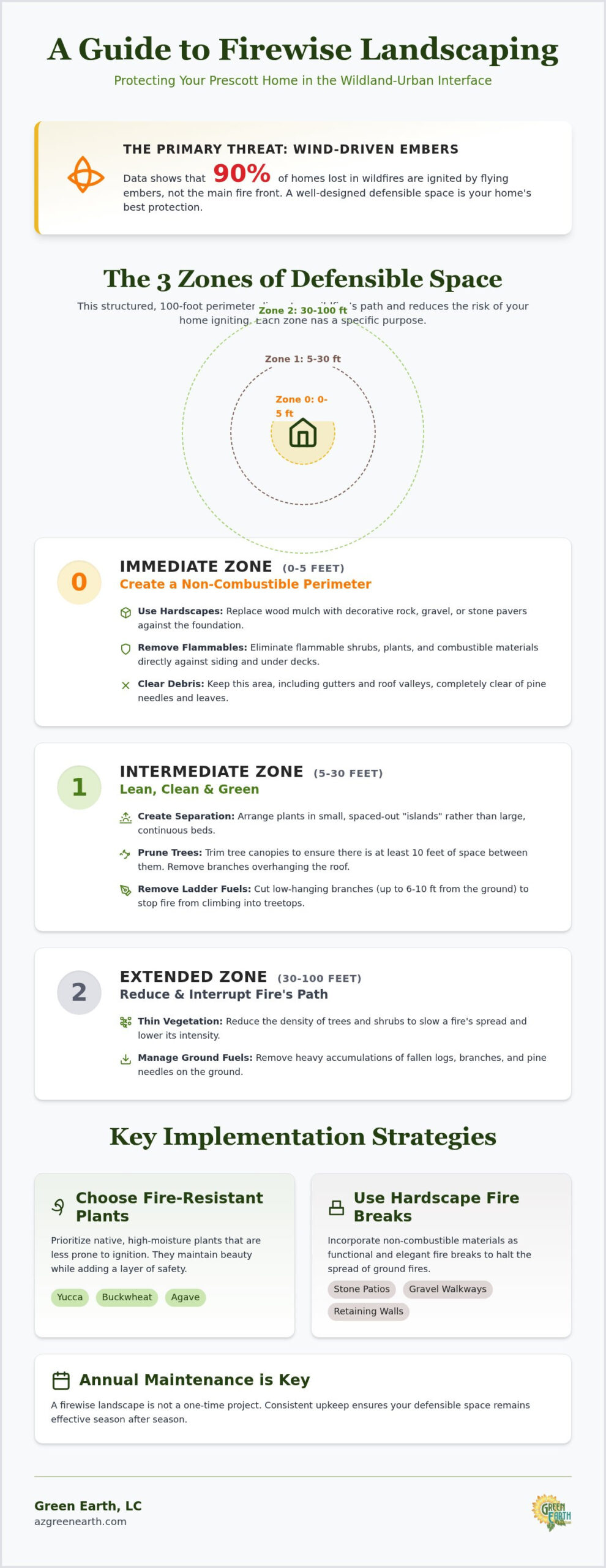
Most homeowners fear the main fire front, but the primary threat is much smaller and more mobile. Data shows that 90% of homes lost to wildfires are ignited by embers, not direct contact with the main blaze. These wind-driven sparks can travel over a mile, finding their way into gutters or under decks. A professional landscape design acts as a physical filter for these embers. By using non-combustible hardscapes and hydrated vegetation, you create a barrier that catches and cools sparks. Defensible space is the essential buffer you create between a building on your property and the wildland area that surrounds it.
Prescott’s Unique Regional Challenges
Our local terrain creates specific fire behaviors that standard guides don’t always address. In neighborhoods like Granite Mountain or Groom Creek, steep slopes act like chimneys, drawing heat upward and causing fire to move with incredible speed. Prescott also sits in a pine-to-chaparral transition zone. This means we manage both the heavy fuels of Ponderosa pines and the dense, volatile oils found in chaparral shrubs. Applying specialized knowledge, much like the precision required for firewise landscaping Cottonwood AZ, is vital for managing these fuel loads. Our team utilizes decades of experience to implement the firewise landscaping prescott homeowners need to navigate these complex environmental factors. We understand how to work with the wind patterns and topography unique to Yavapai County to ensure your home remains a safe haven.
The 3 Zones of Defensible Space for Arizona Homes
Creating a fire-resilient property requires a structured approach to vegetation management. The most effective framework for firewise landscaping prescott homeowners can adopt is the three-zone system. This 100-foot perimeter around your home isn’t about creating a barren wasteland; it’s about managing fuel loads to disrupt fire behavior. By following the standards established by the Firewise USA® program, you can significantly reduce the risk of your home igniting during a wildfire while preserving the natural beauty of Northern Arizona.
Each zone serves a specific defensive purpose. Zone 0, the Immediate Zone, focuses on the first five feet around your structure. Zone 1, the Intermediate Zone, extends from 5 to 30 feet and emphasizes a “lean, clean, and green” aesthetic. Finally, Zone 2, the Extended Zone, covers the area from 30 to 100 feet, where the goal is to thin out dense vegetation and prevent fire from moving through the tree canopy. Organizing your property this way allows you to prioritize high-impact areas first.
Zone 0: The 5-Foot Non-Combustible Perimeter
The first five feet from your home’s foundation is the most critical area for protection. In this zone, the objective is to eliminate any materials that could catch an ember and ignite the structure. We recommend replacing traditional wood mulch with decorative rock, river cobble, or gravel. These materials don’t just provide a fire break; they offer a clean, modern aesthetic that complements our regional architecture. Removing foundation plantings that trap wind-driven embers is also essential. Instead of flammable shrubs against the siding, consider using hardscape construction Cottonwood AZ techniques to build elegant stone patios or gravel walkways that double as permanent fire barriers. If you aren’t sure where to start, our team can help you design a firewise defensible space that balances these safety requirements with high-end design.
Zone 1 & 2: Strategic Thinning and Spacing
Beyond the five-foot mark, the strategy shifts to managing how fire moves across your land. In Zones 1 and 2, the “10-foot rule” is your best guide. This means maintaining at least ten feet of space between tree canopies to prevent fire from jumping from one tree to another. It’s equally important to remove “ladder fuels,” which are low-hanging branches or tall grasses that allow a ground fire to climb into the treetops. On Prescott’s hilly terrain, vertical and horizontal spacing must be even more aggressive. Because fire travels faster uphill, trees on a slope require more distance between them than those on flat ground. Proper thinning doesn’t just improve safety; it reduces competition for water and nutrients, leading to a healthier, more vibrant landscape. Implementing these firewise landscaping prescott strategies ensures your property remains a resilient part of our local ecosystem.
Fire-Resistant Plants and Materials for Prescott
Prescott’s high-altitude environment requires a specific plant palette that balances drought tolerance with fire resilience. When selecting flora for firewise landscaping prescott, homeowners should look for plants with high moisture content in their leaves and low concentrations of volatile oils or resins. Succulents and high-moisture perennials are far superior to resinous evergreens like junipers and pines, which act as torches when ignited. By choosing species that stay hydrated, you create a living barrier that slows heat transfer rather than fueling it.
Native Fire-Resistant Plant Palette
A successful fire-safe garden uses native species that have adapted to Northern Arizona’s cycle of drought and fire. Low-growing groundcovers like Buckwheat and various Yucca species are excellent choices because they maintain green tissue with minimal water. These plants remain resilient even during dry spells, though they benefit from a well-maintained system like the irrigation repair Flagstaff residents use to keep high-altitude landscapes hydrated. Since our founding in 1979, we’ve focused on these sustainable choices to ensure long-term property health.
We strongly advise against “The Big Three” high-fuel plants: Juniper, Cypress, and Cedar. These species contain high levels of flammable sap and often accumulate dead needles internally, making them a significant risk near structures. Instead, consider deciduous trees like Gambel Oak. Because they drop their leaves and have higher water content in their foliage, they can serve as strategic heat shields for your home when properly spaced.
Hardscaping as a Fire Break
Materials that cannot burn are your strongest allies in a fire-prone environment. Integrating pavers, stone retaining walls, and decomposed granite into your design creates permanent fuel breaks that wind-driven embers cannot ignite. These structural elements do more than just stop fire. A well-designed retaining wall can slow the spread of fire on steep slopes, while gravel pathways separate garden beds into manageable islands of vegetation. This approach ensures your yard remains beautiful while functioning as a defensive shield.
Professional drainage grading Arizona projects also play a dual role in safety. Proper grading prevents the soil erosion often seen after a fire removes groundcover, while simultaneously protecting your foundation from monsoon flooding. Combining these functional hardscapes with strategic firewise landscaping prescott design results in a property that is as durable as it is beautiful. Our 47 years of experience in the region ensures that every stone placed and every plant chosen serves a long-term ecological purpose.
Ongoing Maintenance: Keeping Your Defensible Space Effective
Design is only the first step in property protection. To maintain a truly resilient home, you must engage in consistent upkeep. Without intervention, firewise landscaping prescott systems can quickly become compromised by the accumulation of “fine fuels.” These include small, easily ignited materials like dried grasses, weeds, and fallen pine needles. Our 47 years of local experience has shown that many home ignitions during wildfire season result from these neglected details rather than a failure of the overall landscape architecture. Consistent maintenance ensures that your defensive zones remain as effective as the day they were installed.
Seasonal Firewise Checklist
Effective maintenance follows the rhythm of our Northern Arizona seasons. Before the “dry lightning” season arrives in June, a thorough spring cleaning is mandatory. This involves clearing needle litter from roofs, gutters, and under decks where wind-driven embers often collect. You should also manage “volunteer” seedlings and invasive weeds that sprout after spring rains. These plants act as kindling, allowing a small ground fire to spread rapidly across your yard. Pruning is another critical task. Ensure tree branches are lifted at least 6 to 10 feet from the ground. This practice prevents fire from transitioning from the forest floor into the canopy, maintaining a “lean and clean” appearance without sacrificing the shade and beauty of your property.
Irrigation and Hydration
Properly disposing of cleared brush and debris is essential for maintaining a safe perimeter. If you are managing properties in other regions, such as the Southeast, professional services like junk removal tampa fl can help you efficiently haul away large quantities of yard waste and clutter.
Hydration is a biological defense mechanism. A well-watered plant has higher leaf moisture, making it significantly harder to ignite than a drought-stressed one. In our arid climate, consistent moisture is best achieved through a precision drip system. These systems deliver water directly to the root zone, ensuring plants remain healthy and less volatile during extreme heatwaves. If your system has leaks, broken emitters, or controller issues, it can lead to dry patches that become fire hazards. Regular checks and professional irrigation repair are vital to keep your defensible space functional throughout the summer months.
Managing the health of your vegetation is a year-round responsibility that pays dividends in peace of mind. If you need assistance preparing your property for the high-risk season, our team provides expert Firewise Defensible Space services to ensure your landscape remains a beautiful, protective barrier for your home.
Professional Firewise Design with Green Earth, LC
Since our founding in 1979, we’ve operated as the region’s premier provider of sustainable outdoor solutions. Our approach to firewise landscaping prescott is rooted in nearly half a century of observation and execution within Northern Arizona’s unique ecosystems. we don’t just clear land; we architect resilient environments that honor the natural beauty of our high desert and mountain terrain. As a statewide runner up for Best Sustainable Landscape Designer, we bring a level of craftsmanship that ensures your safety measures actually enhance your property’s aesthetic and ecological value.
We pride ourselves on being a visionary partner for our clients. Whether you own a private estate in the pines or require comprehensive HOA landscape maintenance Arizona boards can rely on, our team delivers disciplined design and execution. We understand the nuances of local fire codes and the mechanical requirements of land management, allowing us to transform complex safety requirements into functional, beautiful realities.
Our Sustainable Fire Mitigation Philosophy
Our “Authoritative Environmentalist” philosophy prioritizes ecological health alongside fire safety. We believe a fire-safe yard should be a vibrant, living space that supports the local environment. This involves the strategic integration of functional outdoor living areas that double as protective buffers. By using locally sourced materials to reduce our environmental footprint, we construct stone features and hardscapes that stop fire spread while blending seamlessly with the Prescott landscape. Every project we undertake is a commitment to long term sustainability and professional excellence.
Getting Started in Prescott
The process begins with a detailed firewise property assessment. During this consultation, we analyze your land’s specific topography, wind patterns, and existing vegetation to identify critical vulnerabilities. We then provide a phased implementation plan, which allows you to manage costs while prioritizing the most essential defensive zones first. This methodical approach ensures that every dollar spent contributes to a measurable increase in your home’s resilience. We invite you to contact Green Earth, LC today to schedule a professional site evaluation and begin the journey toward a safer, more sustainable landscape.
Secure Your Property’s Future with Sustainable Design
Investing in a resilient landscape is the most proactive step you can take to protect your property from Northern Arizona’s wildfire risks. By structuring your land into three distinct defensible space zones and selecting native, high-moisture vegetation, you create a powerful barrier against ember ignition. Effective firewise landscaping prescott homeowners can trust relies on both strategic hardscape placement and consistent seasonal maintenance. These efforts don’t just provide essential safety; they preserve the ecological health and aesthetic value of our unique high-desert environment.
Since our founding in 1979, we’ve dedicated ourselves to excellence in land management. As a statewide runner-up for Best Sustainable Landscape Designer with over 47 years of regional experience, we have the specialized knowledge to transform your safety concerns into a beautiful reality. You don’t have to navigate local fire codes alone. Our team is ready to serve as your visionary partner in creating a landscape that is both stunning and secure.
Protect your Prescott home today—schedule a Firewise consultation with Green Earth, LC. We look forward to helping you achieve lasting peace of mind and a thriving outdoor space for years to come.
Frequently Asked Questions
What is the most important zone for firewise landscaping?
The Immediate Zone, or Zone 0, is the most critical area for home protection. This five foot perimeter around your structure is where you must eliminate all combustible materials. By focusing on this area first, you prevent wind-driven embers from finding a fuel source directly against your siding or under your deck. It’s the foundation of any effective firewise landscaping prescott plan because it addresses the primary cause of home loss during wildfires.
Does firewise landscaping mean I have to cut down all my trees?
No, you don’t need to remove all your trees to achieve a fire-safe property. The goal is strategic vegetation management rather than clear-cutting. You should focus on thinning dense stands and pruning lower branches to remove ladder fuels. Proper spacing between canopies disrupts the path of a fire. While we don’t offer large-scale tree removal, we help you design a layout that keeps your favorite trees while maximizing your home’s resilience; for a broader look at professional emergency tree management, you can discover Statement Tree Care and their comprehensive guide to 24/7 storm damage response.
While the City of Prescott doesn’t strictly ban specific species for established homes, the Wildfire Defense Ordinance mandates fire-resistant choices for new construction. High-resin plants like Junipers, Cedars, and Cypress are strongly discouraged within the first 30 feet of any structure. These species are known as “gasoline plants” because of their volatile oils. Choosing native, high-moisture alternatives ensures your landscape remains compliant with local safety standards and ecological goals.
How often should I update my defensible space maintenance?
You should perform a comprehensive maintenance check at least once a year, ideally in early spring. This timing allows you to clear winter debris and pine needles before the high-risk dry lightning season begins in June. Regular upkeep prevents the accumulation of fine fuels that can ignite easily. In Prescott’s climate, a second check in late autumn is also beneficial to manage seasonal leaf fall and ensure your irrigation system is prepared for the colder months.
Can I use wood mulch in a firewise landscape?
You should avoid using wood mulch within the first five feet of your home. In this immediate zone, non-combustible materials like decorative rock, river cobble, or decomposed granite are the only safe choices. Wood mulch can smolder and carry fire directly to your foundation. Beyond the five foot mark, you can use limited amounts of mulch to retain moisture, provided it is separated by fuel breaks like gravel paths or stone walls.
Does firewise landscaping increase property value in Prescott?
Yes, implementing firewise landscaping prescott strategies often increases property value and marketability. Many buyers in Northern Arizona prioritize homes with established defensible space because it represents a significant investment in safety and reduced maintenance. Additionally, some insurance companies now require these mitigations to maintain coverage or offer better rates. A professionally designed firewise landscape combines these practical benefits with high-end curb appeal, making your home a more attractive and secure asset.
What is the difference between fire-resistant and fire-proof plants?
It’s a common misconception that certain plants are fire-proof. All vegetation will burn if the heat is intense enough. Fire-resistant plants are simply species that are slower to ignite and burn with less intensity because of their high moisture content or low sap levels. These plants buy valuable time for first responders and reduce the overall heat load near your home. Choosing the right species is about managing risk rather than eliminating it entirely.
How does drainage grading help with fire recovery or prevention?
Professional drainage grading is a vital component of both fire prevention and post-fire recovery. Before a fire, proper grading ensures that moisture is distributed effectively across your landscape, keeping fire-resistant plants hydrated and healthy. After a fire, grading protects your property from the severe soil erosion and debris flows that often follow when groundcover is lost. This structural work safeguards your foundation and prevents monsoon rains from causing further damage to a vulnerable landscape.
Recent Comments