
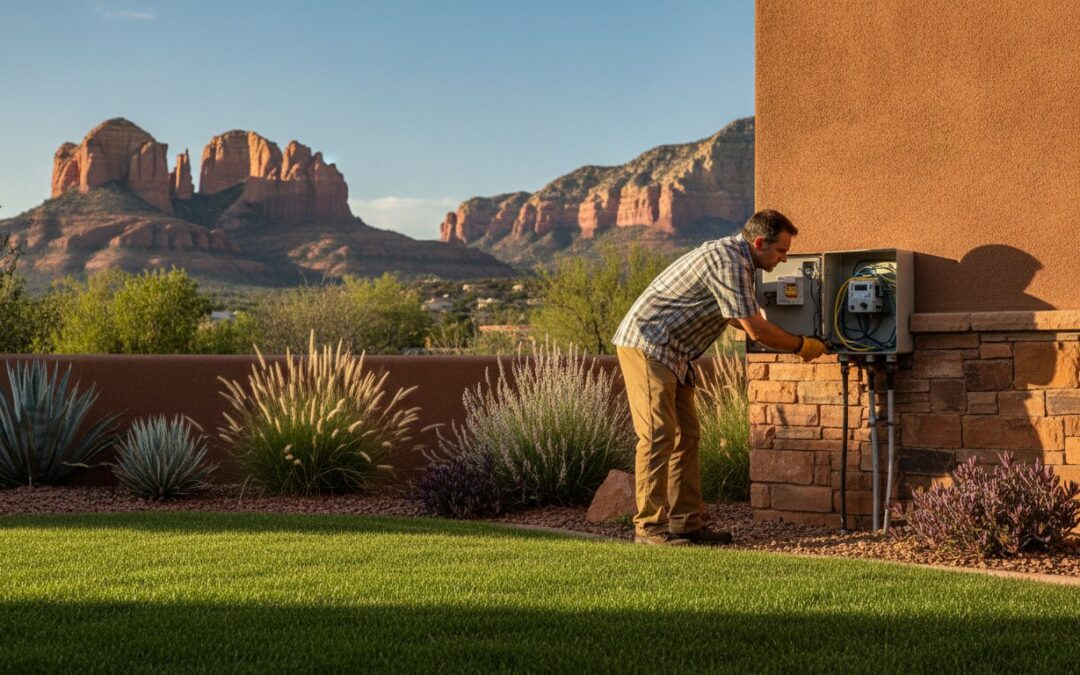
Imagine waking up to a parched, brown lawn in the middle of a Sedona July just because a single wire in your control box came loose. In our high-desert climate, your sprinkler timer isn’t just a convenience; it’s the heartbeat of your property’s survival. Effective irrigation controller troubleshooting Arizona homeowners can perform often makes the difference between a thriving landscape and a staggering utility bill. We understand that staring at a complex wiring diagram or a flashing error code feels overwhelming when the heat is rising and your plants are at risk.
You deserve a system that works as hard as you do to protect the natural beauty of your home. This guide will help you master the basics of diagnosing common timer failures, from power surges to programming glitches. By the end, you’ll know exactly how to restore efficiency to your system and identify the specific moments when calling a Northern Arizona specialist is the smartest investment for your landscape’s longevity. We will walk through essential hardware checks, seasonal programming adjustments for the monsoon season, and the subtle signs of a failing solenoid.
Key Takeaways
- Identify the critical differences between simple programming errors and complex hardware failures to prevent unnecessary landscape loss.
- Discover how extreme Verde Valley temperatures and monsoon lightning strikes specifically degrade your system’s sensitive electrical components.
- Master the fundamental steps of irrigation controller troubleshooting Arizona homeowners can perform to ensure their systems remain efficient during peak summer heat.
- Learn to recognize when professional diagnostic tools are required for advanced electrical issues like short circuits or valve solenoid failures.
- Explore how upgrading to a smart, weather-based controller can protect your property from overwatering while lowering your monthly utility costs.
Understanding Your Irrigation Controller: The Brain of Your Arizona Landscape
Your irrigation controller serves as the central nervous system for your entire property. It processes complex data and sends electrical signals to your valves, dictating the survival of every plant in your yard. In the Verde Valley, where temperatures fluctuate wildly, this device is more than a convenience; it’s a critical management tool. Mastering irrigation controller troubleshooting Arizona is the first step in maintaining a healthy, vibrant landscape. When the “brain” of your system fails, the rest of your hardware becomes useless regardless of how well your pipes are laid.
Older traditional timers rely on manual inputs and fixed schedules. They don’t account for a sudden monsoon or a cooling trend in Sedona. Modern smart controllers represent a leap forward in efficiency. These devices use Wi-Fi to pull local weather data, automatically suspending watering when rain is detected. This level of precision is essential for effective desert irrigation system repair and long-term sustainability. Sensors act as the eyes and ears of the controller, providing real-time feedback on soil moisture levels and rainfall to prevent wasteful runoff.
Common Symptoms of a Failing Controller
Identifying a malfunction early prevents costly damage to your landscape. Watch for these specific indicators that your controller’s health is declining:
- Blank display: A dark screen often signals a power surge or a failed internal transformer, leaving your plants without a water source.
- Zone failure: If specific areas of your yard stay dry while others thrive, the controller may have lost its connection to those specific valves.
- Ghost cycles: Watering that occurs at unscheduled times indicates a glitch in the internal logic or a programming conflict that needs immediate attention.
- Frozen buttons: If the interface doesn’t respond to your inputs, the internal circuitry has likely reached its end of life.
The Environmental Impact of Controller Errors
A single programming error can waste thousands of gallons of water before you even notice a problem. In Northern Arizona, where water is our most precious resource, an inefficient controller is an ecological liability. Faulty systems lead to runoff, soil erosion, and unnecessary stress on local flora. We position ourselves as the “doctor” for the brains of your system, ensuring every signal sent is accurate and efficient. At Green Earth, we view irrigation controller troubleshooting Arizona as a form of environmental stewardship. By ensuring your system runs with precision, we protect the natural beauty of Sedona and the surrounding highlands while keeping your utility costs manageable. Reliable control means your landscape receives exactly what it needs to thrive, no more and no less.
Step-by-Step DIY Irrigation Controller Troubleshooting
Many homeowners feel a sense of dread when their landscape suddenly goes silent. However, irrigation controller troubleshooting Arizona doesn’t always require a master technician’s intervention. Many common failures result from simple connectivity issues or power interruptions that you can resolve in minutes. Before you assume the entire unit needs replacement, start with the most basic components. Safety is paramount during this process. While the wires leading from your controller to the valves are low voltage, usually 24 volts, the power coming from your wall outlet is high voltage. Always unplug the transformer before touching any internal wiring or terminal strips to ensure your safety.
These diagnostic steps are particularly vital for drip irrigation repair Arizona. Because drip emitters are often hidden under mulch or decorative rock, you might not notice a system failure until a prized agave or desert willow begins to wilt. A functional controller ensures these delicate systems deliver the precise, slow-release watering they were designed for, protecting your investment from the harsh Verde Valley sun. Homeowners dealing with emitter failures or damaged lines throughout the region should also review the latest strategies for drip system repair Northern Arizona to address the unique challenges posed by both desert heat and high-altitude freezes.
The Power and Battery Check
Begin your investigation at the source of energy. It’s common for a GFI outlet to trip during a summer storm, cutting power to the unit. Plug a small appliance, like a lamp, into the same outlet to verify it’s live. Next, inspect the transformer; if the plug feels cold to the touch while the unit is supposedly running, the transformer may have failed. Finally, replace the backup battery. This small component is the primary cause of lost programming. If your clock resets or your schedule disappears after every minor power flicker, a fresh battery will usually solve the problem.
Inspection of Field Wiring and Terminals
Open the controller door and examine the terminal strip where the colored wires attach. Arizona’s dust and seasonal humidity can lead to corrosion or loose connections. Focus specifically on the “common wire,” which is typically white. If this single wire is loose or corroded, every zone in your system will fail to activate. Look for nicks or fraying in the wires leading out of the box. Rodents or even recent gardening work can easily damage these lines, breaking the electrical circuit required to open your valves.
Know your limits to avoid further damage. If you’ve verified the power source, replaced the battery, and tightened all terminals but the system still refuses to cooperate, it is time to stop. If the troubleshooting requires a voltmeter to trace a short circuit deep in the soil or involves opening the sealed internal circuitry, put down the tools. At this stage, reaching out for an expert evaluation is the safest way to restore your system’s integrity without risking a complete hardware failure.
Arizona-Specific Challenges: Why Controllers Fail in the Verde Valley
Northern Arizona’s geography creates environmental stresses that standard equipment manuals rarely address. When performing irrigation controller troubleshooting Arizona homeowners must account for a climate that ranges from scorching desert floors to frozen mountain peaks. Our 47+ years of experience in the Verde Valley has shown that local hardware doesn’t just fail; it weathers. The same intense sun that fuels our vibrant desert flora acts as a slow catalyst for electronic degradation, making regional expertise vital for maintaining a reliable system.
The arrival of the monsoon season introduces the most immediate threat: atmospheric electricity. Lightning strikes in the Sedona area frequently cause massive power surges that travel through the electrical grid or directly through the ground wires. These surges can fry sensitive microprocessors instantly. Even without a direct hit, the high humidity and sudden temperature drops during a storm can cause condensation inside poorly sealed units, leading to short circuits that are difficult to diagnose without professional equipment.
Local wildlife and water chemistry also play significant roles in system longevity. Rodents in the Verde Valley often chew through irrigation wires buried in the soil, seeking moisture or simply sharpening their teeth. Additionally, the high mineral content in our local water leads to hard water buildup on rain sensors. These deposits can “blind” the sensor, causing it to report wet conditions to the controller even during a record-breaking drought, effectively shutting down your watering schedule when your plants need it most.
Sedona and Camp Verde: Dealing with Desert Heat
In the lower elevations, summer temperatures frequently exceed 110°F. This extreme heat bakes outdoor-mounted controllers, causing plastic housings to become brittle and LCD screens to fade until they are unreadable. To protect your investment, we recommend weather-resistant enclosures that provide a secondary layer of insulation. It’s also essential to use UV-rated wiring for any exposed runs to prevent the insulation from cracking and exposing the copper core to the elements.
Flagstaff and Prescott: High-Altitude Considerations
Managing a system in the high country requires a different strategy. Controllers in these areas must withstand dramatic temperature swings and prolonged freezing cycles. Snowmelt can seep into underground wire splices, causing intermittent connectivity issues that only appear during the spring thaw. Understanding irrigation repair Flagstaff needs is about more than just fixing leaks; it’s about ensuring your controller’s logic is programmed to handle the shorter growing seasons and unique drainage patterns of the Mogollon Rim. Plastic components in these regions are particularly prone to cracking if they aren’t specifically rated for high-altitude UV exposure and sub-zero temperatures.
When to Call Green Earth for Professional Irrigation Troubleshooting
While basic checks often yield results, certain malfunctions exist beyond the scope of a standard toolkit. When irrigation controller troubleshooting Arizona properties reveals deeper electrical inconsistencies, professional intervention becomes a matter of protecting your landscape investment. Tracing an underground short circuit or diagnosing a faulty master valve requires specialized equipment like voltmeters and wire tracers that most homeowners don’t keep in the garage. Misdiagnosing a complex wiring issue can lead to accidental system damage or, worse, a total failure that leaves your plants vulnerable during a heatwave.
Professional diagnostics are especially critical for large-scale HOA landscape maintenance Arizona systems. These multi-zone configurations often involve intricate sensor arrays and master valves that coordinate water flow across several acres. A single glitch in a 48-zone controller can disrupt the ecological balance of an entire community. Our team acts as the “doctor” for these systems, using precise diagnostic tools to isolate failures within the controller’s logic board or the field wiring without the need for destructive digging. We ensure that your sensors are properly integrated so that your system responds accurately to real-time environmental changes.
Signs of Professional-Level Electrical Issues
Some signs are unmistakable indicators that your system requires an expert’s eye. If your display shows a persistent “No AC” or “Fuse” error code despite a fresh battery and a live outlet, the internal transformer or circuit board has likely suffered a fatal surge. Physical evidence, such as a faint burnt smell or visible discoloration on the terminal strip, are also immediate red flags. Intermittent failures, where a zone works on Monday but fails on Wednesday, often point to a failing solenoid that is mimicking a controller error. These electrical “ghosts” require methodical testing to resolve permanently.
Why 47 Years of Experience Matters
Our 47+ years of history in the Verde Valley allow us to bridge the gap between legacy hardware and modern smart technology. We don’t just provide a quick fix; we perform a comprehensive system audit to ensure your irrigation meets current water conservation standards. This sustainable approach prevents future failures and reduces your environmental footprint. We understand the nuances of both desert and high-altitude systems, allowing us to provide solutions that are as durable as they are efficient. If your DIY efforts have reached a standstill, schedule a professional diagnostic visit to restore your system’s integrity and your peace of mind.
Upgrading to Smart Controllers: The Future of Arizona Irrigation
While mastering irrigation controller troubleshooting Arizona can extend the life of an aging timer, there eventually comes a point where hardware limitations hinder your landscape’s potential. Traditional timers operate on a “set it and forget it” logic that simply doesn’t align with the volatile weather patterns of the Verde Valley. Transitioning to a weather-based smart controller represents the most significant step you can take toward total water efficiency. These devices don’t just follow a schedule; they interpret real-time data to ensure your plants receive the precise amount of hydration required for their specific species and soil conditions.
Smart technology is the backbone of modern desert landscape design Northern Arizona. By integrating these systems into your outdoor environment, you support a philosophy of sustainable beauty that respects our regional water scarcity. During an unexpected Sedona monsoon, a smart controller automatically pauses your watering cycle based on local rainfall data, saving you from the waste and potential plant stress of overwatering. This level of automation provides peace of mind, knowing your landscape is protected even when you are miles away from home.
Top Benefits of Smart Irrigation Technology
The advantages of upgrading extend far beyond simple convenience. Homeowners who switch to smart controllers often see substantial water savings, sometimes ranging from 30% to 50% compared to traditional manual timers. These systems feature real-time leak detection and instant smartphone notifications, allowing you to address issues before they lead to high utility bills or property damage. You can adjust your entire watering schedule from an app, making seasonal transitions between the dry spring and the humid monsoon season as simple as a few taps on your screen. Many Arizona municipalities also offer rebates or financial incentives for installing EPA WaterSense certified technology, making the upgrade an even wiser investment.
Green Earth’s Smart Controller Installation Service
Effective smart irrigation requires more than just a Wi-Fi connection; it requires local expertise. We provide custom programming tailored to your specific Northern Arizona microclimate, accounting for variables like elevation, sun exposure, and soil type. Our team handles the professional setup of Wi-Fi bridges and outdoor sensors to ensure a reliable, seamless connection. We don’t just install a box on the wall; we act as your visionary partner to optimize your system’s performance for the long term. With our ongoing support, you can be confident that your irrigation system remains a responsible guardian of your property’s natural beauty and our community’s shared resources.
Securing the Future of Your Northern Arizona Landscape
Maintaining a healthy, vibrant yard in the Verde Valley requires both technical vigilance and a deep respect for our local environment. By mastering the basics of irrigation controller troubleshooting Arizona, you’ve taken a proactive step toward protecting your property from the stresses of extreme heat and unpredictable monsoons. Whether you’re performing simple battery swaps or deciding to transition to weather-based smart technology, your commitment to efficiency supports the long-term ecological health of our entire region. A functional controller is more than a convenience; it’s a vital tool for sustainable water management.
While DIY diagnostics are valuable, complex electrical shorts and large-scale system audits are best handled by seasoned professionals. Green Earth, LC brings over 47 years of Northern Arizona landscaping expertise to every project. As statewide recognized sustainable design specialists, we understand the specific irrigation demands of Sedona, Cottonwood, Flagstaff, and the surrounding highlands. We take pride in acting as a visionary partner for homeowners who value both beauty and conservation. Don’t let a faulty timer jeopardize your investment or lead to wasteful utility bills. Schedule Your Professional Irrigation Diagnostic with Green Earth, LC Today. We look forward to helping you achieve a resilient, water-wise landscape that thrives in every season.
Frequently Asked Questions
Why is my irrigation controller display blank?
A blank display usually indicates a complete loss of power or a failed internal transformer. Start by checking your GFI outlet to see if it has tripped; then verify that the transformer is securely plugged in and producing heat. If the outlet is live but the screen remains dark, the internal fuse or the logic board itself may have suffered a fatal surge during a recent storm.
Can a power surge damage my sprinkler timer during an Arizona monsoon?
Lightning strikes and atmospheric electricity during the monsoon season are leading causes of hardware failure in the Verde Valley. These surges can travel through power lines or ground wires, instantly frying the sensitive microprocessors inside your unit. Protecting your system with a high-quality surge protector is a smart investment for any homeowner performing irrigation controller troubleshooting Arizona diagnostics.
How often should I change the battery in my irrigation controller?
You should replace the backup battery once every year to prevent the loss of your customized watering schedules. While the battery doesn’t run the valves, it maintains the internal clock during brief power flickers. In Sedona’s intense summer heat, a failed battery can lead to your system resetting to factory defaults, which often results in dead plants or massive water waste.
Why are some zones working but others are not?
When specific zones fail to activate, the issue is typically a loose connection at the terminal strip or a faulty valve solenoid. If your irrigation controller troubleshooting Arizona checks show that the wiring is secure, the problem likely lies in the field. A damaged wire in the soil or a solenoid that has reached its end of life will prevent that specific zone from receiving the electrical signal to open.
What does a “short circuit” error on my controller mean?
A short circuit error is a protective measure the controller takes when it detects an electrical overload in a specific zone. This is frequently caused by a burnt-out solenoid or a wire that has been nicked by gardening tools or pests. The controller shuts down the affected zone to prevent the excess current from damaging the expensive internal circuitry of the main unit.
Is it worth upgrading to a Wi-Fi smart controller in Arizona?
Upgrading to a smart controller is one of the most effective ways to practice environmental stewardship while lowering your utility bills. These units use local weather data to automatically suspend watering during rain or increase it during extreme heatwaves. This precision can reduce your outdoor water consumption by 30% to 50%, making it a vital tool for sustainable landscape management in our arid climate.
How do I reset my irrigation controller after a power outage?
Most modern controllers feature a dedicated reset button or can be power-cycled by unplugging the transformer for 60 seconds. If your programming disappears every time the power dips, it is a clear sign that your backup battery is dead. After a reset, always double-check your start times and zone durations to ensure your landscape remains protected and your water-wise schedule is intact.
Does Green Earth offer irrigation troubleshooting for HOAs in Sedona?
We provide comprehensive irrigation troubleshooting and maintenance for HOA and commercial properties throughout Sedona and the Verde Valley. Our team manages complex, large-scale systems with dozens of zones, ensuring that community landscapes remain lush and efficient. We specialize in sustainable water management, helping boards reduce waste while maintaining the high aesthetic standards expected in Northern Arizona’s premier neighborhoods.
Recent Comments